Giant Cogs

Posted by James Turnbull, Friday, 30th June 2006

1 Star2 Stars3 Stars4 Stars5 Stars

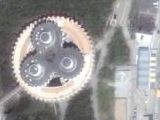
On the southern coast of the Crimean peninsula in Ukraine there’s giant cogs! They were left over parts from the world’s largest clock, which spanned 600m across the coast and was used by scientists in Mir space station to tell the time. Honest. It’s not a hotel. That would be silly.

Thanks: Old (Funny name…)

Square Circle, Saudi Arabia

Posted by Alex Turnbull, Friday, 30th June 2006

1 Star2 Stars3 Stars4 Stars5 Stars

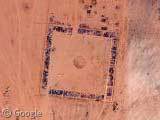
Here in Saudi Arabia, there’s a large square with a smaller circle inside it. Um… yeah, I really don’t know what this place is!

It’s just outside of a small town, and the square is about 500 metres across, defined by walled(?) areas which sometimes contain small buildings. Some sort of compound? An empty and organised shanty town? A very tidy dump?

But the weirdest thing is course, is the totally bizarre colour scheme. Whaddup with that?

Thanks to Uri.

Nazca Lines

Posted by James Turnbull, Thursday, 29th June 2006

1 Star2 Stars3 Stars4 Stars5 Stars

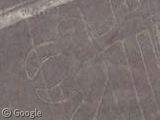
The bizarre Nazca Lines were created thousands of years ago (between 200BC and 600AD) using simple tools to scrape away the dark pebbles and reveal the light sand underneath.

Although they’re called the Nazca lines, the famous geoglyphs also feature hummingbirds, spiders, monkeys, and lizards and this giant parrot. But nobody’s really sure why the Nazca people went to all this effort - the images are so large that they couldn’t have seen them without some sort of aircraft, and that’s not very likely as the lines predate manned flight by just a few years.

Apparently for the best view of the lines you need to take a flight over the 53 mile area.

Thanks: too many people to list who submitted this before and after it was high resolution. Thanks all!

Corinth Canal

Posted by Alex Turnbull, Tuesday, 27th June 2006

1 Star2 Stars3 Stars4 Stars5 Stars

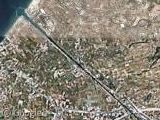
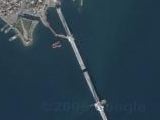
Following on from yesterday’s Rio-Antirio Bridge, right at the very end of the Gulf of Corinth is the Corinth Canal, a 6.3 kilometre long canal which technically turned the Peloponnesian peninsula into an island upon its completion in 1893. Although the canal is only 21 metres wide it’s considered a great technical achievement for its time, and saves small ships the 400 km long journey around the Peloponnesus.

Corinth Canal

At each end of the canal there are unique submersible bridges which can be lowered to the bottom of the canal to allow the boats to get past! Very cool. You can see a sequence of photos showing the bridge in action on the Wikipedia page.

Mid-air refuelling

Posted by James Turnbull, Monday, 26th June 2006

1 Star2 Stars3 Stars4 Stars5 Stars

Over a seemingly dull field in California we find an unusual sight - a mid-air refuelling of a C-5 Galaxy by a smaller KC-135! Very, very cool.

The image ghosting is caused by the way satellite photographs are taken in two parts; one is high-resolution, but in black and white, and the other is a lower resolution but captures the colour. The second image is then sharpened with the first to create the colour images we see in Google Earth.

However, in the case of planes in flight, the plane has moved slightly between the two photographs. Now if we just knew how many milliseconds apart the two images are taken you could calculate the speed of the aircraft.

Thanks: Hoppilpolia, rob, chewbaccawokka, Ant, Frank and of course, Helomech from the Google Earth community.