Archive for October, 2007

Google Sightseeing takes you on tour of the world as seen from satellite, using the free Google Earth program, or Google Maps in your web browser. Each weekday your guides James and Alex present new weird and wonderful sights as suggested by readers.

The editors: James & Alex

Truck spillage

Wednesday, 31st October 2007 by James

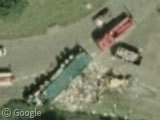
Near the city of Liverpool, UK, an articluated lorry appears to have taken the roundabout a bit too fast, and toppled over onto the side of the road.

Whatever it was the trailer was carrying is now splattered across the verge. Any ideas for what the contents were?

Also see our previous related entries Truck crash and Trucks pulling trucks.

Thanks: quercus63

Miniature Parks across the Globe

Monday, 29th October 2007 by James

Miniature parks and model villages are sort of like a pre-internet 3D Google Earth, allowing you to view a representation of a village or city sights from above.

So it’s no surprise that on visiting my local park, Bekonscot Model Village in Buckinghamshire, I was more excited than a 5-year-old let loose in a sweetshop. As I stomped around the 1930s English villages I wondered if I could see the park on Google Earth?

Sadly, the resolution of Bekonscot in Google Earth just isn’t high enough to make out any of the lilliputian houses, trains or airplanes. However, I discovered the village is a founding member of the International Association of Miniature Parks, and many of the other member parks have great resolution.

So, today we are going to explore International Miniature Parks, where we’ll see the best sights on the globe, just smaller and more fuzzy!

Mini Europe

Mini Europe is located in Belgium but features sights from the whole of the European Union including Big Ben, Mount Vesuvius, the Berlin Wall (complete with falling action) and the Eiffel tower (pictured in the thumbnail).

Miniatürk

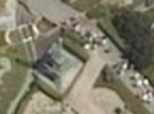
Miniatürk is a miniature Turkey in the city of Istanbul. In the thumbnail is the miniature version of Atatürk Olympic Stadium.

Minimundus

Minimundus in Austria claims to offer the “most beautiful buildings of all 5 continents”. St Peter’s Square is easy to spot and the Opera house is also in there somewhere.

Still in Minimundus, The CN Tower’s height is being challenged by its neighbour the Eiffel tower, despite being almost twice the size in real life!

Rügen Park

At just 926 km² Rügen (Germany’s largest island) is only 2/3 the size of London, but if that’s just too much area for you to cover you can instead explore the tiny Rügen island at Rügen Park, located on the island of Rügen.

As an added bonus, to the west of the park you will find everywhere else, including the great pyramids, the Whitehouse and, pictured in the centre of the thumbnail, a pre-sinking Titanic.

Sardegna in Miniatura

Another miniature island within itself is Sardegna in Miniatura, which reproduces the Italian island of Sardinia.

Swiss Miniatur

Swiss Miniatur aims to “summarise Switzerland” in miniature form. Clearest in the Google Earth image is the Swiss Alps, located in the north-east of the park.

Italia in Miniatura

Back to Italy, Italia in Miniatura is located on a man-made island in the shape of Italy (of course), and features the country’s most famous landmarks. Look to the north of the mini-country and again you can just about make out the white peaks of the Alps.

Despite being a mini-Italy, they also have special section for a mini Eiffel tower. The resolution is too poor to make it out, but you’ve probably seen it enough already!

The rest…

For completeness, the other members of the International Association of Miniature Parks not featured today are the low-resolution Mini Israel, Miniatuur Walcheren, Pueblo Chico, Klein Erzgebirge, Miniature World, Catalunya in Miniatura, Pirenarium, and the previously featured excellent resolution Madurodam.

Further information on all the parks is available on the group website and Wikipedia has a large list of miniature parks which features many more.

Warsaw Palace of Culture and Science

Friday, 26th October 2007 by Alex

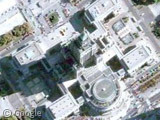
The 230.68 metre (757 foot) tall Warsaw Palace of Culture and Science is the tallest building in Poland and the 187th tallest building in the world. Completed in 1955, the design of the building is of course in the Stalinist architectural style, and very similar to the previously featured Moscow State University1.

The palace was actually a gift from Joseph Stalin to the people of Warsaw, and it’s said that when he offered the people the option of either a metro system, or the palace - the people chose a metro. So naturally Stalin gave them this palace.

Warsovians apparently hated this huge building, both in terms of design and political symbolism. Since Soviet domination over Poland ended in 1989 however, most of Warsaw’s residents have come to accept it as an important and integral part of their skyline.

More at Wikipedia and at the official site.

Thanks to Alexandra, Maciej Godlewski, Hubert Grzywacz, Yano and Max.


  1. Which itself is one of seven similar skyscrapers Stalin had built in Moscow. 

It’s a Mystery

Wednesday, 24th October 2007 by James

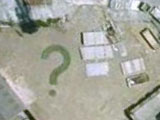
There’s a neat question mark, about 11m tall, drawn on the ground of a construction site in the city of Rennes, France.

Of course, the question about this question is: why is it there?

The “?” appears to be made out of grass, perhaps by removing the turf around it. However, in this photo of the construction site there is curved paving to the bottom left which could correspond to the area of the question mark.

I also found these pictures which might be of the same area, but they don’t provide many additional clues.

So, I’m turning it over to you, our sleuthing readers, to solve this mystery! Any ideas?

Thanks to Julien Balas

Dove-shaped Crop Circle

by Alex

Please note that some or all of the objects mentioned in this post are no longer visible on Google Earth or Google Maps.

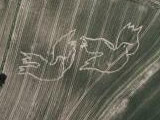
Ok, so this is hardly a crop-circle, but whoever has created this giant drawing of a pair of doves in a field in Somerset, England, certainly shows dedication and creative flair. B+.

Note: Actually I appear to have been mistaken about the latest Google Earth image update having reached Google maps - as this sight no longer appears on Earth, and is therefore due to disappear from Google maps any day now.

Thanks to Bydand.

New Imagery in Google Earth October 07. Again.

Tuesday, 23rd October 2007 by Alex

In a rather unusual move, Google has just updated their image database for the second time this month! Frank at the Google Earth Blog has the full-rundown, but here’s a short list of some of the places which have seen updates to whet your appetite.

Best of all, it appears that this latest update has already made its way onto Google Maps! So as usual, get exploring, and remember to send us what you find!

The Sundial Bridge

by James

Crossing the Sacramento River in Redding, California is the sundial bridge which (as you might have guessed) serves the dual purpose of being both a bridge and a sundial!

I previously tried to use North America’s largest sundial to tell the time on Google Earth, which was much more effort than I’d anticipated, and not an exercise I’m keen to repeat.

However, according to “Sundial 101“, telling the time on the sundial bridge should be easier, as “the base plate is titled at an angle equal to the latitude, and the style is perpendicular to the base, which will align it with the earth’s axis”.

Which apparently means that the time can be simply read from the equally spaced markers to the North of the bridge. Each marker represents an hour from 10am until 3pm (I guess that outside these times you’ll just have to look at your watch).

Therefore, I’d say that this photograph was taken at approximately 11.30am!

The sundial bridge was designed by renowned Spanish architect Santiago Calatrava whose work always looks great from above. We’ve previously featured his Saint-Exupéry TGV Terminal and Montjuic Communications Tower. Calatrava’s design for the World Trade Center Transportation Hub in NYC is currently under construction and is expected to be completed by 2008.

More info on the bridge from Tutle Bay Exploration Park and CNet News and you may also enjoy Felippo’s extensive sundial collection.

Thanks to otiica on the Google Earth forum & Anthony Ochoa

Stromatolites

Monday, 22nd October 2007 by Alex

This is Hamelin Pool in Shark Bay, Western Australia, and in our thumbnail you can see the kite-shaped observation jetty where visitors can observe some of the world’s oldest creatures - Stromatolites.

Looking for all the world like rocks which have grown into bizarre shapes, Stromatolites are believed to have been formed by the “trapping, binding, and cementation of sedimentary grains by microorganisms, especially Cyanobacteria“, and have existed on Earth for 3.4 billion years.

Don’t be mistaken though - these aren’t fossils. This is one of only a few places in the world where living marine Stromatolites can be found, which themselves are over 3000 years old.

Which makes these the world’s oldest living creatures too.

Thanks to Stephen Jackson. Read more about Hamelin Pool and Stromatolites at Wikipedia.