Archive for June, 2008

Google Sightseeing takes you on tour of the world as seen from satellite, using the free Google Earth program, or Google Maps in your web browser. Each weekday your guides James and Alex present new weird and wonderful sights as suggested by readers.

The editors: James & Alex

Blue Trees

Monday, 30th June 2008 by James

It’s commonly quoted as fact that in nature, no food or vegetable is naturally blue.

This information was again disputed recently by the re-introduction of blue Smarties1, this time using 100% natural seaweed extract to create the blue colour.

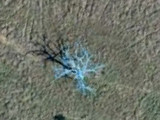
Additional support for the “blue-in-nature” brigade comes in the form of blue trees spotted on Google Earth. Firstly, in Australia’s Mount Annan Botanic Garden there’s a strikingly-blue tree.

The Garden’s website explains that the tree has been dead for many years, but is home to various types of termites and slaters.

So, it’s the termites that make the tree blue? Well, no. Further investigation reveals that the tree was in actual fact painted blue. For no particular reason.

Perhaps we’ll have better luck with this blurry shot of a blue tree in Northern California.

Unfortunately, this isn’t natural either. It’s the work of artist Claude Cormier, who decorated a perfectly normal tree with 70,000 blue Christmas baubles. Again, for no particular reason it would seem.

So perhaps natural blue is restricted to seaweed after all!

See a ground level pictures of the Australian tree and the American one on Flickr.

Thanks to Felippo, Logan and James.


  1. Be sure to read the Wikipedia page for the brilliantly factual description of the sweets’ shape. 

The Happy Couple

Friday, 27th June 2008 by Rob

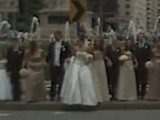
As the summer wedding season gets into full swing, even Google is muscling in on the action, and has managed to capture a rather charming shot of the newlyweds - probably much to the disappointment of the photographer who wanted the exclusive!

In my opinion, a spectacular photo opportunity, as this is Columbus Circle in New York City, a famous landmark which is surrounded by amazing skyscrapers - not least the Trump International Hotel and Tower behind the party.

Along with the 44 story luxury hotel, Columbus Circle features the New York home of CNN as well as The Time Warner Centre, two striking glass towers which each top out at 229m. This is also home to a record-breakingly expensive penthouse that was sold in 2003 for $54.7 million.

Thanks to the new imagery which allows for nearly 360 degree views, you can see all of New York’s skyscrapers instead of the first 5 floors of them, so get hunting and tell us!

Find out more about the history of Columbus Circle at Wikipedia, as well as more on The Time Warner Centre and Trump International Hotel and Tower.

Thanks: streetviewfun

The (Current) Largest Restaurant in the World

Thursday, 26th June 2008 by James

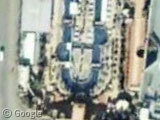
Syria’s Damascus Gate restaurant has recently been certified by Guinness as the “World’s largest restaurant”, stealing the crown from Thailand’s (previously featured) Mang Gorn Luang.

Seating up to 6014 diners at one time, it easily tops the previous holder’s 5000 capacity.

Damascus Gate employs 1800 members of staff to cover the 54000 m2 outside seating area, which is decorated with waterfalls, ponds, and replica archaeological monuments.

However, what strikes me about the “World’s largest restaurant” is that it looks so small, especially compared to all the World’s largest x that we’ve previously featured.

Read more and see a rather dull video on the BBC’s article.

Thanks to Anthony Silverbrow.

Landform

Wednesday, 25th June 2008 by Alex

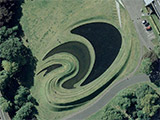
The skeptics amongst you might initially think that this bizarre twisted lake isn’t natural real, but rather that the Google engineers have just discovered Photoshop’s Twirl feature. However I assure you that it is real, as it’s only a few minutes down the road from where I work!

This is actually a sculpture, “Landform” by Charles Jencks - an immaculately sculpted earth, grass and water monument in the grounds of the Scottish National Gallery of Modern Art, Edinburgh. The artist describes it as being “based on a strange attractor and the flow of earth and traffic”.

The best thing about Landform though, is that you can wander around all over it, as several people can be seen doing on the day this image was taken.

Read more about Charles Jencks and the Scottish National Gallery of Modern Art at Wikipedia.

Thanks to Fred B.

Three Sisters, Australia

Tuesday, 24th June 2008 by Alex

Here in New South Wales, one of the most popular sights are the famous Three Sisters - three spectacular rock pinnacles which tower over the Jamison Valley in the Blue Mountains.

The rock spires are named Meehni (922 m), Wimlah (918 m), and Gunnedoo (906 m) and the view of them from the nearby observation platform at Echo Point is pretty dramatic. Apparently there’s a metal staircase here that leads down to the valley which is made up of 1,000 individual steps.1

The Blue Mountains aren’t actually a range of mountains, but rather a vast plateau - with cliffs up to 760 metres high. There is truth in the “blue” part though - when viewed from a distance, the valley seems filled with an eerie blue haze that can also be seen in photos.

It’s widely believed that the blue colour has something-or-other to do with evaporating oil from the Eucalyptus trees that swamp the valleys, but in fact the hue is down to a process known as Mie Scattering which occurs when UV radiation is scattered by atmospheric particles.2

Read more about The Three Sisters, Jamison Valley, the Blue Mountains and Katoomba Scenic Railway at Wikipedia.

Thanks to Mr. Stokes and Glenn Baker.


  1. So my Australian colleague Glenn says anyway. 

  2. No, I didn’t understand it either. 

The Top Gear Test Track

Monday, 23rd June 2008 by Rob

Last night in the UK saw the start of the eleventh series of popular BBC2 car show Top Gear - so it’s time to finally visit the Top Gear studio and track!

Based at Dunsfold Park in Surrey, the two mile track was built on an old RAF airfield by Lotus engineers.

As seen from the opening credits, the large hanger by the track is the studio, although the large Top Gear logo isn’t there any more (or perhaps this picture was taken before filming). Just next to the studio, you can see the production office of Top Gear, which is, according to the makers, just a portakabin!

A member at Google Earth Community has posted an overlay of the track, so you can get an aerial overview of Gambon and the follow-through, with the Hammerhead sitting at the end of the runway. The lack of visible tyre marks suggests that the images was captured before the ‘Power Lap’ and ‘Star in a Reasonably Priced Car’ features began.

You can find out more about Top Gear and Dunsfold Park at Wikipedia. Sightseeing car fans in the UK can watch the most recent Top Gear again at BBC’s iPlayer.

Thanks to Scott Blair, Shane Ferguson, Justin Flavin, Stu Gowdy, Lee, Patrick, Scott and Matt Wix.

Desert Week Roundup

Saturday, 21st June 2008 by Alex

And so, we come to end of our first ever desert week. It turns out that we only featured two actual deserts over the week, and we even failed to mention the world’s largest desert!

Despite these we think it’s been a success, but we’d to hear your feedback. Did you enjoy desert week? Do you wish it had been longer, or perhaps shorter? Are there any other theme weeks you’d like to see? Let us know your thoughts!

Here’s the list of all the places we featured this week:

Many of you sent in some great desert based suggestions of other sights to see, but we just didn’t have enough time to feature them all. However, deserts aren’t restricted to desert week, so we may sneak a few in during the coming months.

We’re also planning for August to see the return of the popular Island Week for its third outing, and after that Volcano Day is due to make its triumphant return after a 2 year hiatus, and this time it’s going to make the jump to a fully-blown Volcano Week. Know of any great sights for either event? Then get submitting your suggestions!

The Atacama Desert (Desert Week)

Friday, 20th June 2008 by Alex

We’re continuing the first annual GSS Desert Week! We’re mostly posting about deserts and it’s lasting about a week!

The Atacama Desert is a virtually rainless plateau in Chile, South America. Made up of salt basins, sand and lava flows, the 181,300 km2 desert is more than 20 million years old, and as it only receives about 3mm of rain a year is considered to be one of the driest places on Earth. Areas such as the Valle de la Luna haven’t received a single drop of rain in hundreds of years.


Valle de la Luna (Wikipedia) shown bottom left of this image (Ground level photo)

This bizarre landscape isn’t completely devoid of life however. To the east of the Valle de la Luna lies the village of San Pedro de Atacama, which has developed in the middle of the desert thanks to an oasis. People have been living here for a very long time - the ruins at Aldea de Tulor date from 800 BC.1


Aldea de Tulor (Ground level photo)

The Atacama Desert is incredibly rich in copper, and the two largest copper mines in the world, Chuquicamata and Escondida are both here. Escondida alone produced 1.483 million tons of copper in 2007 - 9.5% of the entire world’s output.


Chuquicamata (Wikipedia) and Escondida (Wikipedia) copper mines

Mining here hasn’t always been so successful however - the Atacama Desert is littered with the ruins of 170 old abandoned nitrate (or “saltpeter”) mining towns, all of which (bar one) were shut down after the Germans invented synthetic nitrate at the turn of the 20th century.

The most important of these abandoned mines is the Humberstone and Santa Laura Saltpeter Works, and it has actually been designated a UNESCO World Heritage Site.

Thanks to the extremely arid conditions, cloud cover is incredibly rare in the Atacama desert. Combined with the high elevation of the area, that makes it a perfect location for stargazing, which is why there are several observatories here, including at 2,635 metres the Paranal Observatory, that houses the utterly brilliantly named Very Large Telescope (Wikipedia).

Thanks to Bakan_Vargas, Bleij and Tom (and Chris Branagan too).


  1. The Atacama desert is also famous for the many Incan geoglyphs that we featured in February 2007, including the absolutely fantastic Atacama Giant.