Archive for July, 2008

Google Sightseeing takes you on tour of the world as seen from satellite, using the free Google Earth program, or Google Maps in your web browser. Each weekday your guides James and Alex present new weird and wonderful sights as suggested by readers.

The editors: James & Alex

The Donghai Bridge

Thursday, 31st July 2008 by Alex

Such is the volume of new imagery that is added to Google Earth, that by the time we got around to posting the longest cross-sea bridge in the world, it had already been superseded.

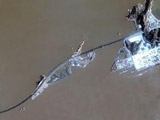
Fortunately for us however, the current reigning champion was captured whilst still under construction, which means that we’re able to bring you the longest cross-sea bridge on Google Earth, China’s Donghai Bridge.

Measuring a whopping 32.5 kilometres (20.2 miles), the Donghai Bridge was completed in 2005, and connects Shanghai (above) to the Yangshan Islands in the East China Sea.

Most of the six lane bridge is low-level viaduct, but there are two cable-stayed sections which allow ships to pass, the larger of which has a span of 420 m.

Apparently the seemingly meandering path the bridge takes across the East China Sea was specifically designed to keep drivers more alert during their long crossing.

While questions have been raised over the financial logic of projects like the Donghai Bridge, China is rapidly emerging as the new Land of Long Bridges. China now has seven of the top twelve longest bridges in the world, all of which were completed in the last 5 years.

There’s information about and a great picture of the Donghai Bridge available at Wikipedia. You can also read about the current longest cross-sea bridge, which will likely also have been superseded by the time we get to it.

Thanks to Lukas Nowacki and Tom.

Watching Me Watching You

Wednesday, 30th July 2008 by Rob

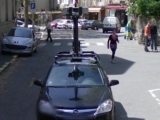
Google is in trouble. The company now has so much money that it’s finding it increasing hard to spend it all - so as a first step has decided to employ a 2 car convoy to capture Street View images!

This means that we get a nice close up of the camera that is used, but strangely it doesn’t appear to be the same as the ones that have been caught elsewhere in either Paris or London.

As has been widely rumoured, it’s possible that this second car is separately collecting 3D imagery using a special laser camera (which bounces off nearby objects to create a 3D map, onto which the street view imagery can be laid).

The two cars rather quickly split up though, so they were probably just setting off from the same place. Of course, there’s always the possibility that new 720° imagery is just round the corner!

Thanks to streetviewfun.

Erratic Boulders

Tuesday, 29th July 2008 by Alex

An erratic boulder is, simply enough, a piece of rock that doesn’t originate from the place where it is found. When these errant boulders are the size of houses however, they take a little more explaining.

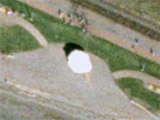
The city of White Rock, British Columbia, gets its name from a large white erratic that seems completely out of place sitting on the shore of Semiahmoo Bay.

In fact, boulders like this one were carried to their current locations by glacial ice, often over hundreds of kilometres. Geologists have suggested that landslides or rockfalls initially dropped the rocks on top of glaciers, which then carried the rocks along with them on their journeys. When the ice melted, the erratics were unceremoniously deposited wherever we find them today.

The largest glacial erratic identified so far is Big Rock, near Okotoks, Alberta. Measuring 41 m by 18 m and standing 9 m high, this massive quartzite boulder weighs around 16,500 tonnes.

Geologists believe that Big Rock made its epic journey between 12,000 and 18,000 years ago - all the way from Mount Edith Cavell in Jasper National Park - a journey distance of nearly 500 km.

There’s more about Glacial erratics, White Rock, and Big Rock at Wikipedia.

Fire destroys Grand Pier at Weston-super-Mare

Monday, 28th July 2008 by Alex

At 6:45am this morning local time, fire fighters were called to a massive blaze taking place at the Weston-super-Mare Grand Pier.

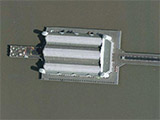
Ironically, the fire service were having difficulty getting enough water to put out the blaze. As you can see in the above image, the pavilion is 800 metres out to sea, and to make matters worse, the tide was out when the fire began.

The pier was first opened in 1904, and was reopened in April this year after a massive revamp. As we’ve seen before it seems to be a tragically frequent occurrence that one of these historic structures burns down, and in fact the Grand Pier previously burnt down in 1930.

Now that the fire has been brought under control, it looks like the pavilion has been completely destroyed, but that the iron foundations of the structure are still standing. Hopefully for Weston-super-Mare someone will undertake the task of restoring the pier to its former glory.

Read more and watch a video at the BBC, see this gallery of pictures or read the pier’s Wikipedia page.

Alton Towers

Friday, 25th July 2008 by Alex

Rounding off our totally unplanned week of obscure towers is… Alton Towers, which is very obscure, being that it’s actually a theme park.

Located in the grounds of a former stately home in Staffordshire, England, Alton Towers opened as a theme park in 1980, and in 2007 it attracted 2.4 million visitors - making it the most visited theme park in the UK.

Alton Towers has a good history of fairly ground-breaking roller coasters, and they currently have 8 in total, including Air - the world’s first B&M flying roller coaster.

Nemesis was Europe’s first inverted roller coaster (Wikipedia).

Probably the best known to this day is Oblivion, the world’s first vertical drop roller coaster (Wikipedia), which opened in 1998 amidst a huge publicity campaign here in the UK. The coaster features a 55m near-vertical drop into a huge dark hole in the ground (ground-level pic).

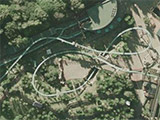
Of course when I personally went to Alton Towers the first time (all the way back in 1986), the biggest name ride was the Corkscrew (Wikipedia). It’s the park’s oldest coaster, and sadly seems to be reaching the end of its lifespan - it looks likely to be replaced soon. You can clearly see where it gets its name in this image.

Alton Towers is open March to November, and given that the UK has some spectacular weather right now I imagine this weekend will see the 2 km² (500 acre) grounds full to bursting with people queuing for the 125 different rides.

More about Alton Towers, as ever, at Wikipedia.

Thanks to Andrew Senter and Andrew Checkley.

Shot Towers

Thursday, 24th July 2008 by James

The Phoenix Shot Tower in Baltimore was erected in 1828 and stands at 71.3m, which at that time made it the tallest structure in the United States, as well as the world’s largest free-standing masonry tower1.

The shot tower was invented by an Englishman in 1783, and soon spread across the globe as the preferred method of making lead shot for shotguns.

The process involves pouring molten lead through a copper sieve at the top of the tower, so that droplets fall the height of the tower, taking the form of tiny perfect balls during their descent. The lead then splash-lands in a water bath at the bottom, which sets the pellet.

These days shot is made using a centrifuge, so now only a handful of the once-ubiquitous shot towers exist worldwide.

The largest shot tower that was ever built is the 80.16m tall Clifton Hill Shot Tower in Melbourne.

Probably very impressive in 1882 when it was completed, but by the standards of today’s tallest towers, it’s tiny!

More info on shot towers at Wikipedia.


  1. Baltimore’s shot tower actually remained the world’s largest free-standing masonry tower right up until 1884 when the crown was passed to the Washington Monument

Hokkaidō Centennial Memorial Tower

Wednesday, 23rd July 2008 by Alex

This is supposedly the Hokkaidō Centennial Memorial Tower in Nopporo Forest Park, Hokkaidō, Japan. The official site claims it’s 100m tall, and was completed in 1970 to honour the 100th anniversary of Hokkaidō’s official colonisation1.

Of course dear geeky-reader, you will have already realised that this is simply an elaborate ruse.

Unmistakably, this is in fact Orthanc, the black tower of Isengard, atop which Gandalf was trapped by the wizard Saruman during The Lord of the Rings: The Fellowship of the Ring.


On the left, the Hokkaidō tower, and on the right, Orthanc.

The proof is incontrovertible, as I found both of these images on the Internet.

Thanks to photojennic.


  1. Matching metres to years seems to be a bit of a common theme in tower design. 

Stefan’s Skyneedle

Tuesday, 22nd July 2008 by James

The Skyneedle is an 88m tower in Brisbane, Queensland, that was constructed for the World Expo ’88.1 During the course of the Expo the tower shone a beam of light upwards that could be seen from 60km away.

After the Expo ended the tower was supposed to go to Tokyo Disneyland, but successful local hairdresser Stefan Ackerie felt that the Skyneedle should stay in Brisbane. He felt so strongly in fact, that he bought it himself and had it moved just 500m to his company’s headquarters.

The tower light was originally only used on special occasions, as it could potentially cause havoc for aircraft headed to the nearby Brisbane Airport, but in 2006 an electrical fault caused a fire near the top of the tower, and today it’s unclear if the light works at all.

There’s a bizarre bonus sight at the back of Stefan’s building too - an 8.5m long tennis racket, which was purportedly designed as a giant catapult?

Just what hairdresser Stefan planned to catapult is anyone’s guess.

More information on Expo ’88 and The Skyneedle at Wikipedia, and Stefan himself at his corporate website.

Thanks to Ashley Thistlethwaite.


  1. See what they did there?