Missing Dictator Special

Posted by Ian Brown, Friday, 28th November 2008

1 Star2 Stars3 Stars4 Stars5 Stars

“He’s not dead, he’s, he’s … resting!” Apologies for the Monty Python reference, but it rings true for a couple of Communism’s stalwarts.

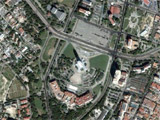
In Cuba, the Plaza de la Revolución (Revolution Square) no longer bears witness to marathon speeches from Fidel Castro.

Up to a million local residents were ‘encouraged’ to stay for the entire duration of ‘inspirational’ speeches lasting many, many hours, standing in the shadow of the memorial to José Martí, Cuba’s national hero for his role in the battle for independence from Spain.

Lining the square are imposing buildings such as the National Library and the Ministry of the Interior, adorned with an ironwork image of another national hero, Che Guevara, and the text Hasta la Victoria Siempre (Forever Onwards Towards Victory).

With Fidel’s withdrawal from public life, brother Raúl has taken on the role of President, with some apparent easing of restrictions on personal freedoms.

Meanwhile, on the other side of the world, the North Korean government has been rather less open about the plan for succession should rumours of Kim Jong-il’s ill-health actually prove to be true.

While some observers believe he died as long ago as 2003, there’s no denying that he missed more recent events such as the parade for the country’s 60th anniversary in September 2008, in which the usual collections of military muscle marched through the city with landmarks such as Kim Il-sung Square - named for his father whose statue was previously featured here - and the Arch of Triumph, which was specifically built to be slightly larger than the one in Paris, just to prove a point.

Rumours of Kim Jong-il’s health weren’t helped by the release of apparently doctored photographs of him. Perhaps he’s hiding out in the Ryugyong hotel, which we’ve previously featured on Google Sightseeing.

Fauld Explosion

Posted by Alex Turnbull, Thursday, 27th November 2008

1 Star2 Stars3 Stars4 Stars5 Stars

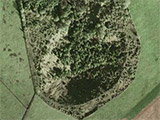
During WWII, the RAF used the old plaster mine at Fauld, England, as storage for up to 20,000 tons of ammunition. 64 years ago today, on the 27th November 1944, the underground ammunition store blew up. The explosion was to this day, the world’s biggest non-nuclear explosion1 (Update: biggest non-nuclear explosion on UK soil).

Nearly 4,000 tons of ordnance exploded, and eye witnesses reported seeing two distinct columns of black smoke rising hundreds of metres from the resulting crater, which is still clearly visible today.

Although at least 70 people died as a result of the explosion, many of the men who were underground at the time actually made it to the surface unscathed. It was later agreed that the most likely cause of the explosion was an airman working on a bomb using a brass chisel - which produced a fatal spark.

Whilst much of the storage facility was annihilated by the explosion, the site itself continued to be used by the RAF for munition storage until 1966, and there are still a considerable amount of unexploded munitions buried below the crater.

The BBC has a story about the Fauld Explosion, Wikipedia has their usual offering, and I found an independent site that has a full history and lots of good photos, including this picture of a soldier loading bombs - which clearly demonstrates just how huge this explosion must have been.

Thanks to Chris Davey.


  1. Presumably this doesn’t include naturally occuring explosions

Guitar-Shaped Mansion

Posted by Ian Brown, Wednesday, 26th November 2008

1 Star2 Stars3 Stars4 Stars5 Stars

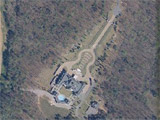
When this stunningly huge estate in Alabama was being designed, the owner must have anticipated the rise of Google Earth, because from down there it must be impossible to appreciate that the grounds have been landscaped into the shape of a gigantic guitar.

With a driveway lined with trees casting shadows to portray the frets on the guitar neck, terraced gardens shaped like the body of a guitar, and a main residence larger than many shopping malls, one could easily imagine this being the country hideaway of somebody living off the proceeds of a few number one albums.

However, it wasn’t dreamt up by some megalomaniac rock star on an acid trip, but rather by the former COO of a scandal-plagued healthcare company. Because of his financial problems, Larry House was forced to sell the property in 2003 at a considerable loss, before construction was even finished.

Let’s look at the numbers:

  • An estimated $26 million to build the estate;
  • 4,645 square metres (50,000 square feet) of living space;
  • 27 acres of land;
  • 21 bedrooms and 22 bathrooms;
  • a 13-car garage;
  • a 25-seat home theatre;
  • a wine cellar for 2,000 bottles;
  • and despite the cost of construction and contents (including many antiques), it sold at auction for just under $4million.

A gallery of the buildings and grounds can be found here, and if this is too lavish for your budget, you could just go with a guitar shaped pool, as previously featured on Google Sightseeing.

Extreme Kayaking

Posted by Alex Turnbull, Tuesday, 25th November 2008

1 Star2 Stars3 Stars4 Stars5 Stars

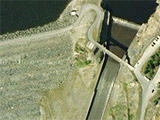
Llyn Brianne is a man made reservoir on the River Towy, west Wales, which was formed by the construction of the UK’s tallest dam, which at around 90m tall is the world’s largest clay core dam.

Recently the BBC has uncovered that thrill-seeking kayakers have been sliding down the reservoir’s spillway during times of high water, which probably makes this the world’s largest water slide.

This “dangerous” activity has been banned by Welsh Water but, as this video on the BBC shows, it looks like one hell of a way to spend an afternoon.

At the time these images were taken the spillway was in full flow but apparently, at times of low water, a couple of houses that were submerged to make way for the reservoir can be seen protruding from the surface.

Thanks to VGT and the BBC.

More about the Llyn Brianne Reservoir Spillway at Wikipedia.

The World’s Largest Dump Truck

Posted by James Turnbull, Monday, 24th November 2008

1 Star2 Stars3 Stars4 Stars5 Stars

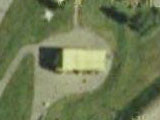
Scraping the bottom of the “world’s largest” barrel1, it’s the awe-inspiring (former) World’s Largest Dump Truck!

Built as a prototype and dubbed the “Terex Titan”, the 20m long truck can carry a payload of up to 350 tons.

The manufacturer came up with loads of possibly untrue facts about the truck, such as being able to hold “2 greyhound buses and 2 pickup trucks”, or “1,000,000 golf balls”.

However amazing these facts, by 1990 the Terex Titan had outlived its useful life and was purchased by the town of Sparwood in British Columbia to be put on permanent display.

Read more on the Terex Corporation and the Terex Titan on Wikipedia, or watch an overly dramatic video of the truck on YouTube.

For more large trucks see our previous post on the Bingham Canyon Mine.


  1. Hang on, where is the World’s Largest Barrel? We’ve not featured that yet! 

Google Street View on iPhone

Posted by James Turnbull, Monday, 24th November 2008

Apple’s recent iPhone 2.2 update has added Google Maps Street View to the already essential device.

With the iPhone’s pinch-zoom and finger-panning, the experience is even better than on the web.

The only downside is that the iPhone doesn’t automatically load Street View from Google Maps links. This means you have to manually drop a pin to get the Street View mode, and then pan around until you find what you’re looking for. Hopefully, Apple will address this in a future update.

However, as a navigational aide, I can see the iPhone Street View being invaluable - just as soon as they add UK Street Views!

Hyperboloid Towers

Posted by Alex Turnbull, Friday, 21st November 2008

1 Star2 Stars3 Stars4 Stars5 Stars

Vladimir Shukhov was a Russian engineer, scientist and architect whose pioneering structural engineering work led to the design of the world’s first hyperboloid structures.

In mathematics, a hyperboloid is a quadric (”a D-dimensional hypersurface defined as the locus of zeros of a quadratic polynomial”) defined by, er… this complex-looking equation. Basically it’s a type of three dimensional surface that is most commonly seen as the shape of power station cooling towers.

The first ever hyperboloid structure was a water tower that was built for the All-Russia exhibition of 1896. The design consists of straight beams in a lattice arrangement, meaning tall towers could be built with minimal wind resistance.

Today seven of Shukhov’s towers remain standing in Russia, including the 160-metre-high Shukhov radio tower in Moscow which was built between 1919 and 1922 during the Russian Civil War. Currently under threat of demolition, the tower is at the top of UNESCO’s ‘Endangered Buildings’ list, and fans have begun a campaign to save it.

The 128 metre Shukhov Tower on the Oka River is the only original surviving hyperboloid electricity pylon, which was a part of a 110kV powerline built between 1927 and 1929. Because of the lattice-style design it’s barely visible in our thumbnail image, but if you click through to the map you’ll be able to see the shadow of the latticework.

The use of hyperboloid structures wasn’t limited to Russia however - in Spain the 158 metre Pylons of Cádiz, completed in 1960, remain as a fantastic example of this method of construction. Here the method was chosen because at the time the Spanish had no way of transporting large steel beams, and Francisco Franco’s regime prohibited the import of anything that was up to the job.

Here’s a KML file of all of the 7 remaining Shukhov towers (or on a map) and there are many other hyperboloid structures in various guises around the world. Wikipedia also has more on Hyperboloid structures, as well as Vladimir Shukhov himself.

Rhoose Point, Wales

Posted by Ian Brown, Thursday, 20th November 2008

1 Star2 Stars3 Stars4 Stars5 Stars

Rhoose Point is the southernmost point of mainland Wales. The point is marked by a 4m standing stone monument surrounded by a stone circle.

The stone was erected in 2000 by the company reclaiming the quarry and surrounding land for housing. Some good pictures can be found at this Flickr set.

More mysterious are the several nearby shapes created from rocks, sand and gravel - a compass, a spiral and other assorted designs. Exhaustive research (i.e. trawling through Google while drinking my morning cup of tea) has failed to reveal any information about these features. Are they art? Very ambitious graffiti? Alien communications? Who made them? Can any locals enlighten us?

Thanks to AndrewAnorak.