All sights in category 'Animals'

Google Sightseeing takes you on tour of the world as seen from satellite, using the free Google Earth program, or Google Maps in your web browser. Each weekday your guides James and Alex present new weird and wonderful sights as suggested by readers.

The editors: James & Alex

Dog Team, Longyearbyen, Svalbard

Posted by Alex Turnbull, Tuesday, 31st July 2007

1 Star2 Stars3 Stars4 Stars5 Stars

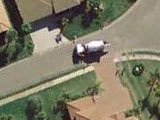
Could these be the shadows of one or more dog sleds following old tracks through the snow on Svalbard, the northernmost part of Norway?

Unfortunately these are only medium resolution images1 (which disappear in Google Maps if you get too close), but zooming right in on Google Earth certainly seems to add weight to the theory.

Perhaps they’re travelling from the nearby EISCAT radar station to the nearest town – the administrative centre of Svalbard, Longyearbyen?

Actually Longyearbyen is interesting too, as it’s the world’s northernmost town2 and therefore has the world’s northernmost of quite a few things, including the world’s most northern bank, ATM, hospital, library, night club, bus station, taxi rank, tourist office, supermarket, school and not not forgetting pub!

Oh yeah, they’ve also got the world’s most northern permanent airport with scheduled flightsSvalbard Airport.

See Wikipedia for more on dog sleds, Longyearbyen, Svalbard and the world’s most northern things.

Thanks to Harry.


  1. I’m not sure if these images have appeared in this weekend’s image update or not, but I wasn’t previously aware of any coverage of this part of the world. 

  2. With 1000 people or more. Longyearbyen has 1800. 

Manatees

Posted by Alex Turnbull, Friday, 4th May 2007

1 Star2 Stars3 Stars4 Stars5 Stars

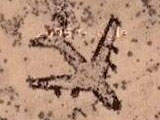
Congregating by this water outlet in West Palm Beach is a whole herd of Florida Manatees, a highly intelligent species of aquatic mammals, also known as Sea Cows.

Manatees! More Manatees!

The water outlet is actually from an adjacent power plant, and Manatees commonly gather in places like this, as the water is artificially heated. This has meant that the Manatess no longer migrate to warmer waters, and have actually become reliant on the heat from the power plants.

You’d think hanging around power plants might not be the safest practice, but actually these manatees are much more threatened by potential collisions with boats – and you can see why, given these ones proximity to the passing traffic.

Thanks: Jim Schomberg.

Feeding Frenzy

Posted by James Turnbull, Wednesday, 25th April 2007

1 Star2 Stars3 Stars4 Stars5 Stars

At first glance this might appear to be a a blurry cloud above the ocean but it is in fact hundreds of seabirds feeding on fish!

News of the feast has spread fast, and you can see more birds approaching from all directions.

If you zoom out it looks like there’s the trail of a ship which has just moved off the image to the South-west, so it’s likely that this frenzy has been caused by fishermen discarding leftover fish. According to Wikipedia this is how some seabird populations get 70% of their total food intake!

Thanks: benomir

Whale Spotting in Google Earth

Posted by James Turnbull, Thursday, 22nd March 2007

1 Star2 Stars3 Stars4 Stars5 Stars

There are about 80 known whale species around the globe, the largest of which is of course the Blue Whale, which can measure up to a massive 30m long.

Such a giant beast should easily be visible on the aerial and satellite photographs of Google Earth, it’s just a matter of finding them…

To start with, there’s definitely a blue whale in this Japanese swimming pool, but I don’t think that counts.

The Route 66 landmark Blue Whale slide is so famous it even appeared in Sega’s King of Route 66 video game. More info.

Outside of UC Santa Cruz’s Long Marine Laboratory there’s an 85-foot long Blue Whale skeleton. The female whale was washed ashore of Pescadero Beach in 1979, after dying of unknown causes.

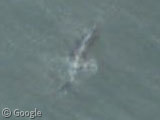
We’ve still not found any live whales though! Off the coast of Santa Barbara there’s a 10m long grey blob that could resemble a whale, or more likely a shark. Either way it would have to be very close to the surface to be seen so easily. I’m not convinced.

Reverence‘ is a sculpture by Jim Sardonis, which depicts two whales seemingly diving into the grass. The tails are each 12-13 foot tall and made of granite. More info.

Back in Japan, and Ueno Park has more than tails – there’s a life size Blue Whale diving into the ground. More info.

And finally, to Argentina, where there could just be real whales.

According to whale expert wildslide these are southern right whales who breed in this area during the months of May and October. Success!

Previously on Google Sightseeing: Whales! and Beached Whale

Thanks: The many people who thought they saw a whale, including: Jonathan_Tronson, FrequentFlyer, danescombe, bagabnoosh, kjfitz, Ralph Mettier, Nick, Jim Morton, Andrew, Rking, Yoshino, Barb, Caraurta, danescombe, Todd Pearson, Andrea from Italy, Nichole, James, A30 & John Hartnup

National Geographic African Megaflyover Project

Posted by James Turnbull, Thursday, 8th March 2007

1 Star2 Stars3 Stars4 Stars5 Stars

News has spread across the internet over the last day or two of a “hack” that allows you much more zooming on Google Maps.

Unfortunately for all the people who’ve wasted hours scanning the earth, this is really nothing new. There are no methods for seeing higher resolution images of your favourite area than you can see today in Google Maps and Google Earth.

The confusion has developed from the recent Australia flyover and the far-from recent Africa flyover project. The result of both projects was images of a much higher resolution than elsewhere in the world – meaning there’s an extra zoom level or two in these areas and these areas only1.

A lot of folk have been suggesting that we feature these “new” sights, and even though we’ve highlighted a few before I thought I’d have another look…

The 500 different Megaflyover photographs included in Google Maps and Earth were selected by Mike Fay from his library of almost 92,000 images, taken from a small plane flying at low altitude.

A couple of my favourite images are these guys in a small village, looking up at the aircraft as it passes over…

I also liked this pack of camels, roaming the desert.

But there’s hundreds more. So please, take my advice: Stop trying to hack URLs, load up Google Earth and switch on the “National Geographic Magazine Layer” under Featured Content. You’ll find it much more rewarding.


Previous Megaflyover shots on Google Sightseeing: Victoria Falls, The Longest Conveyor Belt in the World and N’dama Skull and Australia Day shots: Australia Day (check the comments too), NRMA Motorfest ‘07 & Nessie.

Wikipedia Links: Mike Fay and his MegaFlyover


  1. It wouldn’t make sense to add these extra zoom levels to the other 99.9% of the globe, there would be a whole lot more confusion!