All sights in category 'Movie Locations'

Google Sightseeing takes you on tour of the world as seen from satellite, using the free Google Earth program, or Google Maps in your web browser. Each weekday your guides James and Alex present new weird and wonderful sights as suggested by readers.

The editors: James & Alex

Mount Taranaki/Egmont (Volcano Week 3)

Posted by Alex Turnbull, Friday, 17th October 2008

1 Star2 Stars3 Stars4 Stars5 Stars

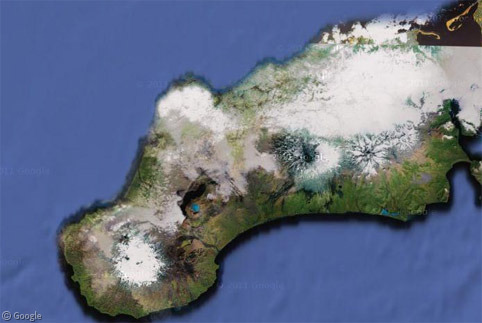
Mount Taranaki/Egmont is another (apparently) active stratovolcano in New Zealand, but this one hasn’t done anything at all since the early 1800s when it reportedly produced “a moderate ash eruption”.1

Most interestingly from our perspective is that we can clearly see how very symmetrical this volcano is. A secondary cone to the south somewhat ruins the effect, but not enough to prevent filmmakers from having used this volcano as a double for Japan’s Mount Fuji in the movie The Last Samurai.

(Wikipedia, aerial photo)

Thanks to Papapenguin and Glenn.


  1. Research shows that minor eruptions have occurred here every 90 years on average, with major eruptions occurring every 500 years. So perhaps a large eruption ought to be expected soon! You know, within the next 300 years or so… 

Oil Rocks

Posted by James Turnbull, Wednesday, 27th August 2008

1 Star2 Stars3 Stars4 Stars5 Stars

The Oil Rocks, 50km off the coast of Azerbaijan, is effectively a small city that has been constructed from interconnected oil platforms and residential areas, all sitting atop rocks, piles of sand and landfill.

Back in 1949, the Oil Rocks were the site of the world’s first successful offshore venture in oil drilling, and by the 1960s 21 million tons of oil was being extracted each year.

Of course, this level of extraction couldn’t continue forever, and the quality and quantity of the oil started falling in the 80s. With it, the upkeep of the platforms and interconnecting roads fell, and today about a third of the oil wells are either inoperative or inaccessible, and many of the connecting roads have become submerged.

Despite the conditions, the platforms still have a combined population of about 5,000 men, who work in week-long offshore shifts, and collectively they produce over half of the total crude oil output of Azerbaijan.

Several action sequences in the 1999 James Bond film The World Is Not Enough are set and filmed on the Oil Rocks, where terrorists used a giant helicopter saw to cut the oil pipes. Obviously.

There’s a thorough history at window2baku.com, Wikipedia has a couple of choice facts, and there’s a photo of the interconnecting bridges at travel-images.com.

Update: What we’re seeing here is actually not the Oil Rocks, but is very close. Oil Rocks is further out to sea, unfortunately in an low res area. You can get an idea of how big Oil Rocks really is from the OpenAerialMap image.

Thanks to Samir Aliyev and Panda32 in the comments.

Hokkaidō Centennial Memorial Tower

Posted by Alex Turnbull, Wednesday, 23rd July 2008

1 Star2 Stars3 Stars4 Stars5 Stars

This is supposedly the Hokkaidō Centennial Memorial Tower in Nopporo Forest Park, Hokkaidō, Japan. The official site claims it’s 100m tall, and was completed in 1970 to honour the 100th anniversary of Hokkaidō’s official colonisation1.

Of course dear geeky-reader, you will have already realised that this is simply an elaborate ruse.

Unmistakably, this is in fact Orthanc, the black tower of Isengard, atop which Gandalf was trapped by the wizard Saruman during The Lord of the Rings: The Fellowship of the Ring.


On the left, the Hokkaidō tower, and on the right, Orthanc.

The proof is incontrovertible, as I found both of these images on the Internet.

Thanks to photojennic.


  1. Matching metres to years seems to be a bit of a common theme in tower design. 

Roald Dahl Plass

Posted by James Turnbull, Thursday, 17th July 2008

1 Star2 Stars3 Stars4 Stars5 Stars

Roald Dahl Plass in Cardiff, Wales, is named after everyone’s favourite Children’s author Roald Dahl who was born here in the Capital, and the word “plass”, meaning “plaza”, is a nod to his parent’s Norwegian origins.

If you’re a fan of Doctor Who or the Torchwood spin-off, then you’ll immediately recognise this as being the location of a spatio-temporal rift in time1.

At the north end of the plaza stands a 21m tall water fountain (which hides the entrance to the secret Torchwood underground cave).

The south-east of the Plaza is home to the National Assembly for Wales, the Senedd. We looked for the Senedd before while touring the United Kingdom’s devolved assemblies, but it wasn’t finished then.

At the north-east of the square is the Wales Millennium Centre, a hall for performing arts. The front of the building has an enormous Welsh poem written across its entire face using the medium of windows. You can read the windows in Microsoft’s bird’s eye view imagery.

There’s more information on Roald Dahl Plass and Cardiff Bay on Wikipedia.

Thanks to AndrewAnorak, Jam, braddie, and Andrew Shackson.


  1. If you didn’t watch either of these shows then I apologise for the gibberish. 

Ice Road Truckers

Posted by Alex Turnbull, Tuesday, 8th July 2008

1 Star2 Stars3 Stars4 Stars5 Stars

Driving across the frozen Amur River between Russian and China we can see a couple of trucks – driven by the fearless and legendary Ice Road Truckers!

Although it seems ludicrous, building “Ice Roads” over lakes, rivers or seas, is at times preferable to carving a road on land, as you can get long continuous straights on the ice, which hilly tree-covered land just doesn’t offer. However in this case it appears to be the only existing way across the river.

Driving across frozen water in a 2 tonne truck is of course slightly dangerous. Depending on the country, the ice only needs to be about 20cm thick for authorities to allow trucks onto the surface, and speeds may be limited to a painfully slow 16mph. Luckily our particular truckers don’t have far to go, unlike the men who drive the 568 kilometre Tibbitt to Contwoyto Winter Road each year.

Ice road truckers were made famous by the TV show of the same name, and the green light has apparently been given to make a fictional film based on the series in 2008. I’ve not seen the TV show, but I hear it’s much more exciting than boring footage of lonely truckers driving at 16mph across vast empty frozen lakes.

Read more about ice roads at Wikipedia.

Thanks to pooms.