All sights in category 'Theme Parks'

Google Sightseeing takes you on tour of the world as seen from satellite, using the free Google Earth program, or Google Maps in your web browser. Each weekday your guides James and Alex present new weird and wonderful sights as suggested by readers.

The editors: James & Alex

Boblo Island

Posted by Ian Brown, Wednesday, 12th November 2008

1 Star2 Stars3 Stars4 Stars5 Stars

This huge pavilion and dance hall is the only remaining structure from Boblo Island Amusement Park in Ontario.

The Amusement Park was open to the public from 1898 until 1993 and through the years it was home to a number of roller coasters, rides, shows and restaurants. The remaining dance hall is about 3300 square metres and for a while had the largest dance floor in the world.

Most visitors reached the island (also known as Bois Blanc) by ferry from Detroit, leading to perhaps the most historically significant development related to the park. In 1948 a US Supreme Court decision upheld the Michigan law preventing corporations from racial discrimination, however the ferry company tried to deny African-Americans passage as the island destination was foreign. The Court eventually decided it was not ‘very foreign’, being socially and economically closely tied to Michigan, and having no ties to nearby Ontario communities.

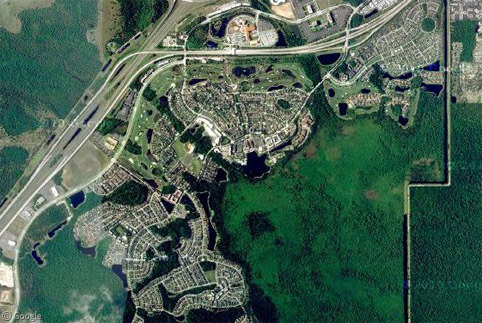
A comprehensive history of the park can be found here. Today the island is being developed with luxury housing, a golf course and a marina.

Just to the West of the island is the tree-lined Livingstone Shipping Channel.

The channel was cut through shallow water to provide a safe route for ship traffic heading south to Lake Erie.

Thanks to Kirk Hayhurst who submitted this fairly regularly for the last couple of years!

Fire destroys Grand Pier at Weston-super-Mare

Posted by Alex Turnbull, Monday, 28th July 2008

1 Star2 Stars3 Stars4 Stars5 Stars

At 6:45am this morning local time, fire fighters were called to a massive blaze taking place at the Weston-super-Mare Grand Pier.

Ironically, the fire service were having difficulty getting enough water to put out the blaze. As you can see in the above image, the pavilion is 800 metres out to sea, and to make matters worse, the tide was out when the fire began.

The pier was first opened in 1904, and was reopened in April this year after a massive revamp. As we’ve seen before it seems to be a tragically frequent occurrence that one of these historic structures burns down, and in fact the Grand Pier previously burnt down in 1930.

Now that the fire has been brought under control, it looks like the pavilion has been completely destroyed, but that the iron foundations of the structure are still standing. Hopefully for Weston-super-Mare someone will undertake the task of restoring the pier to its former glory.

Read more and watch a video at the BBC, see this gallery of pictures or read the pier’s Wikipedia page.

Alton Towers

Posted by Alex Turnbull, Friday, 25th July 2008

1 Star2 Stars3 Stars4 Stars5 Stars

Rounding off our totally unplanned week of obscure towers is… Alton Towers, which is very obscure, being that it’s actually a theme park.

Located in the grounds of a former stately home in Staffordshire, England, Alton Towers opened as a theme park in 1980, and in 2007 it attracted 2.4 million visitors – making it the most visited theme park in the UK.

Alton Towers has a good history of fairly ground-breaking roller coasters, and they currently have 8 in total, including Air – the world’s first B&M flying roller coaster.

Nemesis was Europe’s first inverted roller coaster (Wikipedia).

Probably the best known to this day is Oblivion, the world’s first vertical drop roller coaster (Wikipedia), which opened in 1998 amidst a huge publicity campaign here in the UK. The coaster features a 55m near-vertical drop into a huge dark hole in the ground (ground-level pic).

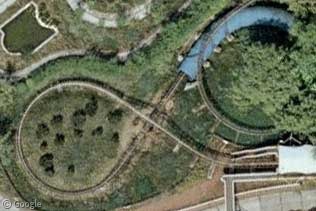
Of course when I personally went to Alton Towers the first time (all the way back in 1986), the biggest name ride was the Corkscrew (Wikipedia). It’s the park’s oldest coaster, and sadly seems to be reaching the end of its lifespan – it looks likely to be replaced soon. You can clearly see where it gets its name in this image.

Alton Towers is open March to November, and given that the UK has some spectacular weather right now I imagine this weekend will see the 2 km² (500 acre) grounds full to bursting with people queuing for the 125 different rides.

More about Alton Towers, as ever, at Wikipedia.

Thanks to Andrew Senter and Andrew Checkley.

Storm King Art Center

Posted by Alex Turnbull, Thursday, 10th July 2008

1 Star2 Stars3 Stars4 Stars5 Stars

Dotting the landscape here in Mountainville, New York, is a collection of bizarre shapes and interesting shadows. This is actually a huge outdoor sculpture garden called the Storm King Art Center.

Founded in 1960 by Ralph E. Ogden as a gallery for Hudson River School painters, today the 202 hectares (500 acres) of landscaped lawns, fields and woodlands are home to hundreds of sculptures.

New York resident sculptor Mark di Suvero has several pieces here, such as Mozart’s Birthday and Mother Peace (more info and pictures are available at the Storm King site).


Mother Peace, 1970

Di Suvero was in construction as a young man, but after a serious accident started using an arc welder to create large outdoor sculptures incorporating scrap metal and structural steel – like the enormous Pyramidian (this photo at Flickr gives a good sense of scale).


Pyramidian, 1970

Internationally renowned Polish sculptor Magdalena Abakanowicz created the seemingly accurately titled “Sarcophagi in Glass Houses” that we can see here (more info and ground-level pic).


Sarcophagi in Glass Houses, 1989

Another American, David von Schlegell, is responsible for several pieces on permanent display here titled “Untitled”, including this one, “Untitled” (ground level picture).


Unititled, 1969

Not wanting to be left out, the UK is represented by the brilliant Andy Goldsworthy, whose 694 metre (2,278 foot) long Storm King Wall can be seen falling into the lake, and emerging from the other side to take a meandering path through the trees (more info and ground-level photo).


Storm King Wall, 1998

There are many other recognisable artworks dotted about the grounds, including Adam by Alexander Liberman and Free Ride Home by Kenneth Snelson, as well as others that I haven’t been able to find any information about, like this large boat-like thing perched on a small island, or this mish-mash of what looks like huge red tubes.

The Wikipedia page on Storm King is short but to-the-point, whilst the official site would have to try very hard to be any more rambling and wordy. There’s a Flickr Pool with some good images too.

Thanks to Ryan, Wayne Citrin and Adrian Likins.

Arches National Park

Posted by Alex Turnbull, Friday, 13th June 2008

1 Star2 Stars3 Stars4 Stars5 Stars

The Arches National Park in Utah, USA, is an area of unique geological formations, most famous for the huge abundance of naturally formed sandstone arches, of which over 2,000 have been formed due to the gradual erosion of the rock.

The most famous of the natural arches here is Delicate Arch, which features on Utah license plates, but unfortunately isn’t all that impressive looking from above.

Landscape Arch on the other hand is impressively big – its span is over 90 metres (300 feet)!

We can also clearly see Natural Arch – it’s the pale saddle shaped one here. I get the impression it’s more awe inspiring in real life!

The National Park features many other fascinating formations, including Balanced Rock, which is described as “a large balancing rock, the size of three school buses”. You can see the shadow of the huge rock in this thumbnail image.

Finally we come to the Fiery Furnace — an area of maze-like narrow passages and tall rock columns which (much like the biblical story from which it gets its name), is easily survivable. As long as you’re on the ranger-guided tour that is.

Also see our older posts on the Rainbow Bridge, Utah and the Devil’s Tower, Wyoming. You can read more about The Arches National Park at Wikipedia or see ground level pictures at Flickr.

Thanks to Cortney Moody, Jeff Alu, Jens Kilian, Jens Kilian, Michael Lustig, Roland Bock, woowoowoo, Jason Wolfe, Stuart and Steve Bryson.