Search Results for 'spiral'

A Trio of Tripoints

Posted by Ian Brown, Wednesday, 12th August 2009

1 Star2 Stars3 Stars4 Stars5 Stars

A tripoint is a geographical location where three borders meet – most notably those of different countries, but also (to a lesser extent) counties, states, provinces, etc. While many of the world’s 157 national tripoints are located in the middle of lakes, rivers, deserts or mountains, those that are in populated areas are often marked with monuments of some kind.

The Swiss city of Basel is home to one of the most spectacular tripoint monuments at the location where it borders Germany and France.

Tripoint

Basel’s dreiländereck (literally “3 lands place”) is home to a soaring metal three-sided spiral which bears the flags of the 3 countries. It is located on a quay in the river Rhine, near a restaurant of the same name. The actual tripoint is located just to the north-west, in the middle of the river.

Tripoint

Germany also has a significant tripoint where it meets Belgium and the Netherlands. Vaalserberg features a number of tourist attractions including a viewing tower, cafes and a maze.

Tripoint Tripoint

While Google Maps seems to show the tripoint in a tree, I believe the actual location is marked by the 3 small monuments visible by their shadows in the upper-left of this image.1

Tripoint

Not all tripoints are marked as cohesively. The one where Austria, Hungary and Slovakia meet has a number of monuments scattered across the different borders – all quite small, so check Panoramio to see them in detail.

Tripoint

Where is your favourite location with one foot in one country, one foot in a second, and … perhaps your nose in a third?

For more like this, see our 2008 post about Complicated Borders. Thanks to AndrewAnorak and David Grenewetzki.


  1. This location was formerly a quadripoint, with the tiny territory of Moresnet which existed until 1920. No official quadripoints currently exist – see Wikipedia for details of one that almost exists in the Zambezi river. 

Rinpung Dzong

Posted by Ian Brown, Wednesday, 15th April 2009

1 Star2 Stars3 Stars4 Stars5 Stars

For our first post from Bhutan we visit the town of Paro and the Buddhist monastery Rinpung Dzong.

Rinpung Dzong

Nestled in a river valley and surrounded by mountains, Paro is home to 20,000 people and numerous significant monasteries, of which Rinpung Dzong is the largest. The present structure was completed in 1646 but a temple and fortress were first built on the elevated rocky outcrop in the fifteenth century. In addition to the monastery, the building houses administrative offices for the town and surrounding district.

Used for some scenes in the movie Little Buddha, the temple is perhaps best known for an annual festival1 which attracts crowds of people from across the valley, in addition to increasing numbers of tourists. It takes place in a small courtyard a short (but steep) walk uphill from the monastery.

Rinpung Dzong

The highlight of the festival is the unveiling of a 300 year old sacred banner known as a Thanka. The Thanka is unfurled in the middle of the night on the side of a 4-storey building (on the right of the image above); people line up to briefly touch the scroll before dawn when it is removed to prevent sunlight from harming the ancient fabric.

To the north-east (and further uphill), a former watchtower for the Dzong – with its unique design of six spiralling floors – has been converted into the National Museum of Bhutan.

Rinpung Dzong


  1. This blog entry also has good pictures and description of the Paro Festival – scroll about 1/3 of the way down the page. 

Waldspirale

Posted by John Andresen, Tuesday, 9th December 2008

1 Star2 Stars3 Stars4 Stars5 Stars

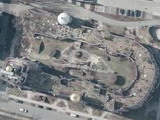
The Waldspirale, in Darmstadt, Germany, which at first glance from above may appear to be a park, is actually an apartment building that reaches twelve floors at its highest point.

The fascinating building was designed by Friedensreich Hundertwasser, an Austrian architect and painter, between 1998 and 2000. Unfortunately, he died shortly before it was completed. Going with Hundertwasser’s personal style, the building contains Russian onion domes and few straight lines1. The roof of the building is a green roof, planted with beech, maple, and lime trees.

The building has 105 apartments, as well as a cafe and a bar at the top of the spiral. Uniquely, the building has over 1000 windows of which no two are the same.

Flickr has many ground level photos of the Waldspirale.


  1. According to Hundertwasser, straight lines are “the devil’s tools.” 

Rhoose Point, Wales

Posted by Ian Brown, Thursday, 20th November 2008

1 Star2 Stars3 Stars4 Stars5 Stars

Rhoose Point is the southernmost point of mainland Wales. The point is marked by a 4m standing stone monument surrounded by a stone circle.

The stone was erected in 2000 by the company reclaiming the quarry and surrounding land for housing. Some good pictures can be found at this Flickr set.

More mysterious are the several nearby shapes created from rocks, sand and gravel – a compass, a spiral and other assorted designs. Exhaustive research (i.e. trawling through Google while drinking my morning cup of tea) has failed to reveal any information about these features. Are they art? Very ambitious graffiti? Alien communications? Who made them? Can any locals enlighten us?

Thanks to AndrewAnorak.

Strategically Positioned Crop Circles

Posted by Alex Turnbull, Saturday, 4th August 2007

1 Star2 Stars3 Stars4 Stars5 Stars

Here’s a nice new crop circle we haven’t seen before, south of Leeds, England, and handily for drivers who might be fans of crop art, this is right next to the M1 motorway. Funnily enough, the M1 seems to be a bit of a hotspot for crop circles, as we’ve previously featured several others just 11 miles south, beside exactly the same road. Strange huh?

Just south of Swindon, there’s another crop circle we haven’t seen before, but this time it’s a pretty cool-looking spiral shaped one. But as there’s clearly no motorway, why put one here?

Yup, you guessed it. This is directly west of “the world’s busiest international airport”1, Heathrow.

If only we knew what these symbols were trying to tell us, eh?

Thanks to JT, AWDfury and GEarth Hacks. Read more about crop circles at wikipedia.


  1. Disputed of course, but technically true, Heathrow does have more international passengers than any other airport.