Archive for August, 2006

Google Sightseeing takes you on tour of the world as seen from satellite, using the free Google Earth program, or Google Maps in your web browser. Each weekday your guides James and Alex present new weird and wonderful sights as suggested by readers.

The editors: James & Alex

Island of the Dead (Island Week)

Thursday, 31st August 2006 by Alex

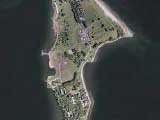
At first glance Hart Island in the Long Island Sound, New York, seems a rather inconspicuous little island. Dig a little deeper… and things get a little more disturbing.

In 1869 Hart Island was established as the City’s public cemetery - NYC’s Potter’s Field, where impoverished, unidentified, unclaimed or unwanted bodies are buried. Over the next 120 years the island was home to virtually every conceivable kind of a socially undesirable person - in a wide variety of facilities including:

  • A prison for Confederate soldiers
  • An isolation zone during a yellow fever epidemic
  • A women’s tuberculosis hospital
  • An insane asylum
  • An old men’s home
  • A young men’s reformatory
  • A WWII Navy disciplinary barracks
  • A narcotic rehabilitation centre

The island was also home to a Nike Ajax missile base, and the missile silos are still visible even from up here.

Today Hart Island is no longer any kind of jail (the last prisoners were transferred to NYC’s infamous Rikers Island in 1991), but the City Cemetery is still maintained by the Department of Corrections - during the week a consignment of inmates is brought here by bus to bury the forgotten dead.

Each year up to 3,000 bodies are buried in Hart Island’s Potter’s Field, which is marked out in squares by white gravestones - with up to 150 adult bodies or 1,000 infants packed into each square.

The DOC estimates that up to 750,000 burials have taken place here since 1869 (although around 100 disinterments take place each year too), but given how tiny the island is, this must surely be America’s most densely packed cemetery. In 1948 the prisoners erected a monument to all the unclaimed dead who are buried on Hart Island, which still stands to this day.

Hart Island isn’t open to the general public, but in 2000 a group of historians were allowed to visit and the resulting ground level photo-tour is well worth seeing.

Links: Hart Island Wikipedia page, the Hart Island official site, and a detailed history of the island.

Thanks to Nat.

Cockburn Island (Island Week)

Wednesday, 30th August 2006 by James

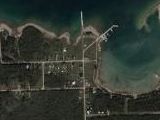
Cockburn Island is a ‘ghost’ island in Ontario, which despite the apparent signs of life (there’s a small town and marina) has an official population of zero. The 1996 census listed a population of just two, but both people had left by 2001, making this the least populated incorporated municipality in Canada.

Some of these abandoned houses are supposedly still used as holiday homes, but what interests me if the makeshift airport to be found deep in the forest. It’s evidently still in use but I’ve found no mention of the airport around the internet. Most websites say that the marina is the “only way of getting on the island”, but it’s clearly not. If you asked me, an abandoned island would be the perfect place for an evil empire to keep its headquarters…

Thanks: Matt Blum & Taylor

South Georgia and the South Sandwich Islands (Island Week)

Tuesday, 29th August 2006 by Alex

Welcome to the loose collection of islands in the southern Atlantic Ocean known as South Georgia and the South Sandwich Islands.

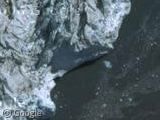
Currently an overseas territory of the United Kingdom, the glacier covered main island of South Georgia was invaded by Argentinean forces on 19 March 1982 - triggering the start of the Falklands War.

South Georgia is also the final resting place of British explorer Ernest Shackleton, who is buried somewhere just south of the settlement of Grytviken, which is looking a little run-down since whaling ended here in 1966 - you can still see the rusting remains of whale oil processing plants and abandoned whaling ships.

Most of the rest of the island group is uncovered by high-resolution, with the stunning exception of the Candlemas Islands, a pair of uninhabited volcanic islands surrounded by hundreds of awesome icebergs.

Long list of further reading: South Georgia and the South Sandwich Islands, Grytviken, Falklands war, the Candlemas Islands, and finally the official site of South Georgia!

Iwo Jima (Island Week)

Monday, 28th August 2006 by James

(It’s Island Week all this week at GGSS, which means we’ll mostly be posting about Islands. Catchy name, huh?)

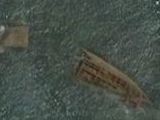
The tiny volcanic island of Iwo Jima, part of the Ogasawara Islands, is just over 1000km south of Tokyo. It was the location of the Battle of Iwo Jima, one of the deadliest battles of WWII, and you can still see wrecked ships along the coastline.

Iwo Jima’s Mt. Suribachi was also where the famous “Raising the Flag on Iwo Jima” photograph was taken. Supposedly the most reproduced photograph in history, it was used as the inspiration for the USMC War memorial in Washington.

Thanks: SnowManson, John, Stephan Segraves, Thomas, Tyler Casella & Peggy

1st Annual Island Week!

by James

After the roaring success of Annual Volcano Day a while back we’re adding a new event to the GGSS calendar - Island Week!

For the rest of the week (or until we get bored) we’ll be posting sights related to small pieces of land that are surrounded completely by water. Enjoy!

Baikonur Cosmodrome

Sunday, 27th August 2006 by James

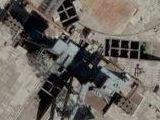
Baikonur Cosmodrome is the world’s oldest and largest operational space launch facility where you can clearly see the Energia, Soyuz and Proton launch platforms. Located in what is now Kazakhstan, the facility was named Baikonur to confuse the West of its exact location, as the town of Baikonur is some 320km away (although anyone who has flown on the bright orange budget airline would have expected this).

On the base we can also see a full-scale model of the Ptichka - the second of Russia’s Space Shuttle designs. The Ptichka construction began in 1988 and followed the Buran, which we’ve previously spotted. The name means ‘little bird’ in Russian, but was only a nickname as the shuttle was cancelled just before it was completed and formally named.

The real Ptichka is kept indoors at Baikonur Cosmodrome, as was the original Buran shuttle. However the only Soviet craft to enter space was destroyed in 2002 when the roof above it collapsed, crushing the Buran and its mockup of the Energia booster rocket. I could be wrong but it was probably this big building with no roof. Can you spot a bit of Buran?

Thanks: Georgi Petrov (x3), dimuskin, Tesla_HV, & Hamish CJ (Get me pictures?)

Rum Slick

Friday, 25th August 2006 by Alex

Just off the coast of St. Croix, U.S. Virgin Islands, is what looks rather like a Rum Slick - waste from the production of molasses at the nearby Cruzan Rum Distillery.

Rum Slick

Certainly the dark patch starts directly offshore from the point where the distance is shortest between the distillery and the sea - but surely it would be madness to so obviously pollute such beautiful waters, especially when the island’s economy relies so heavily on tourism?

Thanks to Joshua Germany.

The Crystal Palace

Thursday, 24th August 2006 by Alex

The Crystal Palace was a huge iron and glass building originally erected in Hyde Park to house the Great Exhibition of 1851 (photo tour). After the exhibition the building was moved to Upper Norwood where it stood from 1854 until 1936, when it was sadly destroyed by fire.

Today the park where it stood is still known as Crystal Palace Park, but where the building originally was, now stands the 222 metre Crystal Palace Transmitter, which is surprisingly, London’s 2nd tallest structure (second only to Canary Wharf!).

There are remnants of the exhibition still here however, including this awesome collection of wholly anatomically inaccurate dinosaur sculptures!

Another relic of the Victorian era is this fantastic circular maze, which dates all the way back to 1872!

Obligatory Wikipedia links: The Crystal Palace, the Great Exhibition, Crystal Palace Park, the Crystal Palace Transmitter, Crystal Palace Victorian Dinosaurs.

Thanks: Alain Trembleau and Simon Cope.