Stromatolites
Monday, 22nd October 2007 by Alex Turnbull
This is Hamelin Pool in Shark Bay, Western Australia, and in our thumbnail you can see the kite-shaped observation jetty where visitors can observe some of the world's oldest creatures - Stromatolites.
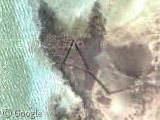
Looking for all the world like rocks which have grown into bizarre shapes, Stromatolites are believed to have been formed by the "trapping, binding, and cementation of sedimentary grains by microorganisms, especially Cyanobacteria", and have existed on Earth for 3.4 billion years.
Don't be mistaken though - these aren't fossils. This is one of only a few places in the world where living marine Stromatolites can be found, which themselves are over 3000 years old.
Which makes these the world's oldest living creatures too.
Thanks to Stephen Jackson. Read more about Hamelin Pool and Stromatolites at Wikipedia.

About the author

Alex has decided that his title will be Senior Vice President of Stuff.


Stomatolites are very cool, but they are not as old as bristlecone pines: http://en.wikipedia.org/wiki/Bristlecone_pine
Doug, it’s simply incredible how old those trees are! Here’s a maps link to the rough location of the Methuselah tree, which at 4,839 years old is clearly the oldest living organism on Earth.
Of course after reading your comment, I spent a long time researching the definition of exactly what defines a “creature” (as opposed to a tree), with the intention of being able to say that my statement still stood, and that Stromatolites are the world’s oldest living creatures, not organisms.
Princeton University’s Wordnet service defines the word “creature” as “a living organism characterized by voluntary movement”, and Wikipedia states that Cyanobacteria, and many other bacteria, do indeed move.
Of course I’m not a biologist… and by this point am so completely out of my depth that I’m fully expecting to be ripped a new one by any kid who took high-school science. 😀
So perhaps any biologists reading (you know who you are!) can clear this matter up?
A colony of bacteria is not an organism or a creature and it is highly unlikely that those Stromatolites are the oldest colonies of bacteria in the world. The bacteria themselves probably do not live very long at all. I also wonder how the colonies have survived 3000 years, surely there have been sea level changes in that time?