Archive for November, 2007

Google Sightseeing takes you on tour of the world as seen from satellite, using the free Google Earth program, or Google Maps in your web browser. Each weekday your guides James and Alex present new weird and wonderful sights as suggested by readers.

The editors: James & Alex

European Barge Lifting

Friday, 30th November 2007 by Alex

Today we’re posting a roundup of the most interesting ways Europe has employed to get canal barges up-and-over stuff. The simplest method is of course a bridge, of which you can see several excellent examples in our previous post, A Canal Across Germany. However sometimes barges need to traverse obstacles that a bridge cannot cross, and Europeland has employed several ingenious solutions to particular geographic problems.

Between Saint-Louis and Arzviller in France, a system was required that enabled the canal to cross the Vosges Mountains. The solution is the Saint-Louis-Arzviller inclined plane, a single structure that replaced 17 locks upon its completion in 1969.

Basically, vessels float into a gigantic bathtub which is then hauled up a 108.7 metre-long ramp at 41°. This vertical change of 44.6 m used to take 8 to 13 hours to traverse, but can now be achieved in just 4 minutes.

Such canal inclined planes are actually not uncommon, but the Saint-Louis-Arzviller example is probably the steepest. In Belgium, engineers have a more traditionally modest angle, but over a much greater distance - the Ronquières inclined plane climbs 68 m vertically, but is nearly 1.5 kilometres long! This time there are two giant bathtubs (actually known as caissons), and the journey takes a much more leisurely 45 minutes to complete.

Seemingly on a roll, Belgian engineers are also responsible for the Strépy-Thieu boat lift - an absolutely monumental machine that dispenses entirely with inclines, and just lifts the barges straight up and down in two counterbalanced caissons1. The difference between water levels is 73.2 metres, meaning this is officially the world’s tallest boat lift. At least until the new one at the Three Gorges dam is finished anyway…

We already posted the world’s steepest flight of locks, the Caen Hill Flight, so instead here’s the Foxton Locks - a set of ten canal locks consisting of two “staircases” each of five locks. Because the Foxton locks can hold many boats at once, they’ve become a very popular location for Gongoozling - the art of watching activity on UK canals. No, seriously - there’s a Wikipedia page on Gongoozlers and everything.

The best thing about the Foxton locks however, is that we can actually see a barge in one of the locks.

The UK also has two working boat lifts - the Anderton Boat Lift in Cheshire, England, and the awesome Falkirk Wheel in Scotland (which is unfortunately not available on Google Earth or Maps, but Microsoft’s Live Local has a good image of it2).

Although both rely on Archimedes’ Principle, the Falkirk wheel is unique as it is the only rotating boat lift in the world. Barges enter the wheel at the ends of two opposing 15 metre arms, which then rotate through 180° in five and a half minutes, using only the energy it takes to boil 8 kettles!

Read more at Wikipedia about the Saint-Louis-Arzviller inclined plane, the Ronquières inclined plane, the Strépy-Thieu boat lift, the Foxton Locks, the Anderton Boat Lift, and the Falkirk Wheel.

Or, if you’re really interested, “Canal lifts and inclines of the world” by Hans-Joachim Uhlemann seems to be definitive book on this subject.

Thanks to Jel and others.


  1. According to Archimedes’ Principle, floating objects displace their own weight in water, so when a boat enters, the amount of water leaving the caisson weighs exactly the same as the boat. Meaning that the caissons weigh the same whether they are carrying a boat or just water. 

  2. Browser restrictions apply - most often this means that Mac users must use Firefox. 

Greenwich prime meridian

Thursday, 29th November 2007 by James

The equator, or latitude 0, separates the northern and southern hemispheres of the globe. Defined as the middle point of the two geographic poles, there’s no way anyone could argue about its location.

However the meridian - longitude 0 - has no scientific definition so could basically be anywhere you like on the planet.

The most widely accepted meridian was defined at the Royal Observatory in Greenwich, London. However, even here the meridian has shifted about a bit.

18th century astronomer James Bradley’s meridian is still shown on UK maps today, but has otherwise mostly been forgotten. The much more famous meridian, which is now used as the base point for all the world’s time zones, was defined by George Airy.

Airy’s prime meridian was chosen using the very scientific system of setting up his equipment in the observatory as close as possible to Bradley’s equipment, but without getting in the way!

Two miles directly north of Greenwich, on the banks of the River Thames, Airy’s meridian is marked out by a line of trees.

Also just to the north of Greenwich is a millennium sundial, which is a few metres off the meridian. Purportedly this was a construction error and the clock will always be wrong by about 8 minutes!

If you were to take your satnav device along to the observatory at Greenwich, or just set longitude to 0 in Google Earth, you’ll find yourself outside the observatory at this seemingly insignificant point, 102.5 metres east of the prime meridian.

That’s because Google Earth, and your satnav, use the International Reference Meridian, which was defined much later by observing stars from many different countries.

So readers, if you were defining a new meridian, where on the globe would you put it?

More information on the prime meridian, the world geodetic system, how it’s used in Google Earth and the prime meridian at Wikipedia.

Thanks to LionelB, Reagan Blundell, Sly Golovanov, Frank Taylor & Roy G. Ovrebo.

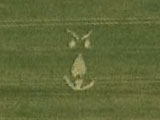
Mystery Crop-Circle Face

Tuesday, 27th November 2007 by Alex

Back in 2005 we had tons of fun trying to work out whose face could be seen in this Peruvian sand dune.

So who wants to hazard a guess as to who some amateur crop-circle makers were trying to draw, when they created this very suspicious-looking face in a field in Germany?

Thanks to Marius.

Mississippi Basin Model

Monday, 26th November 2007 by James

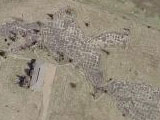
The Mississippi Basin Model reproduces the drainage basin of the Mississippi River at a horizontal scale of 1:2000 and a vertical scale of 1:100. This makes it the largest small-scale working model in the world1!

The concrete model was built by the Army Corps of Engineers in the 1940s, and initial earthwork was carried out by German POWs. It was eventually completed in 1966.

By the 1980s the model was superseded by computer modelling techniques, but it was widely agreed that the model had been a success: helping to solve numerous flood-control problems and thus saving lives.

Thanks to Ned Mitchell.


  1. Which is total nonsense, how can anything ever be the largest-small thing? 

World’s Largest Crosses

Friday, 23rd November 2007 by Alex

As so often seems to be the way with claims of “World’s Largest”, there’s a certain amount of jostling for the top slot - regardless of who should rightfully be in it.

Most often described as the World’s Largest Cross is the one in Effingham, Illinois. Unfortunately it isn’t covered on Google Maps, but Microsoft have a view of the area.1 Bizarrely, on the day this image was taken the cross appears to have donned some sort of invisibility cloak, but take my word for it, at 60.3 m high it just ain’t that big.

Over in Groom, Texas, they also have a very large cross, and we can actually see it this time. Dubbed “The second largest cross in the western hemisphere“, it used to be the largest in the western hemisphere (until they built the Effingham cross to be 2.4 m taller). Anyway, it’s a dubious claim-to-fame either way.

Never fear though, as there’s a truly spectacular large cross to see near Madrid, Spain. The Valle de los Caídos (Valley of the Fallen) contains one of the world’s largest basilicas, which was hewn out of a granite ridge by Spanish dictator Francisco Franco - to honour those who fell during the Spanish Civil War.2 Absolutely towering above the basilica is the tallest memorial cross in the world, a 152.4 metre high stone cross that took 18 years to complete.3

Not to be outdone, in Nazereth plans are underway to build the true “World’s largest cross” - but at a proposed 60 metres they’re not even going to come close.

More on Effingham, Groom and the Valle de los Caídos at Wikipedia, and in our own original post on the Valle de los Caídos (the imagery of it has been updated since then).

Thanks to Jan & michael woodruff


  1. If you’re not using Internet Explorer or Firefox, expect this link not to work. 

  2. Wikipedia says: “Spain’s Socialist Government has been debating plans to re-designate the Valley of the Fallen a “monument to Democracy” or as a memorial to all Spaniards killed in conflict.” 

  3. The memorial as a whole was allegedly built by the forced labour of 20,000 Republican prisoners. 

Plymouth Rock

Thursday, 22nd November 2007 by James

Today, the fourth Thursday of November, is the American holiday of Thanksgiving.

The Thanksgiving festival traditionally thanks God at the end of the year’s harvest, and is a tradition passed down from the Plymouth Colony who settled in New Plymouth in 1620.

When these Pilgrims first landed they apparently stepped on what is now known as “Plymouth Rock”, a large piece of granite which is currently housed in the rectangular building on the shore.

The rock wasn’t identified as being of any significance until over a hundred years later in 1741, when an elder of the church pointed it out as being “the stone”.

Since then it’s been broken in two, dragged all around Plymouth, and had numerous chunks removed. Its current resting place was built in 1920 and puts the rock back at sea level.

Happy thanksgiving to all our American readers!

Wikipedia: Plymouth Rock, Plymouth Colony & Thanksgiving

Thanks to Steve Ransom, AndrewAnorak & John

Oceanic Flight 815

Tuesday, 20th November 2007 by James

No-one could deny that it’s got more and more stupid with each passing episode, but somehow many of us are still hooked on Lost1, the TV show about large group of good-looking people stuck on a mysterious island.

In what was the most expensive pilot episode of all time, a plane crashed onto a beach. Part of this expense can be attributed to the use of a real passenger jet as a set for the downed aircraft.

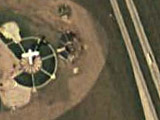
According to Lostpedia, the fictional Oceanic flight 815 was a Boeing 777, but the part was actually played by a chopped-up Lockheed L-1011 TriStar. The nose section of this plane is kept under cover, on location in Hawaii:

Before it began its TV career the plane was owned by Delta airlines and had flown some 58,841 flight-hours without crashing onto any desert islands. The fuselage section of the plane is kept closer to the beach where filming happens:

Previously on Google Sightseeing: 4,8,15,16,23,42 - finding the Lost island

Thanks: Lostpedia


  1. Annoyingly, Lost doesn’t return to TV until February 2008, meaning that I’ve wasted hours of my life reading theories and wild speculation on Lostpedia and watching the new “missing scene shorts” shorts - or rather, “mobisodes” (which is easily the worst name for anything I’ve ever heard. Ever.) 

Runway Roads

Monday, 19th November 2007 by James

When the American Eisenhower interstate system was constructed it was a specific requirement that one in every five of the 46,837 miles of road had to be kept perfectly straight. The idea was that during times of war the roads could be used as emergency runways, negating the need for more airports.

Sadly, urban legend website Snopes debunks this as totally unsubstantiated codswallop.

A similar story is told in the UK, and many believe that straight sections of the M1 Motorway near London were also planned as potential runways. These claims are also easily debunked by the presence of over-bridges and large concrete central reservations, neither of which are very helpful when attempting to land on the road.

The UK version of the myth also extends to most other motorways, some of which have more truth than others. A couple of the motorways were in fact built across and on top of former runways, such as the M8 and the M62, which replaced RAF Burtonwood. Today you can still see one of the former runways intersecting the motorway at 45 degrees1.

But still, being a former runway doesn’t qualify these roads as being of any use as a runway today!

In China, we can see a runway-to-road conversion happening, as the original Baiyun International Airport is transformed from airport in the southern (older) imagery to highway in the northern (more up to date) images.

However, it seems China have no plans to use these roads as an emergency runway.

But all is not lost - Singapore’s East Coast Parkway is finally what we’re looking for: a road that was actually designed to operate as an emergency runway!

1.25 miles of the road near to Changi Airport was constructed in a nice straight line, with no camber and a central reservation made from easily-removable pot plants.

Thanks to Cookie monster, yym_c & others.


  1. This is right beside last month’s truck spillage which, if you’ve not been following the comments, is not zombie chickens but waste probably destined for landfill.