Archive for January, 2008

Google Sightseeing takes you on tour of the world as seen from satellite, using the free Google Earth program, or Google Maps in your web browser. Each weekday your guides James and Alex present new weird and wonderful sights as suggested by readers.

The editors: James & Alex

Barton Swing Aqueduct

Thursday, 31st January 2008 by Alex

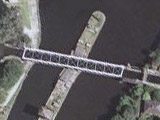
In the past we’ve featured some incredible feats of engineering in service of canals and their traffic, but perhaps none as elegant as the Barton Swing Aqueduct, England.

Designed by Edward Leader Williams1 and first used in 1893, the aqueduct carries the Bridgewater Canal over the Manchester Ship Canal. If a tall vessel needs to pass underneath on the MSC, the 71m-long iron trough swings through 90° to allow them clear passage.

Gates at either end of the bridge hold around 800 tonnes of water in place while it swings, and another set of gates on either bank hold back the rest of the canal.

Furthermore, this is actually a double swing bridge, as the Barton Swing Bridge pivots on the same purpose-built island simultaneously. How cool is that?

More about the Barton Swing Aqueduct, the Manchester Ship Canal and Edward Leader Williams at Wikipedia.

See our other posts on European Barge Lifting, A Canal Across Germany, the Corinth Canal, the Caen Hill Flight and the Saint Lawrence Seaway for more impressive canal engineering.


  1. Who was responsible for the Manchester Ship Canal itself, as well as the previously featured Anderton Boat Lift

Northrop YF-23

Wednesday, 30th January 2008 by James

Continuing the thread of unique plane finds is this sighting of a Northrop YF-23 .

y23.jpg

Specifically, this aircraft is YF-23 model PAV-2, which was nicknamed “Gray Ghost”. We know for a fact that it’s this model as only two were built, and the other one was painted black. ;-)

What’s interesting about the YF-23, apart for its brilliantly bizarre wing-shape, is that it came very close to being a staple fighter of the American Air Force.

Looking for an upgrade to the aging F-15 Eagle model, the US Air Force awarded contracts to two potential replacements: the YF-23 and the now-common F-22 raptor. It’s not been revealed why, but the F-22 won the competition and the YF-23 model was scrapped.

After the engine was removed PAV-2 was placed on display here, in a car-park outside Northrop Grumman’s factory in El Segundo.

Further information on the plane is, of course, available on Wikipedia.

Thanks: McMaster_de.

Antique WWII warplanes

by James

There are hundreds of different aircraft “in flight” to be seen on Google Earth, waaaaay too many to post them all here on Google Sightseeing1. But every now and then there’s a rare sighting that we feel the need to share.

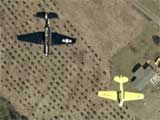
A field in North Carolina features two antique WWII warplanes flying overhead: a Grumman TBF Avenger and a yellow North American T-6 Texan, which you can clearly see has “USAF” written on the right wing.

planes.jpg

Of the 9,836 Avengers built, just 42 are still considered air-worthy (including the one we see here!). What’s even more amazing though is that the nearby Hickory Regional airport has two of the same rare aircraft parked on the tarmac!

hickory.jpg

OK, it’s not really a coincidence, this second image is a different aerial photograph so it’s almost certain that these are the same planes.

Thanks to morgantongis, Delta102 & jtouran at GE, via GEarth Blog


  1. The excellent all aircraft in flight collection on the Google Earth forum currently features 3,527 placemarks! 

Google Sightseeing is now optimized for your iPhone and iPod Touch!

Tuesday, 29th January 2008 by James

If you’re lucky enough to own an iPhone or an iPod Touch then you’ll be delighted to hear that Google Sightseeing is now fully optimized for handheld sightseeing!

Just dig out your iPhone on Touch and point Safari to http://googlesightseeing.com/1 to get the optimized site.

iphone1.jpg

We’ve simplified the site layout to make it much easier to read on the small screen and reduce the download size for when you’re using the EDGE network.

iphone3.jpg

The newly optimized GSS also integrates with your device’s built in Google Maps application2, so you can now pinch zoom your way around the latest Google Sightseeing sights!

iphone2.jpg

Lastly, we’ve also created a “Web Clip” icon, so if you have the latest 1.1.3 firmware you can add Google Sightseeing to the home screen for one-touch access!

We’d like to hear your feedback on the new site, so please either comment here or send us an email.


  1. If you haven’t got yourself an iPhone yet then visit http://m.googlesightseeing.com/ in any browser to see what you’re missing. 

  2. Unfortunately there’s currently no way to tell the Google Maps application to switch to satellite view, so if you’ve been looking at maps you’ll have to manually switch. 

Land sailing

by Rob

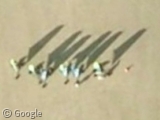
Although it appears to be one of the scariest sports in the modern world, land sailing (or land yachting) has apparently caught on in a big way on this beach in Malo Les Bains, near Dunkirk, France.

landsailstart.jpg

The premise is essentially the same as water sailing - except there are wheels, speeds of up to 70mph, and a harder surface to fall on! Participants sit or lie in a kayak shaped hull, and use pedals or levers to control the sail. Ironically, right next to the water appears to be the best place to do this!

There are multiple size classes, with the most powerful being Class 2 (which boast 8 metre sails), progressively getting smaller and less powerful.

landsailpair.jpg

Also hoping to take advantage of the favourable wind conditions are some kite buggies. These are similar to land yachts, but using a power-kite to propel you along the ground, instead of a sail, and can also reach speeds of 70mph.

parakarting.jpg

For more on parasailing, check out Wikipedia, as well as the Dunkirk landsailing club’s website, where there are plenty of photos!

Thanks: James

Holocaust Memorial Day

Monday, 28th January 2008 by James

Yesterday, 27th January, various countries celebrated Holocaust Memorial Day, which is dedicated to remembering the victims of the Holocaust.

27th January was chosen as it was the date on which Auschwitz was liberated in 1945. The concentration camp is not currently covered by high resolution imagery but you can see archive aerial shots as Google Earth overlays.

In 2004 the monument to the murdered Jews of Europe was established in the centre of Berlin. The monument is over 19,000 m2, the entirety of which is covered with 2,711 concrete slabs of various heights. Between the slabs the ground slopes about unevenly, and there is no predefined path through the monument.

holocaust1.jpg

An underground museum below the monument holds the names of all known Jewish Holocaust victims and a quote above the entrance reads:

“It happened, therefore it can happen again: this is the core of what we have to say”.

holocaust2.jpg

Further information on the monument on Sacred Destinations.

Thanks: Chris Westbrook, Stephan Gajewski, Leon el africano and David Boardman

Brú na Bóinne

Thursday, 24th January 2008 by Alex

Brú na Bóinne (Palace of the Boyne) is a World Heritage Site situated in a bend of the River Boyne, County Meath, Ireland. The site contains around 40 passage graves as well as other standing stones, henges and later features. Brú na Bóinne is the location of some of the world’s most historically important Neolithic passage graves, Newgrange, Dowth and Knowth.

Newgrange

The Newgrange passage grave was built between 3300 and 2900 BC, making it more than 500 years older than the Great Pyramid of Giza in Egypt. Hidden for over 4,000 years, Newgrange was only re-discovered accidentally in 1699, but it was hugely restored between 1962 and 1975 and today consists of a huge mound retained within a circle of 97 intricately carved kerbstones, topped by a high wall of white quartz and granite.

Newgrange was built in such a way that at dawn on the shortest day of the year, the winter solstice, a narrow beam of sunlight for a very short time illuminates the floor of the chamber at the end of the long passageway.

The Newgrange mound is 76m across and 12m high, and within the mound an 18m-long passage leads to a cross-shaped chamber with an arched roof. The ceiling of the chamber rises to a height of nearly 6m, and incredibly, has remained essentially intact and waterproof for over 5,000 years.

Dowth

The oldest of the three principal tombs, Dowth has been less developed as a tourist attraction than its neighbours (it was partly excavated in 1847 though it had been pillaged long before that). Quartz was found around the mound, indicating that the entrance to this tomb was surrounded by glittering white, just like Newgrange.

Dowth has two passages leading to two separate chambers, one cross-shaped, and one circular. The circular chamber is, again like Newgrange, touched by the light of the low sun around the time of the winter solstice. A convex central stone reflects the sunlight into a dark recess, lighting up the decorated stones there.

Knowth

The largest of all the passage graves at Brú na Bóinne, Knowth contains more than a third of the total number of examples of megalithic art in all Western Europe.

Made up of one large mound and 18 smaller satellite tombs, the large mound contains two independent passages running east to west, which both lead to a central burial chamber. This east-west orientation suggests that at one time there may have been an astronomical alignment with the spring and summer equinoxes, but this no longer occurs today.

Full scale excavations began on Knowth in 1962, and in contrast to the restoration efforts at Newgrange, it was decided that the fallen quartz surrounding the mound would not have been part of a front wall, but rather laid out to form a white “apron” in front of the entrance.

Other

The 780 hectares of Brú na Bóinne are absolutely loaded with other Neolithic structures - I easily found Dowth Henge, and many others - and yet the reason that so many structures were built in this specific location remains completely unknown.

More about Brú na Bóinne, Newgrange, Knowth and Dowth at Wikipedia, or visit the much more in-depth Knowth.com for some excellent inforation and some great aerial photos.

Death Road

Wednesday, 23rd January 2008 by James

Yungus Road, or “Death Road” as it is known to the locals, has often been described as the most dangerous road in the world.

Running from Bolivia’s capital La Paz into a rainforest region known as the Yungas, the road has no barrier to the edge, and the two-way traffic shares a space just 12ft wide.

deathroad.jpg

From the aerial shots, the road looks relatively safe as it casually winds through the trees. But load up the terrain layer in Google Earth, and you’ll see scary hairpin bends leading around the edge of a cliff face.

In fact, it seems “Death Road” is a very suitable nickname, as it’s estimated between 200 and 300 people die in this area each year!

deathterrain.jpg

Notoriety hasn’t helped the death toll here, as thrill-seeking tourists now visit the area just to drive on the road and it’s even popular with mountain biking lunatics.

More information and pictures on BBC, Wikipedia and Bolivian Geographic

Thanks: nova72