Bayer’s Crosses

Posted by James Turnbull, Wednesday, 24th September 2008

1 Star2 Stars3 Stars4 Stars5 Stars

Where would you expect to find the world’s largest illuminated advertisement? With my years of experience in completely-useless “World’s largest” facts, I would definitely assume it would be in America, perhaps in Times Square or maybe Las Vegas.

But I would, of course, be wrong. The largest illuminated advertisement in the world is found in the German city of Leverkusen, and is known as the Bayer Cross.

The 51 m diameter logo advertises the German chemical company Bayer AG, which has also given the world aspirin, heroin and methadone. Hanging between two 118 m steel towers, the 300 tonne advert has held its world record since 1958. Unfortunately, the giant logo fails to cast an appreciable shadow.

Nevermind, the logo is again represented at the company headquarters, this time flat on the ground.

Read more about Bayer at Wikipedia and see the giant advert at Flickr.

Thanks to volker lauterbach.

Mystery Stone Arrow

Posted by James Turnbull, Tuesday, 23rd September 2008

1 Star2 Stars3 Stars4 Stars5 Stars

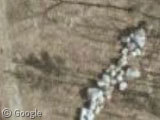
Near Sebago Lake in Cumberland County, Maine, we find a strange arrow arranged from piles of stones:

What makes the arrow really bizarre is that rather than your usual pointing-style arrow, this apears to be a representation of the sort of arrow you might shoot with a bow. But why?

Without any clues of what it could mean, I presumed it was still an arrow for pointing, and followed the path north-east to a quiet pertrol station, but the trail went dead.

Buried treasure? Terrorist targeting device? Innocent stone wall? What do you think?

Thanks to RFIDGuy.

Gateway to the Americas

Posted by Alex Turnbull, Monday, 22nd September 2008

1 Star2 Stars3 Stars4 Stars5 Stars

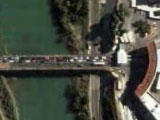
The Laredo International Bridge 1 is one of four road bridges that cross the Rio Grande to connect the cities of Laredo, USA and Nuevo Laredo, Mexico.

The 320 m long bridge is officially known as the Gateway to the Americas International Bridge (Wikipedia) and, as we can see from this satellite shot, the sheer volume of cars waiting to get into the states really help it to live up to its name – nearly a million cars cross this bridge each year, albeit slowly.

There’s a webcam on the American side that shows a typical American street scene, while the webcam on the Mexican side seems to always show a scene very similar to what we can see in the satellite shot.

In the webcams you might also spot one of the 4 million pedestrians who cross the bridge on foot each year.

Laredo International Bridge 2, or officially the Juárez-Lincoln International Bridge (Wikipedia), was built in 1976 to alleviate traffic on the first bridge, and is only open to buses and non-commercial traffic.

Slightly shorter at 307 m it has six lanes, four or which head north into the US. All four northbound lanes appear to be continually gridlocked, which is hardly surprising when you hear that over 4 million non-commercial vehicles cross here every year.

Google’s Street View car never got close enough to see the bridge itself, but we can see the front of the border control building from a distance.

Next up is the Laredo International Bridge 3, or Colombia-Solidarity International Bridge (Wikipedia), which has eight lanes this time and of all the bridges so far carries the most commercial traffic – around 270,000 vehicles each year.

Our final road bridge is the Laredo International Bridge 4, or World Trade International Bridge (Wikipedia), which despite also having eight lanes, is only open to commercial vehicles – a LOT of them. In the past year this bridge has been crossed by nearly 1.2 million commercial vehicles.

It’s not only road bridges that connect the two countries here either – there’s also the Laredo International Railway Bridge, or Texas-Mexican Railway International Bridge (Wikipedia) which connects the Texas Mexican Railway in the US with Mexico’s Kansas City Railway.

Ironically, unlike the road bridges, the Google Street View car got close enough to the railway bridge for a photo opportunity.

As if that wasn’t enough bridges, plans are already underway for the construction of yet another road bridge and two more railway bridges.

For the full breakdown of statistical data about these bridges, see this traffic distribution chart at cityoflaredo.com.

Congratulations to Fraser, who finally got a suggestion published.

World’s Tallest Electricity Pylon for Single Phase AC Powerline

Posted by Alex Turnbull, Friday, 19th September 2008

1 Star2 Stars3 Stars4 Stars5 Stars

Update: Apologies pylon fans, as Jonathan points out in the comments, we’ve mistakenly identified the wrong huge white and orange power pylons. The pylons in this post are in fact the Elbe Crossings 1 and 2, and the actual World’s Tallest Electricity Pylons for Single Phase AC Powerline are here instead.

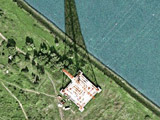
This is, wait for it… the World’s Tallest Electricity Pylon for Single Phase AC Powerline – which forms part of the Bremen-Industriehafen Weser Powerline Crossing, Bremen, Germany.

There are actually four of these 111 m tall pylons, carrying two parallel sets of single phase AC powerline across the Elbe, and all four look to be painted a lovely stripe of white and International Orange (a colour often used to help people avoid flying planes into tall things).

Especially for dr.R. and cookie monster.

Talk Like a Pirate Day 2008

Posted by James Turnbull, Friday, 19th September 2008

1 Star2 Stars3 Stars4 Stars5 Stars

Avast Ye! ‘Tis only turned ou’ t’ be International Talk Like a Pirate Day again! Arr! We got a bucketload o’ Street View sights for you scurvy dogs, gar!

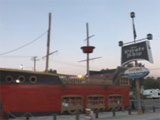
This pirate’s ship gone an been turned int’ a landlubber’s restaurant – Ye should walk t’ plank for this sin! Gaaar!

Har be some scallywag buccaneers guardin’ a shop full o’ tourist tat, they should be sent t’ Davy Jones’ locker!

Aar, this be more like it – a giant jug o’ grog! And ‘t be a stripper bar! Shiver me timbers!

Yaar, also ye can see Talk Like A Pirate Day 2007.

I be thanking Virtual Seatrotting! Yaaaaar.