Brick Train

Posted by Alex Turnbull, Friday, 12th September 2008

1 Star2 Stars3 Stars4 Stars5 Stars

Is it a giant turd? Is it Superman? No, it’s a train! Made entirely from bricks!

See, seriously. A train made from bricks, and all in the name of art apparently.

The brainchild of sculptor David Mach, the brick train cost around £760,000, contains 185,000 bricks and took 34 brickies a total of 21 weeks to build. Modeled on the 1938 record-setting “Mallard” steam train, the art work is presumably supposed to pay some sort of homage to Darlington’s rich railway heritage, but nevertheless caused controversy when it was unveiled in 1997.

Would any of you keen sightseers like to comment about what you think the artist was on, er… I mean, what the artist’s intentions were, when he decided to make this?

Here’s some more info, and a ground-level photo.

Thanks to Alex McGlashan.

Live Long and Prosper

Posted by Rob, Thursday, 11th September 2008

1 Star2 Stars3 Stars4 Stars5 Stars

This weekend, I was lucky enough to see the only flying Avro Vulcan in existence, yet Murphy’s Law dictated that my camera should under no circumstances work. So, whilst this post was to be interjected with marvelous self-made photography, it will instead attempt to use the imagery that Google provides.

Thankfully, you have been gamely notifying us of all the Vulcans you could find, and we have built up quite a collection. There are currently less than 20 survivors, mostly in the UK.

Firstly, at Southend Airport, the Avro XL426 was the 44th of the 88 delta-wing bombers that were built, and this one entered service in August, 1962.

Since 1986, this model has been taken under the wing of the Vulcan Restoration Trust, who dutifully care for the old bird, and occasionally taxi her up and down the runway to stretch her legs. According to submitter Mark, the best view is to be had from the train line that runs right beside the airport.

The XM603 sits rather forlorn at Woodford Airfield, near Manchester, the once gleaming paint tinting to a lifeless green hune.

Information on this one seems difficult to come by, but message board chatter from 2006 suggested that the relic was to be broken down to parts. In fact, her death only served to make others stronger, including the XH558! This photograph shows her final resting place.

Once the United Kingdom’s main deterrant against Cold War threat, armed with nuclear and, presumably, nerve pinch weaponry, the XL391 stands guard at Blackpool airport1.

It was bought in 2004 on eBay for £15,102, but when the buyer realised he would have to pay another £20,000 to move it anywhere, they abandoned it where it was, sniff, scrapped in 2006.

If you live in the United States, there is one at Castle Air Museum in California, a roofed one at the Air and Space Museum in Nebraska2 and finally one snuggled up next to a B-52 at Barksdale AFB, which also shows just how deceptively huge they are:

If you want to see the Vulcan flying, and happen to live near an airshow, there’s still a chance this year!

Thanks: Eddy Rhead, Adam Sadler, Steve Wrona, Tim and Mark


  1. Sharp readers may remember this mentioned when we visited Blackpool airport earlier this year, as it played host to the Red Arrows air acrobatic team. 

  2. Another blast from the past, this is the home of the infamous “YOU, AMERICA MAKE PROUD!” motto. 

Denge’s Concrete Ears

Posted by James Turnbull, Wednesday, 10th September 2008

1 Star2 Stars3 Stars4 Stars5 Stars

Way back in the 1910s and 20s, before radar had become a useful technology, Britain needed a way to try and detect incoming enemy aircraft. The solution was to build enormous concrete “listening ears” around the south coast of Britain, whose purpose was literally to “hear further”.

The most famous examples of these “acoustic mirrors” are the three at the former Royal Air Force base of Denge. The largest is more-or-less just a 60 m long curved wall.

The smaller two mirrors however, more closely resemble large satellite dishes on pedestals.

Believe it or not, the “listening ears” did actually work, although they were rather prone to error, due to it being difficult to hear the difference between incoming aircraft and passing boats.

As aircraft got faster, using the dishes as a warning system became much less practical, and when radar eventually matured, the huge listening ears were permanently discontinued.

Lots more information and ground level pictures on Andrew’s sound mirror page.

Thanks to jono.

Offensive Ponds

Posted by Alex Turnbull, Tuesday, 9th September 2008

1 Star2 Stars3 Stars4 Stars5 Stars

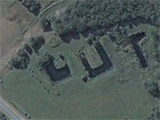
Is that… the word “SLUT” carved into the ground of Nova Scotia?

On closer examination it becomes clear that the “S” is actually a tree shadow – but the remaining letters look to be formed by the shapes of three small ponds.

Since “LUT” doesn’t make a lot of sense, what if the “L” were actually a “C”? Why on Earth would anyone have built three ponds in the shape of the letters of the word “CUT”?

Thanks to hfx_chris.

Island Week Image Update

Posted by Alex Turnbull, Monday, 8th September 2008

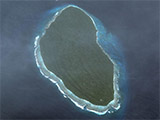
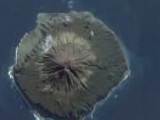
Last week was our our third annual Island Week, and we had another fascinating week! This year even more of you than ever sent in brilliant islands for us, most of which we simply didn’t have time to post.1 Here’s the full roundup of what we did:

Apparently the guys over at Google enjoyed Island Week too – as they chose today to provide us with a huge collection of brand new imagery – meaning we’ll have lots of new things to see during next year’s Island Week.

Frank at the Google Earth blog is posting an ongoing roundup of the new imagery as it’s discovered, but so far updates have been found in the following countries:

Australia, Canada, Czech Republic, France, Greece and the Greek Islands, Italy, Japan, Laos, Mexico, Phillipines, Portugal, Slovakia, Spain, Switzerland, Thailand, Turkey, US, Vietnam

Updates are visible in Google Earth only so far, but will be visible in Google Maps within the next few days, whereupon you’ll have no excuse not to be the one who makes the next big Google Earth discovery… Now go! Fame awaits!


  1. If you’d like to help us clear our backlog of submissions, why not apply to become a Google Sightseeing staff writer? We’d love to welcome some new faces aboard, as it means more posts for everyone!