Museum of Islamic Arts, Doha

Posted by Ian Brown, Friday, 19th December 2008

1 Star2 Stars3 Stars4 Stars5 Stars

Recently opened in Doha, Qatar, is the spectacular Museum of Islamic Arts.

Designed by renowned architect I.M. Pei, this museum cost $300million to construct and is home to a large collection of priceless artifacts funded by the Qatar royal family. While construction was completed on schedule in 2006, delays to the interior displays meant the opening was put off until December 1, 2008.

After seeking inspiration at significant Islamic buildings around the world, Pei requested that the museum be located on a new artificial island in Doha Bay, to ensure that it would not be crowded or overshadowed by any future construction in this booming emirate.

Reviews are mixed, with the Independent positively gushing (follow the ‘more pictures’ link for excellent images), while the International Herald Tribune’s writers were of mixed opinion. One describes it as exquisite, while another was less thrilled, finding many flaws in the building and displays (more wonderful images in the multimedia section). Contract Magazine describes the architectural features and also has a good gallery.

Santa Claus, Indiana

Posted by Ian Brown, Thursday, 18th December 2008

1 Star2 Stars3 Stars4 Stars5 Stars

Like the rest of the world at the moment, it’s obvious that the 2200 residents of Santa Claus, Indiana, are totally immersed in the Christmas spirit.

Originally named Santa Fe, the town had to change its name in 1856 when it applied for a post office only to discover that there was already another town with that name in the state. Wanting to keep the first part of the name, Santa Claus was the only thing the citizens could think of, though this history has since been embellished with tales of small children, snowy evenings and sleigh bells.

The town exploits its name as much as possible, with streets (Mistletoe Drive, Candy Cane Lane, not to mention a road for each of the reindeer), lakes (Christmas, Holly and Noel) and entire subdivisions (Christmas Lake Village, Holiday Village) following the theme.

Holiday World is North America’s oldest themed amusement park, having opened in 1946 as Santa Claus Land. The name now reflects the move to celebrate holidays (and attract visitors) throughout the year. The park includes numerous rollercoasters and other rides, as well as the Splashin’ Safari waterpark, with the world’s largest enclosed water slide.

The post office mentioned earlier (which is now located in a small mall, complete with Santa outside) came to notice in 1914 when the postmaster James Martin started to answer letters addressed to Santa Claus. Today, a team of volunteers respond to around 10,000 letters sent to Santa Claus from children around the world. The Santa Claus Museum is a couple of doors down.

Daisen-Kofun

Posted by Ian Brown, Tuesday, 16th December 2008

1 Star2 Stars3 Stars4 Stars5 Stars

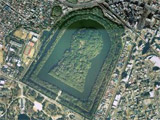
Nestled in the bustling city of Osaka lie many kofun – keyhole shaped and mounded tombs or tumuli – the largest of which is Daisen-Kofun.

Daisen-Kofun is the resting place of Emperor Nintoku who ruled Japan in the early 5th century, with this kofun dated to 443AD. At 486m long and 305m wide, it is considerably larger than the Great Pyramid of Giza in Egypt. Protected by 3 moats and rows of trees, it is a silent enclave invisible from nearby roads, as Street View shows.

The 740 officially-designated Royal kofun are strictly protected against most excavation, but past research has shown that Emperors and other royals were buried with mirrors, swords, clay pots and other goods. It is believed that the tombs were originally covered with stones, but time and nature have provided a covering of trees.

There are several other kofun visible in the area surrounding Daisen-Kofun.

Estimates of the total number of kofun range from 10,000 – 30,000, with construction taking place between the 3rd and 7th centuries AD. In addition to keyhole-shaped kofun, researchers have discovered many round and square tombs, as well as a few octagonal ones. Similar tombs are also found in Korea.

Clusters of kofun are visible in several locations throughout Japan, including Nara City which does have a reasonable Street View.

To learn more, I encourage you to read this detailed history of the Kofun period.

Thanks to Matt Van Pelt, Norimasa Hayashida, Nao and Tetsuo Tanno.

Orapa & Letlhakane Diamond Mines, Botswana

Posted by Ian Brown, Monday, 15th December 2008

1 Star2 Stars3 Stars4 Stars5 Stars

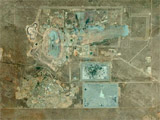
For our first post from Botswana, let’s visit the communities of Orapa and Letlhakane, home to some of the largest diamond mines in the world.

While we’ve seen a “world’s largest diamond mine” before, it is no-longer in use. Wikipedia explains that Orapa is currently the largest open cast mine by area. Each year, this joint venture between De Beers and the Botswana government (Debswana) produces 20 million tons of ore and 40 million tons of waste rock. The ore yields about 18 million carats of diamonds and $1billion in revenue!

The town which has grown up very near the mine has schools, hospitals, a game park and an airport, all operated by Debswana to serve the population which has expanded rapidly in recent years.

It also has fences – the entire community is surrounded by a network of defenses against anybody tempted to try to steal diamonds … which actually make Orapa a very safe place to live! I can only guess that the squares visible are fences with roads patrolled by security.

The processing facilities at Orapa also handle ore from other Debswana mines, including the one at nearby Letlhakane, which is quite spectacular in appearance, though much smaller – it produces only about 1 million carats each year.

The community of Letlhakane is some distance from the mine, and not inside its square fences, so may not enjoy the same level of security.

Thanks to Nonprophet.

Complicated borders

Posted by Alex Turnbull, Friday, 12th December 2008

1 Star2 Stars3 Stars4 Stars5 Stars

Here’s a fairly long train travelling through an icy Moldova, eastern Europe. A train is hardly an uncommon sight on Google Earth – but this particular train will travel from one side of Moldova all the way to the other in an incredible two minutes flat.

The train has just left neighbouring Romania and is passing through Moldova on its way to Ukraine… but as you may have guessed by now, this train passes through Moldova at the exact point where the three countries meet. If the train had been just a little longer, it could have actually straddled all three countries at the same time!

Elsewhere in Europe, we find the Belgian town of Baarle-Hertog – which is in the Netherlands.

Baarle-Hertog is made up of twenty separate Belgian exclaves in the Netherlands, and three other pieces on the Dutch-Belgian border. Even more confusingly, there are also seven Dutch exclaves within the Belgian exclaves!

The Dutch parts of the town are called Baarle-Nassau, and the border is so complicated that there are some houses that are divided between the two countries. Allegedly there was once a Dutch law which required restaurants to close earlier than those in Belgium, which for some restaurants simply meant that the clients had to move tables to the Belgian side.

Read more about Moldova, Baarle-Hertog and Baarle-Nassau at Wikipedia. BLDG blog also has an excellent article about Baarle-Hertog.

Thanks to Eric Hagerman and Nev Stokes.