World’s Longest Staircase

Posted by Ian Brown, Friday, 30th January 2009

1 Star2 Stars3 Stars4 Stars5 Stars

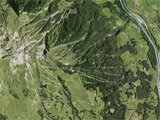
The longest staircase in the world can be found on the slopes of Mount Niesen in the Swiss Alps.

The 11,674 steps run alongside the Niesenbahn funicular which travels from the side of the Kander river in Mülenen (altitude 693m) to the terminus near the 2362m summit of Mount Niesen.

During the 28 minute ride, the funicular - which opened in 1910 - travels through lush Alpine woods, passes through several tunnels and across some elevated sections.

While the staircase is only used by service personnel, it is opened to 200 people for one day a year for the Niesenlauf stair run. The Galerien pages of the race’s German site give you some idea of what an ordeal this must be - running through cloud, rain or even snow, though the race takes place in June.

The record for the event is 1h2m for men and 1h9m for women, which I find remarkably fast considering the number of steps is equivalent to climbing the CN Tower 4.5 times, or Taipei 101 almost 6 times or the Empire State Building more than 7 times, though it does look like some sections are somewhat less steep than others.

There appears to be a more conventional hiking trail for public use, with the number of switchbacks along the way giving some sense of how steep this pyramid-shaped mountain really is.

The mountain’s visitor guide has some great pictures and information, and YouTube has a fast-forward trip up the funicular and a high-speed stroll to the summit.

World’s Largest Cowboy Boots & Hat

Posted by Ian Brown, Thursday, 29th January 2009

1 Star2 Stars3 Stars4 Stars5 Stars

There are a few contenders for the World’s Largest Cowboy Boots. The best claim perhaps belongs to this pair, which stands 12m tall, outside the North Star Mall in San Antonio, Texas. Tall as they are, they’re barely visible from above, but thankfully the Street View car drove right by.

And they make quite the sight when decorated for Christmas!

A solitary boot of almost the same height can be found in Edmonton, Alberta. Also hard to pick out on the satellite image, Live Maps’ birds eye view is somewhat better.

It’s about 30cm shorter than the pair in San Antonio, but is equally impressive when lit up!

Meanwhile, a 6.5m pair of boots - along with a 13m wide steel cowboy hat - can be found in Oxbow Park in Seattle, Washington … and on Street View and Live Maps.

These structures were relocated from their original gas station location, where the boots contained the bathrooms!

Another location with a larger-than-life cowboy hat is the mini-replica of the Eiffel Tower in Paris, Texas, barely visible from the nearest Street View image:

The hat was added in 1998 in an effort to one-up the residents of Paris, Tennessee after several back-and-forth attempts to create the largest replica.

And in Yukon, Oklahoma, a beautifully landscaped boot can be found in Chisholm Trail Park - named for the route of a 19th century cattle drive between Texas and Kansas. The decorative landscaping, including fountains in the two small ponds, is even more visible on Live Maps’ birds eye view.

Thanks to ‘Koty’, Ray, . and Felippo.

Weirdness on the Ocean Floor

Posted by James Turnbull, Wednesday, 28th January 2009

1 Star2 Stars3 Stars4 Stars5 Stars

There’s some odd sightings on the ocean floor, thanks to the much-improved ocean surface depth images that were added to Google Earth and Maps last week!

Reader aliosha was browsing the atlantic and discovered a bizarre grid pattern in the deep.

About 150 km square, it presumably isn’t a natural occurrence, but what else could create such a pattern it what must be extremely-deep water?

Even more bizarre, off the coast of Indonesia is what would easily be the largest writing on the planet. At around 130 km wide, it would dwarf second place by a factor of about 30x.

Unfortunately, it is only the largest writing on Google Earth, as this message doesn’t actually exist.

It says “DTS/SIO”, and was added by David T. Sandwell (DTS), a professor of geophysics at the Scripps Institution of Oceanography (SIO).

The sea bed imagery comes from a variety of bathymetry sources, including the SIO, and Mr Sandwell added the false underwater canyons so that they could see where the SIO’s data was being used.

Thanks to aliosha and GEarth Blog (who also have news of a special event Google are hosting next week in relation to oceans on Google Earth).

The Best Job in the World

Posted by Alex Turnbull, Tuesday, 27th January 2009

1 Star2 Stars3 Stars4 Stars5 Stars

Yesterday1 was Australia Day, when each January 26th, Australians crack open some beers and toss another shrimp on the barbie to celebrate their arrival on the world’s smallest continent all the way back in 1788.

Australia has many wonderful things to celebrate, not least in being the location for the claimed best job in the world, which is a post that requires the successful applicant to take up residence on the tropical Hamilton Island, off the Queensland coast.

The job was offered a couple of weeks ago and the story quickly spread round the entire web2, as it promises the winning applicant the role of “caretaker” - which basically amounts to a bit of blogging, feeding some fish, and collecting the island’s mail. No formal qualifications are required, but candidates must be willing to swim, snorkel, dive and sail.

For completing these duties, (which amount to 12 hours a month of actual “work”), the successful applicant will receive a salary of A$150,000 ($103,000, £70,000) for six months, and get to live rent-free in a three-bedroom villa, complete with pool.

It turns out that Hamilton Island is a lot more densely populated3 than the promotional materials would have you believe - meaning that we weren’t able to determine which is the actual villa where the successful applicant will reside - but there’s loads of nice ones to choose from. Infinity pool anyone?

Hamilton Island is the second largest inhabited island of the Whitsunday Islands, and is in fact dedicated almost exclusively to tourism. Anybody fancy some go-karting?

There’s lots of other islands to explore here, including Dent Island where they’re building a golf course, or Whitsunday Island, where on Whitehaven beach we find a couple of seaplanes, a beach party and… is that a helicopter?

Also worth mentioning is Hayman Island, which is home to a resort built by Reg Ansett, which features its own harbor and several helipads. Of course, there are at least 3 swimming pools and even a recursive pool-in-a-pool (on an island).

If you’re thinking that the Whitsunday Islands might be a good place to spend a few months, then you’ve got until the 22nd of February to apply.

Thanks to our Austrian (no, I’ve not misspelled that) correspondent, Al Cohole.


  1. Or today (just), depending on your time zone

  2. Of course it’s all just an enormously successful PR stunt, designed to promote tourism in Queensland, but the organisers insist the job itself is for real. 

  3. Can anyone work out what’s going on here

The Very Large Array

Posted by Ian Brown, Monday, 26th January 2009

1 Star2 Stars3 Stars4 Stars5 Stars

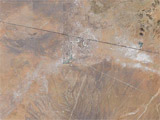
Sprawled across the Plains of San Augustin in New Mexico is the Very Large Array - a Y-shaped radio astronomy observatory made up of 27 independent dish antennas.

The scale of the VLA operation is quite remarkable- each dish is 25m across and weighs 209 tonnes. They travel on train tracks which make up each of the three 21km arms of the array. A specially designed locomotive maneuvers the antennas into different configurations for specific observations.

The 27 antennas effectively provide the imaging capability of an antenna 36km wide, with the sensitivity of a dish 130m across. This allows the study of the sun, planets, black holes, pulsars, quasars and myriad other astronomical objects.

Construction was started in 1973 and completed - $78.5million later - in 1980. Currently, new hardware is being installed to improve the capabilites of the observatory - making it the Expanded Very Large Array, and funding is sought to add further dishes across the state to expand the system even further.

The VLA has featured in several movies including Contact, Independence Day and 2010: Odyssey Two.

It was apparently a location of interest for the driver of the Street View Car. Not content to pass by on Highway 60, which crosses the tracks, but without a good view of any dishes

… a detour was taken down Old Highway 60, past a great view of many dishes, to the point where it reaches the tracks directly beneath one of the dishes.

Google Sightseeing has covered all sorts of telescopes in the past, some of which have received great image updates since they were first posted.

Thanks to the many readers who suggested this one: james v, Stilt, Tim, Matt, Jonathan Hoppe, Benjamin, Benjamin, Doug Hershberger, Jarrod Lombardo, Leandro Garcia, Glenn, Trevor, Derek and Yablo.