Search Results for 'calatrava'

Calatrava’s Buildings

Posted by Ian Brown, Wednesday, 11th November 2009

1 Star2 Stars3 Stars4 Stars5 Stars

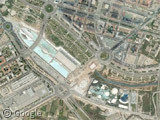
Continuing our exploration of the work of Santiago Calatrava, we visit some of his more notable buildings, beginning with an in-depth look at the magnificent Ciutat de les Arts i les Ciències – the City of Arts and Sciences in his home town of Valencia.

CAC

With construction ongoing since 1996, the complex consists of five main areas, of which one (L’Oceanogràfic aquarium) was designed by a different architect.

The Palau de les Arts Reina Sofia contains 4 performance halls for music, theatre and opera in a building that many would consider designed for inter-galactic travel.

CAC CAC

Resembling an immense eye to represent visual arts, L’Hemisfèric houses an IMAX theatre, planetarium and Laserium.

CAC CAC

Rising behind is the skeletal form of El Museu de les Ciències Príncipe Felipe, a hands-on science museum.

CAC CAC

Bordering the decorative pools is L’Umbracle, a landscaped park and sculpture gallery under a network of white arches.

CAC CAC

Calatrava’s contributions also include a bridge and central plaza, both of which are currently under construction. However, apartment buildings that were supposed to have been developed in the area have been put on hold for financial reasons.

The forms seen above are reflected in two important buildings on the Atlantic island of Tenerife. The Auditorio de Tenerife on the waterfront of Santa Cruz features a 1600-seat main hall with a pipe organ and a smaller chamber hall, all contained within one of the most amazingly-shaped buildings ever seen.

Tenerife caltravra

Also in Santa Cruz, the Tenerife International Centre for Trade Fairs and Congresses features 40,000 square metres of exhibition and meeting space. Thanks to this week’s Street View update, we can also now see it from ground-level.

Tenerife

Another waterfront building can be found by Lake Michigan in the form of the Milwaukee Art Museum which was the first of Calatrava’s projects to be completed in the US. The museum’s main feature is a movable sunshade which can retract in poor weather and at night; it also has a signature cable-stayed bridge.

MAM MAM

As with his bridges, not all of Calatrava’s buildings have been popular. The visually stunning Gare do Oriente train station in Lisbon has been criticised for cutting off the city centre from the river, and for not protecting waiting passengers from the elements.

Lisbon

Thanks to the many people who suggested the CAC … paco, Eduardo R. de Lima, Stolz, Arrianus, Carlos Urena, javier, Simone, antonio waller, Sebas Font, Trompie, Michael Zacherl, Pablo, andysamp, Ximet, Andros and Martin.

Calatrava’s Bridges

Posted by Ian Brown, Monday, 2nd November 2009

1 Star2 Stars3 Stars4 Stars5 Stars

Santiago Calatrava is a renowned Spanish architect whose work we’ve admired in the past on Google Sightseeing. We’re going to take a more in-depth look at his innovative work in two areas, beginning today with bridges.

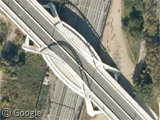
One of Calatrava’s earliest bridge commissions helped cement his international reputation for civic engineering, the Bac de Roda bridge in Barcelona. Like the vast majority of his work, the structure is entirely white.

Bridge Bac de Roda Bridge

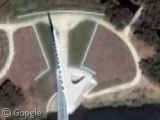
Part of the city’s pre-Olympic development, the bridge incorporates steel cables, a method used in many of Calatrava’s subsequent designs, including the Puente del Alamillo in Seville, which features a 142m tall mast.

Puente del Alamillo Puente del Alamillo

Similar in design to the previously featured Sundial Bridge, the Puente del Alamillo was part of Seville’s preparations for Expo ‘92.

In Buenos Aires the 100m long Puente de la Mujer uses the same technique, but the mast is angled forward rather than backwards. In this case, the mast also supports a section of bridge that pivots through 90 degrees to allow boat traffic to pass, coming to rest at the stabilising pylon visible in the river to the south.

Puente de la Mujer

While Calvatara’s bridges are generally well received and establish themselves as symbols of the communities where they are built, there have been some exceptions. In Bilbao, the Zubizuri has met with opposition on several fronts.

Zubizuri

The Zubizuri’s deck includes glass bricks which apparently break easily and become very slippery in the rain, additionally, the placement of the bridge on the river edge (rather than the elevated city street) made it somewhat impractical to actually use, so the city had to build a connecting walkway – the curved structure to the left of the bridge. Calatrava actually felt this was detrimental to his creation, and amazingly, won €30,000 through his legal action.

Furthermore, Calatrava’s Ponte della Costituzione in Venice – shown as under construction on Google Maps, but actually completed a year ago – has also met with controversy for being too expensive, inaccessible to anyone unable to traverse its many steps, and for being too close to one of the city’s classic bridges across the Grand Canal.

Venice Bridge

Named for one of Dublin’s most famous writers1, the James Joyce bridge has had a better reception from locals, perhaps because the design mirrors many of the other arched bridges across the Liffey. However like the Zubizuri, the James Joyce has a glass block walkway2 – though it’s possible that the frosted finish to the glass makes it safer to traverse in Irish weather!

James Joyce Bridge

Another of Calatrava’s bridges, named for another writer – Samuel Beckett – is under construction further east. It will be a swing bridge very similar to Puente de la Mujer.

Finally, the spectacular Chords Bridge in Jerusalem is one of Calatrava’s more notable recent bridge designs, but unfortunately it’s not yet visible on Google Maps.

The second part of this examination of Calatrava’s work looks at some of his most famous and notable buildings.

Thanks to Redder Zooming.


  1. The house facing the south end of the bridge was the location for Joyce’s story The Dead

  2. Which is illuminated at night

Torqued Towers

Posted by Alex Turnbull, Wednesday, 20th May 2009

1 Star2 Stars3 Stars4 Stars5 Stars

This is the Turning Torso tower in Malmö, which at 190 metres is Sweden’s tallest skyscraper. The most striking thing about this tower is that it appears to be twisted around its axis. It has nine segments of five-story pentagons that are offset from one another, meaning that the topmost segment is set at ninety degrees to the ground floor.

The Turning Torso was designed by world famous Spanish architect, Santiago Calatrava (some of whose work we’ve featured in the past), and represents part of a growing trend for elaborately warped and twisted “torqued towers“.

In San Francisco’s Golden Gate Park the new M.H. De Young Museum was completed in October 2005 – replacing the original building that had been damaged in an earthquake. To prevent damage to the new building, it can move almost a metre thanks to a system of sliding plates and fluid dampers. It’s also entirely clad in copper, which will eventually oxidize, taking on a green colour reflective of the surrounding vegetation.

From many places around the park, the most striking feature of the building is the 44 metre Hamon Tower, the impressive twist of which can be clearly seen from both an aerial and ground-level point of view.

Tower designers aren’t just rotating their towers either – although still under construction in Google’s images, the China Central Television Headquarters building was completed in December 2008, and its design almost defies belief. Especially when you consider that this area is also prone to earthquakes!

Technically the CCTV building isn’t a traditional tower, but rather a “continuous loop of six horizontal and vertical sections covering 381,000 square metres of floor space”. This is probably best summed up by the building’s local nickname – “Big Shorts”.

There are several other torqued towers around the world that are either in planning, or already under construction. However I wonder how many of them will be delayed or cancelled due to the current economic climate?

  • 1 World Trade Center, New York City, (formerly known as the Freedom Tower), will have a roof set at 45° from the bottom.
  • The Infinity Tower, Dubai, will feature a 90° twist like the Turning Torso, but will be nearly twice the height.
  • The Chicago Spire, Chicago, also designed by Santiago Calatrava, will be 160 metres taller than the Sears Tower.
  • The Burj al-Taqa, Dubai, will feature a twisted hyperboloid design, and will generate all its own energy.

Finally, check out the totally insane Signature Towers and equally ludicrous Dubai Towers Dubai which are both planned for construction in Dubai.

See the amazing skyscraperpage.com for more jaw dropping future skyscrapers.

Thanks to stephan and Vectoor.

The Sundial Bridge

Posted by James Turnbull, Tuesday, 23rd October 2007

1 Star2 Stars3 Stars4 Stars5 Stars

Crossing the Sacramento River in Redding, California is the sundial bridge which (as you might have guessed) serves the dual purpose of being both a bridge and a sundial!

I previously tried to use North America’s largest sundial to tell the time on Google Earth, which was much more effort than I’d anticipated, and not an exercise I’m keen to repeat.

However, according to “Sundial 101“, telling the time on the sundial bridge should be easier, as “the base plate is titled at an angle equal to the latitude, and the style is perpendicular to the base, which will align it with the earth’s axis”.

Which apparently means that the time can be simply read from the equally spaced markers to the North of the bridge. Each marker represents an hour from 10am until 3pm (I guess that outside these times you’ll just have to look at your watch).

Therefore, I’d say that this photograph was taken at approximately 11.30am!

The sundial bridge was designed by renowned Spanish architect Santiago Calatrava whose work always looks great from above. We’ve previously featured his Saint-Exupéry TGV Terminal and Montjuic Communications Tower. Calatrava’s design for the World Trade Center Transportation Hub in NYC is currently under construction and is expected to be completed by 2008.

More info on the bridge from Tutle Bay Exploration Park and CNet News and you may also enjoy Felippo’s extensive sundial collection.

Thanks to otiica on the Google Earth forum & Anthony Ochoa

Saint-Exupéry TGV Terminal

Posted by Alex Turnbull, Saturday, 17th June 2006

1 Star2 Stars3 Stars4 Stars5 Stars

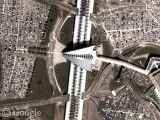
Following up on a comment in Alex’s TGV post back in October, I present Saint-Exupéry International Airport in Lyon and more specifically the TGV terminal . The airport was built in 1975 but the TGV terminal with its stunning roof was an addition in 1994. The terminal was designed by AIA 2005 Gold Medal winner Spanish architect Santiago Calatrava. From ground level shots it almost looks like an organic form that has grown out of the ground.

The airport is named after Antoine de Saint-Exupéry. Antione was a pilot who flew in the early days of flight and became a highly decorated pilot in WW2. In 1943 he wrote the now world famous children’s book The Little Prince which is still a best seller today, especially for young children learning French. Aged 44 Antoinne flew his last mission to collect information on German troop movements over the Rhone valley. He took off the night of July 31st 1944, and was never seen again.

Saint-Exupéry TGV Terminal in Lyon

Thanks: Eric C. Ubersax, Konstantin, Markus, Brice Favre, zmaster (the original comment poster) & Jonathan Rawle (who then submitted it)