Before and After: Greensburg, Kansas

Posted by Chris Hannigan, Friday, 13th November 2009

1 Star2 Stars3 Stars4 Stars5 Stars

If you ever need reminded of just how powerful Mother Nature can be, look no further than the city of Greensburg, Kansas.

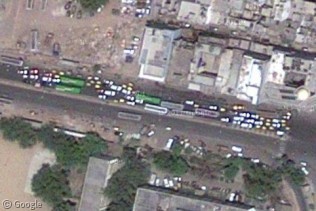
A small community in the heart of the United States, Greensburg has had its share of severe conditions over the years. Now, thanks to the differing image capture dates, we’re able to see a dramatic before and after comparison of the most extreme weather to hit the town in its history.

The aerial view of the city shows a community very similar to many other towns scattered across the Kansas countryside. Switching to street view however is an entirely different story. On May 4, 2007, over 95 percent of the city was destroyed when a 2.7 km (1.7 mile) wide EF5 tornado1 ripped through town. The National Weather Service recorded 330km/h (220mph) winds during the storm, which sadly killed 11 people.2

Driving around town in the virtual street car, it’s hard to find a single thing built before the tornado that remains standing today. Most of the structures visible in street view, including the water tower, were subsequently rebuilt.

Greensburg is home to the world’s largest hand dug well, which is 33 m (109 ft) deep and nearly 10 metres (32 ft) across.3 Known as the “Big Well”, its associated museum was completely destroyed by the winds, but a 450 kg meteorite stored in the museum survived, and was found a few days later in amongst the rubble4.

Greensburg today is rebuilding as a “green” town. Reconstruction is being accomplished with ecologically-sound building supplies. A new factory is being built near town to manufacture ultra-green modular homes, and the city will be breaking ground on a facility for four 2.5-MW wind turbines to handle all their power needs. Maybe the city’s name is a coincidence, but Greensburg may soon be the greenest town in America.

Information about the Greensburg tornado can be found on Wikipedia, and you can read about Greensburg’s rebuilding effort on their website.


  1. The tornado was the first EF5 recorded after the Enhanced Fujita Scale was introduced in 2007. 

  2. However thousands of people were saved by the 20-minute warning given by the town’s severe-weather sirens. 

  3. In fact only the Pozzo di S. Patrizio in Italy is larger. 

  4. Even 330 km/h winds can’t blow away a 450 kg rock! 

The World’s Most Haunted Sites

Posted by Chris Hannigan, Friday, 30th October 2009

1 Star2 Stars3 Stars4 Stars5 Stars

Want to see a ghost? Not scared of the dark? We’ve got a list of 5 of the most haunted destinations in the world for you to visit1. Bring a flashlight and let’s get started…

Many places can claim to be haunted, but on every list you find a certain few that keep popping up. The Myrtles Plantation in St. Francisville, LA USA is one of these places, and is considered one of the most haunted locations in the United States. Built in 1794, the property is said to be the site of up to 10 different murders, and home of 12 resident ghosts. Visitors claim to hear footsteps going up and down the halls, see ghostly children running around the property, and even talk with the ghosts of slaves who ask about chores. Want to visit? Go ahead and book a room because it’s currently a thriving bed and breakfast.

Our second stop isn’t actually a specific location, but an entire country. With the rise of paranormal television shows and magazines, Singapore is quickly becoming known as a hotbed of activity for wannabe ghost hunters. Throughout the city there are numerous ghostly stories to be told. One location is said to be haunted by an entire family that committed suicide together. Another home in Changi Beach apparently is haunted by a ghost that likes to slap house guests across the face! It gets worse though… at the Bedok Tenant House, supposedly a ghost actually killed a woman. The victim went on to become a screaming ghost herself! Maybe that’s all just a bit to scary and you should just stay in the city. Well be careful when travelling on the subway, apparently there are headless ghosts that run through stations terrorising passengers!

Stop number three takes us to England and the infamous Tower of London. GSS visited the tower back in 2005, and the street view update has now given us the ground level perspective. The tower was built way back in the year 1078, so you know there are some creepy stories to be told. Guests claim to see numerous shadows replaying the violent murder of the Countess of Salisbury. She tried to run from her scheduled execution back in 1541, but was chased and then axed to death by her executioner. Others claim to see more legendary ghosts like the beheaded Ann Boleyn. She’s often seen by guests carrying her head in her hands around the property.

Back in the United States, the retired Queen Mary is often called the most haunted ship in the world. Now permanently docked in Long Beach as a hotel, this once luxury ocean liner has been the set for numerous movies and ghost hunting television programs from both the US and the UK. Visitors report being touched by invisible fingers in their room, hear banging and movements from throughout the ship, and even claim to hear a soldier calling for help from the engine room. Strangely enough, it just so happens that a soldier was crushed to death in there back in 1966.

Our last stop takes us to Scotland and to perhaps, the most haunted structure in the world. The site of the Edinburgh Castle has been occupied by man since the late Bronze Age, and the current castle has been dated back to 12th century. The structure sits atop a volcanic rock 80 meters high, with the steep cliff faces surrounding it visible from the street view car. Visitor’s stories range from tales of wandering war prisoners, headless drummers, and ghostly dogs. Some even claim to hear the tunes of a long-dead piper player coming from the castle’s ancient tunnels. Story goes that the piper discovered the tunnels a few hundred years ago, and was playing his tune so that people on the surface could hear him and map his progress. Well at one point the tunes stopped, and the piper was never found. Over two thousand years of history certainly mean the next time you visit the castle and its dungeons, you’re surely not to be alone.

Be sure to check Google for some more great ghost stories at each of these locations. Wikipedia offers great historical information on the Tower of London and Edinburgh Castle. If you’re brave enough, spend the night by booking a room at either the Queen Mary or Myrtle’s Plantation.

Special thanks goes out to Greg, Sergio, Will, Mike, Gareth, Jeff, Kate, Dave, Michele, Ron, Max, James, Ned, Robert, Terry, Boris, Benjamin, Matt, Paul, 7up7, Steve, and Larry for the suggestions and links!


  1. Not a top 5 list, just 5 worthy of a mention. 

Ghost Town: Prypiat, Ukraine

Posted by Chris Hannigan, Wednesday, 21st October 2009

1 Star2 Stars3 Stars4 Stars5 Stars

New writer: Chris Hannigan Chris is from Savannah, Georgia, USA where he works as a computer lab instructor for a major aerospace company. Previously employed by an airline, Chris has flown to many places around the world and continues to travel with his family today.

This post is part of an occasional series where we visit some of the world’s most interesting abandoned places.

On April 26, 1986, reactor number four at Chernobyl Nuclear Power Plant exploded, resulting in the worst nuclear disaster in history. The explosion itself killed 56 people, but the accident caused four hundred times more fallout than the atomic bombing of Hiroshima; the full consequences of which have yet to be realised.

GSS have visited Chernobyl twice before, but this article will discuss the city of Prypiat, Ukraine, which was home to a population of over 50,000 residents before the accident, and which today is merely a ghost town.

The city sits right in the middle of a 30km exclusion zone around the plant. Trees and weeds have grown over most of the streets and buildings, but remarkably much of the town is still intact. Schools1, parks, a stadium, and even a ferris wheel can still be seen today.

On the day following the explosion, government workers ordered the residents to evacuate. Many families were told they would only be gone for three days, but the evacuation was actually permanent. As a result, many buildings within the town still contain personal belongings that were left behind by their owners. Items such as TVs, furniture, children’s toys, and clothing can be seen inside the buildings, left just where they were on the day of the accident.

As a result of the fallout from the explosion, much of the land around the city has been designated “inappropriate for farming or agriculture” for the next 200 years. One area hit especially hard is known as the Red Forest. These woods, just south of Prypiat, turned a deep red colour after the explosion, and slowly the trees began to die as a result of the radiation. Eventually, much of the woods were bulldozed and buried, but they remain one of the most contaminated areas in the world.

Following some of the roads out of the city will lead to the control points that secure the 30 km exclusion zone around the plant. These checkpoints are staffed by guards and police.

Even with all of the potential health hazards of visiting the city today, several Ukrainian companies actually offer guided tours of the area. If you plan on visiting Prypiat yourself, make your way to the nearby town of Chernobyl, another settlement evacuated by the disaster. There, a few apartments, a lodge, and even a hotel exist and are still in use today.

Prypiat and the Chernobyl disaster are of course well documented on Wikipedia.


  1. A 4-story school collapsed in July 2005 due to deterioration.