The world’s largest Russian doll

Posted by Ian Brown, Thursday, 8th January 2009

1 Star2 Stars3 Stars4 Stars5 Stars

Matryoshkas, or Russian dolls, are sets of wooden figures of decreasing sizes placed one inside the other. With a Russian name and a long Russian history, you might be slightly surprised to discover that the world’s largest Russian doll, is in Manzhouli, China.

This 30m high replica Matryoshka was built in 2007 to act as a tourist attraction. It features pictures of Chinese, Mongolian and Russian girls to reflect the ethnicities of the region. The plaza also includes 200 smaller dolls decorated with famous people from around the world.

This Inner Mongolian city is China’s busiest land port of entry, handling 60% of imports and exports to Russia and Eastern Europe, as well as trains between Beijing and Moscow. The huge train yards and station indicate the importance of rail in this region.

The border between the two countries is marked by another impressive plaza, gates and the usual posts of officialdom.

Photos of the doll and other areas of the city can be seen at Panoramio.

Thanks to Micradott.

The Golden Temple, Amritsar

Posted by Ian Brown, Wednesday, 7th January 2009

1 Star2 Stars3 Stars4 Stars5 Stars

In the Indian state of Punjab, Harmandir Sahib (The Temple of God) - commonly known as the Golden Temple - is the most sacred place of worship for the Sikh religion.

In the 1570s the fourth Sikh guru created a pool named Amrit Sarovar - Lake of Immortal Nectar. Over time the city which developed around this area took the shortened name Amritsar. The first temple was completed in 1604 to house the Sikh holy book known as Guru Granth Sahib which in 1708 was named as the perpetual guru of the Sikh faith, ending the human lineage of gurus.

The main temple in the centre of the pool is a blend of Hindu and Islamic architectural styles and is coated with pure gold (estimates vary from 100kg to 750kg!) It has a door on each side to signify that people of all faiths are welcome.

The temple is connected by a causeway to the Akal Takhat, or traditional Sikh Parliament, to which the book is returned every evening and retrieved the following morning, all with great ceremony.

Surrounding the pool are a marble walkway, shrines, museums and offices. There is also accommodation for pilgrims and, to the south-east, a volunteer-run community kitchen and dining hall which provides simple free meals to tens of thousands of visitors every day.

Wikimedia has some excellent pictures.

Thanks to D. Sambhi.

World’s Largest Santa

Posted by Ian Brown, Tuesday, 23rd December 2008

1 Star2 Stars3 Stars4 Stars5 Stars

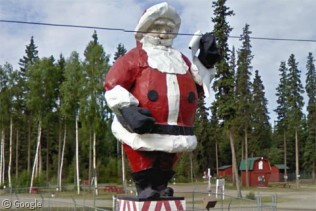
We all know that Santa lives at the North Pole, and the World’s Largest Santa can be found there too… that is, in the city of North Pole, Alaska.

This 12m tall Santa can be found on St Nicholas Drive, outside Santa Claus House. He’s less visible from above, so we’re thankful that the Street View car visited (perhaps to drop off a Christmas wish list … freedom from privacy laws, cheap gas … ?)

While actually 2700km south of the real North Pole, the city takes full advantage of its name, with other streets bearing seasonal titles such as Snowman Lane and Kris Kringle Drive. The streetlights on Santa Claus Lane are made up like candy canes, and the emergency vehicles are painted in Christmas colours.

Thanks to Brandon.

Museum of Islamic Arts, Doha

Posted by Ian Brown, Friday, 19th December 2008

1 Star2 Stars3 Stars4 Stars5 Stars

Recently opened in Doha, Qatar, is the spectacular Museum of Islamic Arts.

Designed by renowned architect I.M. Pei, this museum cost $300million to construct and is home to a large collection of priceless artifacts funded by the Qatar royal family. While construction was completed on schedule in 2006, delays to the interior displays meant the opening was put off until December 1, 2008.

After seeking inspiration at significant Islamic buildings around the world, Pei requested that the museum be located on a new artificial island in Doha Bay, to ensure that it would not be crowded or overshadowed by any future construction in this booming emirate.

Reviews are mixed, with the Independent positively gushing (follow the ‘more pictures’ link for excellent images), while the International Herald Tribune’s writers were of mixed opinion. One describes it as exquisite, while another was less thrilled, finding many flaws in the building and displays (more wonderful images in the multimedia section). Contract Magazine describes the architectural features and also has a good gallery.

Santa Claus, Indiana

Posted by Ian Brown, Thursday, 18th December 2008

1 Star2 Stars3 Stars4 Stars5 Stars

Like the rest of the world at the moment, it’s obvious that the 2200 residents of Santa Claus, Indiana, are totally immersed in the Christmas spirit.

Originally named Santa Fe, the town had to change its name in 1856 when it applied for a post office only to discover that there was already another town with that name in the state. Wanting to keep the first part of the name, Santa Claus was the only thing the citizens could think of, though this history has since been embellished with tales of small children, snowy evenings and sleigh bells.

The town exploits its name as much as possible, with streets (Mistletoe Drive, Candy Cane Lane, not to mention a road for each of the reindeer), lakes (Christmas, Holly and Noel) and entire subdivisions (Christmas Lake Village, Holiday Village) following the theme.

Holiday World is North America’s oldest themed amusement park, having opened in 1946 as Santa Claus Land. The name now reflects the move to celebrate holidays (and attract visitors) throughout the year. The park includes numerous rollercoasters and other rides, as well as the Splashin’ Safari waterpark, with the world’s largest enclosed water slide.

The post office mentioned earlier (which is now located in a small mall, complete with Santa outside) came to notice in 1914 when the postmaster James Martin started to answer letters addressed to Santa Claus. Today, a team of volunteers respond to around 10,000 letters sent to Santa Claus from children around the world. The Santa Claus Museum is a couple of doors down.

Daisen-Kofun

Posted by Ian Brown, Tuesday, 16th December 2008

1 Star2 Stars3 Stars4 Stars5 Stars

Nestled in the bustling city of Osaka lie many kofun - keyhole shaped and mounded tombs or tumuli - the largest of which is Daisen-Kofun.

Daisen-Kofun is the resting place of Emperor Nintoku who ruled Japan in the early 5th century, with this kofun dated to 443AD. At 486m long and 305m wide, it is considerably larger than the Great Pyramid of Giza in Egypt. Protected by 3 moats and rows of trees, it is a silent enclave invisible from nearby roads, as Street View shows.

The 740 officially-designated Royal kofun are strictly protected against most excavation, but past research has shown that Emperors and other royals were buried with mirrors, swords, clay pots and other goods. It is believed that the tombs were originally covered with stones, but time and nature have provided a covering of trees.

There are several other kofun visible in the area surrounding Daisen-Kofun.

Estimates of the total number of kofun range from 10,000 - 30,000, with construction taking place between the 3rd and 7th centuries AD. In addition to keyhole-shaped kofun, researchers have discovered many round and square tombs, as well as a few octagonal ones. Similar tombs are also found in Korea.

Clusters of kofun are visible in several locations throughout Japan, including Nara City which does have a reasonable Street View.

To learn more, I encourage you to read this detailed history of the Kofun period.

Thanks to Matt Van Pelt, Norimasa Hayashida, Nao and Tetsuo Tanno.

Orapa & Letlhakane Diamond Mines, Botswana

Posted by Ian Brown, Monday, 15th December 2008

1 Star2 Stars3 Stars4 Stars5 Stars

For our first post from Botswana, let’s visit the communities of Orapa and Letlhakane, home to some of the largest diamond mines in the world.

While we’ve seen a “world’s largest diamond mine” before, it is no-longer in use. Wikipedia explains that Orapa is currently the largest open cast mine by area. Each year, this joint venture between De Beers and the Botswana government (Debswana) produces 20 million tons of ore and 40 million tons of waste rock. The ore yields about 18 million carats of diamonds and $1billion in revenue!

The town which has grown up very near the mine has schools, hospitals, a game park and an airport, all operated by Debswana to serve the population which has expanded rapidly in recent years.

It also has fences - the entire community is surrounded by a network of defenses against anybody tempted to try to steal diamonds … which actually make Orapa a very safe place to live! I can only guess that the squares visible are fences with roads patrolled by security.

The processing facilities at Orapa also handle ore from other Debswana mines, including the one at nearby Letlhakane, which is quite spectacular in appearance, though much smaller - it produces only about 1 million carats each year.

The community of Letlhakane is some distance from the mine, and not inside its square fences, so may not enjoy the same level of security.

Thanks to Nonprophet.

Tarbela Dam

Posted by Ian Brown, Thursday, 11th December 2008

1 Star2 Stars3 Stars4 Stars5 Stars

Tarbela Dam, found on the Indus River in Northern Pakistan, is the largest earth-filled dam in the world.

The dam was completed in 1976 as the result of a water-rights agreement between India and Pakistan. It is 143m high and almost 3km wide, for a total volume of 106million cubic metres of rocks and earth, making it one of the world’s largest man-made structures.

It holds back a reservoir almost 100km long, though the capacity of the lake has been reduced by silt deposits, just one of many problems encountered by the dam’s builders and operators.

The water is vital to irrigation for farms in the area and power stations at the dam provide a significant portion of Pakistan’s hydro-electric power (caution, vibrant text and background colour!)

Zooming in shows us that it also makes the perfect backdrop for a large religious pronouncement, with Arabic and English text from the Koran reading And HE hath made the rivers for service unto you.

Thanks to Rashid and Syed for pointing us to the first Google Sightseeing entry from Pakistan. This was also our first ‘large type’ from the Koran, though we have had advice to read the Bible and of course, many dams.