The Street View Best Streets Awards

Posted by RobK, Monday, 8th March 2010

1 Star2 Stars3 Stars4 Stars5 Stars

Forget the Oscars – these are the awards that count at Google Sightseeing! The guys at Google are planning to expand their Street View coverage of the UK in the near future, and to get us in the mood they asked the public to vote for their favourite British streets in three categories: the most picturesque, the best for fashion and the best for food.

Now more than 11,000 votes have been counted, and the three Best Streets in Britain have been named. Not all the winners are yet visible on Street View, but rumour has it that Google will be putting that right soon, so watch this space…

Most picturesque street: Shambles, York

Shambles Shambles

It might seem odd that the name of the winner in this category normally describes something that’s a total mess – but “shambles” originally referred to a meat market. This narrow medieval street in York is lined with timber-framed buildings, some of them more than 600 years old, which used to house at least two dozen butchers’ shops. Raw meat would be displayed on shelves outside the shops, and the gutter down the middle of the street would run with blood and offal.

Shambles Shelf

Today, there are no butchers on the Shambles itself (although there is still one on the adjacent Little Shambles) and things are somewhat less gory – chocolate shops and tea rooms are the order of the day.

At number 35, you can see the former home of Margaret Clitherow, who was arrested in 1586 for harbouring Catholic priests, and sentenced to death by “pressing” (being crushed beneath a heavy weight). She was made a saint in 1970 and the house is now a shrine.

Clitherow house

Most picturesque street runner-up: Royal Crescent, Bath

This grand curve of Georgian houses was designed by John Wood the Younger and completed in 1774. There’s no Street View yet, but Wikipedia has a good panorama of the whole street.

Royal Crescent

A couple of interesting bits of trivia about the Royal Crescent: firstly, although the facades of the houses are all uniform, you can see from the aerial view that the design of the houses behind varies widely, as each was built to a different specification for the original buyers. Second, it has been suggested that the crescent, together with the Circus (the circular road just to the east) and streets just to the south were laid out to represent Masonic symbols.

Circus

Most picturesque street runner-up: Grey Street, Newcastle upon Tyne

Another curving Georgian street, this one was built in the 1830s. Although pipped to the top spot in Google’s awards, it headed a list of Britain’s favourite streets as voted by BBC Radio 4 listeners in 2002. (If you’re wondering about the rather drab name, it commemorates Earl Grey – yes, the same man who gave us funny-tasting tea.)

Grey Street Grey Street

Best fashion street: Milsom Street, Bath

Another award for the city of Bath, which is not yet covered by Street View. The buildings here were originally grand town houses, but over time it has become a renowned shopping street, with small boutiques as well as Jolly’s department store, which dates back to the 1830s and is now part of the House of Fraser chain. Find more photos of the area at Geograph.

milsom jollys

Best foodie street: High Street, Stockbridge

The market town of Stockbridge lies in the valley of the River Test, one of Hampshire’s famous trout streams. Its broad high street won the award for its range of pubs, inns, restaurants and specialist food shops1. Again there’s no Street View yet, but you can find plenty more photos on Geograph.

stockbridge grosvenor

You can see the full list of nominees here, with links to Street Views of those that are covered. But do you know better? Have you found a more picturesque, stylish or downright tasty street, in the UK or abroad? If it’s on Street View, let’s have a look at it…


  1. Your correspondent can vouch for the quality of pies from the butcher’s shop here. 

The Berlin Wall, 20 years on

Posted by RobK, Monday, 9th November 2009

1 Star2 Stars3 Stars4 Stars5 Stars

November 9 is an important date in German history for a number of reasons, but today we are commemorating an era-defining moment: the fall of the Berlin Wall exactly 20 years ago.

In the weeks leading up to November 1989, both Hungary and Czechoslovakia had relaxed their border controls, and thousands of East Germans fled to the West through those countries. With the division between West Germany and the DDR1 fatally weakened, the decision was taken to open the border that had been effectively sealed for 28 years.

This was supposed to take place on November 17, but at a press conference on November 9 a government spokesman mistakenly announced that people were free to cross “immediately”. Berliners from both sides flocked to the wall, outnumbering the bewildered border police who at this stage didn’t know what was going on, and of course the rest is history.

wall1

The Brandenburg Gate was a symbolic focus for the fall of the Wall. During the Cold War, the gate was isolated in the “death strip” between two walls – the main outer barrier, facing the west, and a smaller inner one. Today, the Brandenburg Gate sits at the heart of the reunited city2 and the exact position of the wall is marked by a line of cobblestones set into the road.

Brandenburg Gate Cobbles

Cobbles aside, there’s virtually nothing of the wall left to see here, so the rest of this post will search out a few of the places where it – or its legacy – can still be seen. We begin in the north of the city, in the district of Pankow. Here, the “death strip” clearly stands out as a sea of trees that have grown up since the border guards left. A few small sections of wall also still exist here, and, a little way to the south, a few very overgrown Blumenschalensperre – barricades disguised as concrete urns filled with flowers.

Overgrown death strip Wall remnants flower

Also still visible in many places is the track that was used to patrol the border. One of the best preserved sections is beside Schulzestrasse, where the tall lamp posts that originally illuminated the “death strip” can clearly be seen.

patroltrack

At Bernauer Strasse, the border was formed by the walls of the buildings on the southern side of the street – the apartments were in East Germany; the street itself was in the West. Consequently, it was the scene of many escape attempts. To prevent this, the authorities first bricked up the windows and finally evacuated the residents and demolished the buildings along the border. Today, its southern side still largely empty, Bernauer Strasse is home to various memorials to the wall. The Chapel of Reconcilation was opened in 2000 on the site of a former church, which was isolated in no man’s land for years before being demolished in 1985. Just across the street is the Berlin Wall Documentation Centre.

Bernauer Strasse Chapel Documentation Centre

Nearby, the border twists and turns so that near the Nordbahnhof station, West Berlin is actually east of East Berlin! Again, a few stretches of wall are still visible – these were part of the “hinterland wall”, the smaller barrier behind the main wall.

Nordbahnhof wall

The longest stretch of wall still standing is known as the East Side Gallery, and we’ve featured it before. The imagery has improved somewhat since then, although of course it’s still much better appreciated from ground level!

East Side Gallery East Side Gallery

There’s another well preserved length of wall on Niederkirchnerstrasse, not far from the infamous Checkpoint Charlie (although the checkpoint you can see today is only a reconstruction).

Niederkirchnerstrasse Checkpoint Charlie

Our last stop in Berlin is something of an oddity. Steinstücken, a community of about 200 people in the southwest of the city, was once an exclave of the West, entirely surrounded by the DDR. Once the wall was built, its inhabitants were entirely cut off, and could only visit the rest of West Berlin by passing through two East German checkpoints on each visit. This situation lasted for 10 years before a thin sliver of land was exchanged, attaching the exclave to the rest of West Berlin. Although the wall is long gone, the border between Berlin and Brandenburg still follows the same convoluted path today, including the strip barely 20 metres wide.

Steinstücken Steinstücken strip

Although Berlin was the most famous divided German community, it wasn’t the only one. The border between East and West Germany also cut through other, smaller towns. Among them was the village of Mödlareuth, which is divided between Bavaria, in the West, and Thuringia, in the East. The wall was built here in 1966, five years after that in Berlin, and a small part of it has been preserved as an open-air museum, complete with a helicopter and some tanks.

Mödlareuth Helicopter

As you can probably gather, there are a huge amount of wall-related things to see in Berlin, and we could fill dozens of posts with them. Fortunately, a superb German site does a far better job than we would, with a vast store of photos, maps and other information, accessed through a Google Maps interface. It’s only available in German, but there’s plenty to look at even if you can’t read the text. Also check out the fascinating “Wall Traces” section at Berlin’s official website.

Thanks to fellow GSS authors Jenni and Cédric for respectively suggesting and contributing to this post.


  1. Deutsche Demokratische Republik, or German Democratic Republic – the official name of East Germany. 

  2. The imagery doesn’t seem to have been updated since 2006, so you can still see the giant Audi TT that we looked at in a previous post. 

The Equator

Posted by RobK, Thursday, 5th November 2009

1 Star2 Stars3 Stars4 Stars5 Stars

We featured the Greenwich meridian two years ago on Google Sightseeing, so it’s about time we had a closer look at the other global zero: the equator.

Although it is more than 40,000km long, there are surprisingly few towns along the line – much of its length consists of ocean, and on land it crosses large expanses of tropical rainforest.

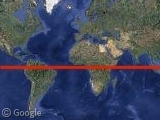
Equator

We start our journey, appropriately enough, in the country named after its location: Ecuador. Perhaps the best known monument marking the equator is Mitad del Mundo (Middle of the World), just outside the capital, Quito. These days, GPS-laden tourists are often alarmed to find that the true zero line appears to be 240 metres north of the line on the ground.

Mitad del Mundo

It’s all a question of which map datum1 you use: The Global Positioning System, along with most online maps, uses the WGS84 datum. So, in the same way that the Greenwich meridian is 100 metres or so away from GPS 0° longitude, the GPS equator (shown in red below) is somewhat north of the Mitad del Mundo line (in blue).

Just to the northeast of the offical Mitad del Mundo monument is a small private museum called Inti-Ñan, which claims to be on the “real” equator. It is, but only on an older datum called SAD69 (shown in yellow). Your GPS won’t read zero until you walk into the main road outside.

Three equators

Heading eastwards through Ecuador, we soon come to the highest point on the equator, and the only place on the line with permanent snow cover: Volcán Cayambe. The summit, just inside the northern hemisphere, is 5,790 metres above sea level; the highest point on the equator itself is some 1,100 metres lower.

Volcán Cayambe

On the other side of South America, in the city of Macapá in Brazil, we find a football2 stadium supposedly built right on the equator, with one half of the pitch in each hemisphere. This is the Estádio Milton Corrêa, better known as the Zerão (”Big Zero”), and it’s only slightly marred by the fact that the WGS84 equator actually runs just past the southern end of the pitch. A little way to the east, along Avenida Equatorial, is a monument known as Marco Zero.

Zerão stadium Marco Zero

Next we cross the Atlantic to Africa. A popular tourist stop in Kenya is this layby on the outskirts of Nanyuki, where a sign (arrowed) marks the location of the equator. In this case it’s pretty accurate, being just 20 metres or so south of the WGS84 line. You can usually find enterprising locals here willing, for a few shillings, to “demonstrate” how water flows down the plughole in opposite directions either side of the line. However, it’s an urban myth and the demonstration is all down to sleight of hand.

Nanyuki kenyasign

Our last location is in Indonesia, in Pontianak on the island of Borneo. Built in 1990, the Equator Monument is a replica of the marker first erected in the 1920s by Dutch surveyors. It’s five times the size of the original, but again it’s disappointing to note that it is 120 metres too far north, according to GPS.

pontianak

One final Google oddity – if you search for the location “0,0″, then as you’d expect you get a placemark at the intersection of the equator and the Greenwich meridian, off the coast of west Africa. What’s more unexpected is the address that is given: 23208 Glenbrook St, St Clair Shores, Michigan. Is this unassuming neighbourhood the real centre of the universe?

0,0 address glenbrook


  1. A datum is a simplified mathematical model of the Earth used as a basis for creating maps. 

  2. Or soccer, for readers in North America, Australia and other silly places :)  

The World’s Biggest Shopping Basket

Posted by RobK, Friday, 23rd October 2009

1 Star2 Stars3 Stars4 Stars5 Stars

Motorists taking State Route 16 through Licking County, Ohio, could be forgiven for thinking they’ve been at the wheel too long when they spot a giant shopping basket looming over the horizon.

Big basket

This is no highway-induced hallucination however: it’s the headquarters of the Longaberger Company, famous for its handmade wooden baskets. Its founder, Dave Longaberger, was a man with a dream — and that dream included going to work in a seven-storey basket. When lesser men than Dave told him it couldn’t be done, he said: “If they can send a man to the moon and bring him back home, they can build a building shaped like a basket.” And he was right.

Longaberger HQ

The building cost $300 million $30 million and took more than two years to build; it was completed in December 19971. The statistics are impressive: it takes the form of a 160:1 scale model of Longaberger’s top-selling Medium Market Basket, more than 60 m long and 30 m tall. The frame is made of steel, with a stucco finish cunningly designed to create a basket-weave effect (which also seems to confuse Street View’s face-blurring technology!) The handles are 100 metres long and weigh 75 tons each, and are even heated to prevent ice building up in winter and falling through the glass roof. (They also create a neat shadow.) On the side of the building, replicating the brass logos on the normal-sized baskets, are giant name plates weighing 340kg each and covered in gold leaf.

Blurring Basket shadow

That’s not the only big basket in these parts, however. Over in nearby Dresden2, where the Longaberger company was founded, there’s a 14-metre long picnic basket, made of real maple wood. Sadly, the imagery here is not high-enough resolution to see it in all its glory (I think this is it), but you can see pictures here. And at the Longaberger Homestead, a kitsch olde-worlde village/outlet store in Frazeysburg, there’s a giant apple basket. Again, the imagery isn’t very good here, so be sure to check out these ground-level photos (complete with giant apples!)

Dresden homestead

Read more about the creation of the Longaberger HQ at Elevator World, or visit the company website.


  1. Sadly, Dave Longaberger had contracted cancer by the time the building was completed, and died in 1999. His ambitious plans to create further basket-shaped buildings have apparently been shelved by the next generation of Longabergers, who now run the company. 

  2. Which bills itself as Basket Village USA

Luzamba airport: plane-wreck central

Posted by RobK, Wednesday, 7th October 2009

1 Star2 Stars3 Stars4 Stars5 Stars

If you’re a nervous flier, you’d do well to avoid Luzamba airport in northern Angola1. It’s not so much that lots of aircraft crash here (although it seems it’s hardly a rare occurence) — more the fact that the wrecked planes are simply left scattered around the place.

Luzamba airport

There are at least four: first up, at the northern end of the runway, an Air Angola Antonov An-26 which overshot the runway in February 1999, killing 2 of the 36 people on board. The International Civil Aviation Organization’s report suggests that the crew might have been drunk. There’s a ground-level photo of the wreckage on Panoramio2.

Wrecked Antonov Wrecked Antonov

At the other end of the airport, and seemingly in better shape, is a Transafrik L-100-30 Hercules (a civilan version of the C-130), which also overshot the runway later the same year. Happily, there were no casualties in this incident. Again, Panoramio features a ground-level photo, which reveals that the plane has been stripped of its engines and other salvageable parts.

Wrecked Hercules Wrecked Hercules

In the trees to the east of the runway are another two crashed planes: one that looks almost as big as the Hercules, and another much smaller one about 50 metres away. Extensive research by Google Sightseeing (or a bit of Googling, at any rate) has failed to identify these planes, although there is a photo of one of them on Panoramio, too, and it looks as though it’s been lying there for some time. Can anyone identify it?

Two crashed planes Mystery plane

Lastly, it’s hard to tell from the aerial view, but could this be another piece of wreckage just on the other side of the runway from the last two planes?

wreckage

Thanks to John.


  1. Not that the country is a major tourist destination just yet, given the after-effects of the 27-year civil war

  2. Incorrectly labelled as an An-24.