All sights in category 'Aircraft'

Google Sightseeing takes you on tour of the world as seen from satellite, using the free Google Earth program, or Google Maps in your web browser. Each weekday your guides James and Alex present new weird and wonderful sights as suggested by readers.

The editors: James & Alex

UTA Flight 772 Memorial (Desert Week 2)

Posted by RobK, Monday, 15th June 2009

1 Star2 Stars3 Stars4 Stars5 Stars

Welcome to the second annual GSS Desert Week! In time-honoured tradition, we’ll mostly be posting about deserts. For about a week!

Even by Saharan standards, the Ténéré region of northern Niger is pretty desolate: a vast sea of sand, broken only by the occasional rocky outcrop, where barely an inch of rain falls each year. So it’s something of a surprise to see a huge picture of a DC-10 among the dunes.

Ténéré desert Flight 772 memorial

The story behind this striking image is a tragic one: it is a memorial to UTA Flight 772, which was blown up by a suitcase bomb in the skies above this spot in 1989, killing 170 people1. An investigation concluded that Libyan terrorists were to blame for the explosion, which occurred 46 minutes after the aircraft took off from N’Djamena International Airport in Chad, en route to Paris. (The flight had originated from Brazzaville, the capital city of Congo.)

N'Djamena airport Maya-Maya airport, Brazzaville

The memorial was created in 2007, to mark the 18th anniversary of the disaster, by Les Familles de l’Attentat du DC-10 d’UTA, an association of the victims’ families. Financed by a compensation fund paid to the victims by the Libyan government, it was constructed by 100 people working largely by hand under the desert sun.

The life-size silhouette of the aircraft lies inside a circle more than 200ft in diameter, created using dark stones set into the sand. Surrounding this circle are 170 broken mirrors, representing those who died, and arrows marking the points of the compass. At the northern point, part of the right wing of the DC-10 has been erected as a monument, with a plaque commemorating the victims.

Ground view of memorial

The association’s website (in French) includes a moving video of the crash site - still littered with perfectly preserved debris - and numerous photographs of the construction of the memorial. (These are large PDF files, but are well worth downloading as they give an idea of the stark beauty of the region as well as the impressive size of the memorial.)

Thanks to Tom Van Steen.


  1. Union des Transports Aériens merged with Air France in 1990. Until the recent Air France disaster, the Flight 772 bombing was the deadliest incident in French aviation history. 

Saharan Stone Circle Mystery

Posted by Alex Turnbull, Monday, 16th March 2009

1 Star2 Stars3 Stars4 Stars5 Stars

Right in the middle of the Sahara desert, in the dunes of northern Niger, there’s a circle which is clearly not a natural formation.

The circle itself is roughly 52 metres across, but if we zoom out a little, we can see eight other markings which mark the sides and corners of a huge square area, about 620 metres on each side.

This French website claims that French soldiers created similar looking circles and markings elsewhere in the Sahara “at the beginning of the aviation era”, although the reason why is unclear. Although the one in the article has no coverage yet National Geographic has a ground level photo of it.

However, very faintly visible above the circle are another set of markings, which might have once been a makeshift runway.

On closer examination, it seems that this particular circle has been “updated” since it was originally made. It’s a little hard to make out, but in the centre of the circle is the word “FACHI”, which it turns out, is the name of the nearest village.

See also the previously posted mysterious circle in a square in Saudi Arabia.

Thanks to Crash.

The Mysterious Case of the Vanishing Airport

Posted by Alex Turnbull, Monday, 9th March 2009

1 Star2 Stars3 Stars4 Stars5 Stars

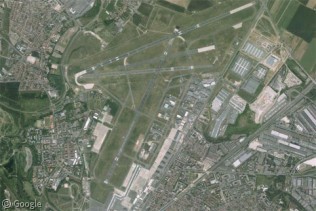
This is Naval Air Station Sigonella, a U.S. Navy installation in Sicily, Italy, as seen in this image on Google Earth that was originally captured on June 27th, 2006.

This next image of exactly the same area is from Microsoft Live Maps, and far from simply being a much older image taken before the facility was built, this was actually captured in 2007

Thanks to widespread coverage, many people are now familiar with the idea that “sensitive” areas of our planet are being hidden from view in the images that online mapping services display.

It’s also commonly understood that the images are usually altered by the company who originally took them (rather than Google, Microsoft, Yahoo, or any other buyer), allowing them to remain in line with their local laws and regulations.

Such areas include military installations, government buildings, and airports - but the point is usually simply to prevent people from viewing the exact details of the site, rather than attempting to deny their very existence.

Last year we saw some imagery in the Netherlands had been altered in a more dramatic way - drawing the ridicule of the Photoshop Disasters blog in the process - which in turn led to even wider recognition of the attempted cover up.

Well, it seems that the companies engaged in these activities have been paying attention, because closer examination of the supposed location of NAS Sigonella reveals that while there are clearly artificial repetitions of parts of the image, the overall result is by far the best Photoshop job we’ve seen on either MS Live or Google Maps.

Unfortunately, to the west of the site we can still see part of a runway that our inexperienced Photoshopper neglected to cover up - so there’s definitely still room for improvement.1

So is this the start of a new trend? Will satellite and aerial photography companies now need to employ full time digital artists to hide things the governments don’t want you to see? Or is this just another example of Microsoft attempting to up the ante against Google?

Read more about NAS Sigonella at Wikipedia.

Thanks to Al Cohole.


  1. TerraItaly are the company responsible, and this isn’t their first failed cover-up job. 

Frozen Plane Wreckage

Posted by James Turnbull, Wednesday, 4th March 2009

1 Star2 Stars3 Stars4 Stars5 Stars

These buildings are what make up Molodyozhnaya, one of the original Soviet research stations in Antarctica, and the site of an unusually large number of plane crashes.

The research station was established way back in 1962 to study meteorology, and was the launch site of over 1000 sounding rockets. But after the Soviet collapse, Russia cut back their expenditure on Antarctica explorations and permanently closed the station.1

Just to the west of the station, we find our first crashed plane in the snow. This Aeroflot Il-14 was heading back to the USSR when the engine failed shortly after take-off, and the plane crashed, killing 4 of the 7 passengers.

Despite the crash site being very clearly visible, this didn’t happen anytime recently. The image was taken in February 2006, but the crash itself occurred all the way back in 1979!

The cold weather has preserved the crashed plane, and the harsh conditions make any attempt to move it impossible.

Browsing around the area, we can spot another four planes, all seemingly crashed and abandoned. Perhaps this the real reason for closing the station - they kept losing too many planes!

Thanks to GEarthHacks.


  1. Russia have talked about resuming operations at Molodyozhnaya in “2007 or 2008″ but so far nothing has happened. 

US Space & Rocket Center

Posted by James Turnbull, Thursday, 12th February 2009

1 Star2 Stars3 Stars4 Stars5 Stars

NASA’s first visitor centre, and one of the world’s largest public collections of space bits is the U.S. Space and Rocket Center near Huntsville, AL.

The main building houses hundreds of space-related artefacts, including bits of real moon rock and the remains of a space monkey, but luckily the best sights are too large to squeeze inside the building and have to be displayed outside1.

Welcoming you to the centre is an A-12 Blackbird which, as I’m sure you know, isn’t a spacecraft, it’s a plane. But, it’s a very cool plane, so we’ll let them off2.

Also noticeable from the entrance is the massive Saturn V, the rocket design that launched NASA’s Apollo and Skylab missions.

However, like the Blackbird, this isn’t a spacecraft; it’s just a full-size mock-up produced especially for the park.

Hoping to actually see some real space things, we come to another Saturn V, this time lying down.

Now this is (sort of) the real deal. Although all three stages come from separate test models not destined for flight, it does have all the inner workings and has thus been awarded the prestigious status of a US national monument.

Alongside Saturn V stands a smaller rocket, Saturn I, which was NASA’s first dedicated “space launcher”.

Again, this particular rocket was never launched, and like the Saturn V is actually a mish-mash of test models. Someone who clearly knows too much about space rockets complains that the booster is even painted incorrectly: “the roll pattern on the fins is also off, as the black-white boundary should be horizontal to the ground an[d] bisecting the root edge of the fins.” Of course we all noticed that glaring error.

Around the other side of the building we find the only “full stack” space shuttle display in the US.

The empty steel model, known as “Pathfinder”, was constructed as an simple weight for testing cranes and other support equipment. It was given the NASA livery in Japan, where it spent some time at the “Great Space Shuttle Exposition” of 1984.

It then returned to America to where we see it now, sitting atop two prototype booster casings which never went into production.

So that was the U.S. Space and Rocket Center, where we can see precisely zero rockets that have ever actually been into space!


  1. Actually, the Saturn V we see here has since been moved indoors, so they must have had a lot of free space in there. 

  2. NASA did fly the related YF-12s in the 1970s, and this A-12 has its tailfin painted in a similar style - presumably they thought no-one would notice the difference?