All sights in category 'Bridges'

Google Sightseeing takes you on tour of the world as seen from satellite, using the free Google Earth program, or Google Maps in your web browser. Each weekday your guides James and Alex present new weird and wonderful sights as suggested by readers.

The editors: James & Alex

The Colgante Bridge

Posted by Alex Turnbull, Wednesday, 10th August 2005

1 Star2 Stars3 Stars4 Stars5 Stars

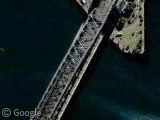
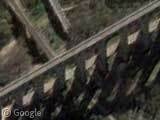
This is the Colgante Transporter Bridge across the river Nervión in Portugalete, Spain. This extremely rare type of bridge (apparently there’s only 8 of them left in the world) is designed to carry a segment of roadway across a river, and you can see quite clearly in this photo why they came up with this design.

This particular bridge was the first of its type ever built, way back in 1893… well not this actual bridge, as unfortunately it was destroyed in 1937 during the Spanish Civil War (three days before it ended) but those crafty Spaniards had in fixed again by 1941.

In our thumbnail you can see the bridge’s gondola, which in the 1890s was fitted out to accommodate first and second class passengers, separated by a net… sounds a bit like British Rail if you ask me.

Colgante Bridge

The entire history of the Colgante Transporter Bridge is available at the official site.

Thanks to Daniel.

Portuguese Bridges

Posted by Alex Turnbull, Monday, 8th August 2005

1 Star2 Stars3 Stars4 Stars5 Stars

Portugal has some pretty cool bridges!

First up is the Arrábida Bridge over the Douro River in Porto. The bridge is 493 metres long, and at the time of its construction in 1963 it had the largest concrete span of any bridge in the world. If you look closely on the eastern side you can see the curve of the arch underneath the bridge (compare with the image on Wikipedia to see what I mean).

Arrábida Bridge

Next up is the Ponte 25 de Abril, which crosses the Tagus river in Lisbon. It was originally named Salazar Bridge but after the Carnation Revolution, the bridge was renamed to 25 April Bridge, the day when the revolution occurred. It’s interesting to have a look at the north side of the shore, where the bridge curves spectacularly over loads of buildings before it eventually touches down (Wikipedia page). We couldn’t work out what this monument on the south bank was though… This monument on the south bank is the Monumento do Cristo-Rei, an imitation of the more famous statue in Rio.

Ponte 25 de Abril Monumento do Cristo-Rei

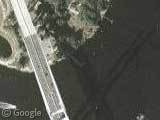
Finally we have the spectacular Vasco da Gama Bridge, which also crosses Lisbon’s Tagus river, but at a much wider point! The Vasco da Gama has a total length of over 17 kilometres and is the longest bridge in Europe. Again, there’s a rather cool curve visible in this one and some cool shadows too (Wikipedia page).

Vasco da Gama Bridge

Thanks to Manuel Freitas, Bodo Möller, Jan Brasna, grufo and Joao Ramires.

The Hampton Roads Bridge-Tunnel

Posted by Alex Turnbull, Wednesday, 20th July 2005

1 Star2 Stars3 Stars4 Stars5 Stars

Here’s the Hampton Roads Bridge-Tunnel, because it’s been a while since we had a bridge. Er, I mean tunnel… no, wait, two bridges! Or is that two tunnels?

Frick.

The Hampton Roads Bridge-Tunnel is a combination of two bridges and two tunnels, connecting Hampton and Norfolk in Virginia (I think that’s right anyway, but perhaps the Wikipedia entry can clear it all up for you).

Anyway, it’s pretty cool – lots of cars on there coming in and out of either end (or is that either middle?).

Oh sod this. I give up.

Hampton Roads Bridge-Tunnel

Thanks to Tiger, Brad, DanielMaui, John Drummond and Ben.

Oresund Bridge

Posted by James Turnbull, Tuesday, 12th July 2005

1 Star2 Stars3 Stars4 Stars5 Stars

Linking the countries of Sweden and Denmark is the Oresund Bridge which actually comprises a cable-stayed bridge, an artificial island (Peberholm) and a tunnel. The total length is 16km and is split over two levels (a railway is below the road). Marcus Rangell also added:

According to what I’ve read, the island is also a biological experiment to see how nature will develop on the island. Currently a bunch of plants have already spread to the island, some are very rare.

Thanks: Roland, Thomas, breakbeat, jensflorian, Marcus Rangell, Simone, Yann & Martin

Venice

Posted by Alex Turnbull, Thursday, 30th June 2005

1 Star2 Stars3 Stars4 Stars5 Stars

This is the beautiful Venice, city of canals. Venice is built on more than a hundred islands in a shallow lagoon, with the canals serving the function of roads – every form of transport is on water or on foot. In fact, Venice is Europe’s largest car-free zone, unique in Europe in remaining a sizeable functioning city in the 21st century entirely without cars or trucks.

I can’t spot any gondolas from up here though, can you?

Venice

In our next thumbnails we’re also featuring St. Mark’s Basilica (you can also see the bell-tower) and the Rialto Bridge. St. Mark’s Basilica overlooks the Piazza San Marco (you know, that square with all the pigeons that’s in all the movies), and the Rialto Bridge is the oldest and most famous bridge which crosses Venice’s Grand Canal. There’s heaps of info over at Wikipedia, and there’s tons of good ground level photos there too :-)

St. Mark's Basilica Rialto Bridge

Thanks: Philip R, morinox, Drew Mills, Andy Kaplan-Myrth, Daniel, Troy Fuqua, GS, Simon Sutcliffe, Bennet Langlotz, Michele, Jan Fabry, jupap7, Martin Willey, Thomas, Mike Krus, Kevin, Ben Singleton, TROY, ray hollis, Vaclav Papousek, Jens Kilian, Bryan Robson, Frederic Argazzi, Max, David Fink and James Edmunds.