All sights in category 'Deserts'

Google Sightseeing takes you on tour of the world as seen from satellite, using the free Google Earth program, or Google Maps in your web browser. Each weekday your guides James and Alex present new weird and wonderful sights as suggested by readers.

The editors: James & Alex

Road Train

Friday, 15th August 2008 by Alex

When Google recently added street view for vast stretches of empty road across the middle of Australia, most people didn’t expect to find much of interest out there.

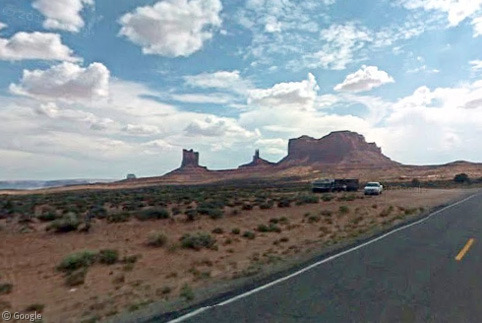
To be fair, those people were mostly right. However, every now and again the street view car did indeed pass something at least. In the deserts of South Australia on the Stuart Highway, we can see an approaching truck. Actually, it’s a really big truck!

Hang on, is that another truck driving dangerously close behind the first one? Nope, the first massive truck is actually pulling another trailer which carries… another truck - followed by another trailer!

The sign on the back of the huge vehicle kindly explains that this is a “ROAD TRAIN” - a kind of trucking used in remote areas of Australia, the United States, and Western Canada to move huge loads across vast distances. In the U.S. and Canada the terms “triples,” “Turnpike doubles” and “Rocky Mountain doubles” are more commonly used.

This particular road train is a “triple”, and is also “doubled-up” (carrying empty road train trailers), but some of these vehicles pull up to 4 trailers at a time. Australia has the largest and heaviest road-legal vehicles in the world, with some weighing up to 200 tonnes.

Previously on Google Sightseeing: Trucks Pulling Trucks

Thanks to Virtual Globe Trotting

Millions and millions of tyres

Wednesday, 16th July 2008 by Alex

Within the Sonoran Desert National Monument, Arizona, is one of the largest stockpiles of discarded vehicle tyres1 in the US - perhaps as many as 10 million individual tyres.

Despite being just south of a town called Goodyear, this is actually the work of a company called Envirotech Industries International, who have been collecting tyres here for the last 10 years.

The company used to recycle the tyres, and intended to start converting the old tyres into fuel - until the state of Arizona closed them down for multiple serious fire-code violations. Envirotech subsequently went bankrupt, leaving the State of Arizona responsible for the facility.

The imagery at Microsoft’s Live service has better resolution, allowing us to see individual tyres that have fallen from the huge piles (one of the breaches of the fire regulations was “Obstructed fire roads”).

If a fire were to break out here, the Arizona Attorney General’s Office have stated that it could “burn unhindered for over ten years”. To put that into perspective, in 1999 it took 250 firefighters 5 days to get a fire at a facility in Ohio under control - and it took a further nine years and more than $32 million to clean up the mess.

There are an estimated 3 billion waste tires stockpiled in the United States, and when they catch fire the environmental fallout can be catastrophic. Government reports stated that the pollution from the 1999 Ohio fire killed more than 10,000 fish in a nearby creek.

The Sonoran Desert National Monument is a small part of the 311,000 km² Sonoran Desert - home to several endangered species, and the most biologically diverse of all the North American deserts.

Read the full story at azcentral.com.

Thanks to kjfitz.


  1. Or “tires” as they’re known in the States. 

Desert Week Roundup

Saturday, 21st June 2008 by Alex

And so, we come to end of our first ever desert week. It turns out that we only featured two actual deserts over the week, and we even failed to mention the world’s largest desert!

Despite these we think it’s been a success, but we’d to hear your feedback. Did you enjoy desert week? Do you wish it had been longer, or perhaps shorter? Are there any other theme weeks you’d like to see? Let us know your thoughts!

Here’s the list of all the places we featured this week:

Many of you sent in some great desert based suggestions of other sights to see, but we just didn’t have enough time to feature them all. However, deserts aren’t restricted to desert week, so we may sneak a few in during the coming months.

We’re also planning for August to see the return of the popular Island Week for its third outing, and after that Volcano Day is due to make its triumphant return after a 2 year hiatus, and this time it’s going to make the jump to a fully-blown Volcano Week. Know of any great sights for either event? Then get submitting your suggestions!

The Atacama Desert (Desert Week)

Friday, 20th June 2008 by Alex

We’re continuing the first annual GSS Desert Week! We’re mostly posting about deserts and it’s lasting about a week!

The Atacama Desert is a virtually rainless plateau in Chile, South America. Made up of salt basins, sand and lava flows, the 181,300 km2 desert is more than 20 million years old, and as it only receives about 3mm of rain a year is considered to be one of the driest places on Earth. Areas such as the Valle de la Luna haven’t received a single drop of rain in hundreds of years.


Valle de la Luna (Wikipedia) shown bottom left of this image (Ground level photo)

This bizarre landscape isn’t completely devoid of life however. To the east of the Valle de la Luna lies the village of San Pedro de Atacama, which has developed in the middle of the desert thanks to an oasis. People have been living here for a very long time - the ruins at Aldea de Tulor date from 800 BC.1


Aldea de Tulor (Ground level photo)

The Atacama Desert is incredibly rich in copper, and the two largest copper mines in the world, Chuquicamata and Escondida are both here. Escondida alone produced 1.483 million tons of copper in 2007 - 9.5% of the entire world’s output.


Chuquicamata (Wikipedia) and Escondida (Wikipedia) copper mines

Mining here hasn’t always been so successful however - the Atacama Desert is littered with the ruins of 170 old abandoned nitrate (or “saltpeter”) mining towns, all of which (bar one) were shut down after the Germans invented synthetic nitrate at the turn of the 20th century.

The most important of these abandoned mines is the Humberstone and Santa Laura Saltpeter Works, and it has actually been designated a UNESCO World Heritage Site.

Thanks to the extremely arid conditions, cloud cover is incredibly rare in the Atacama desert. Combined with the high elevation of the area, that makes it a perfect location for stargazing, which is why there are several observatories here, including at 2,635 metres the Paranal Observatory, that houses the utterly brilliantly named Very Large Telescope (Wikipedia).

Thanks to Bakan_Vargas, Bleij and Tom (and Chris Branagan too).


  1. The Atacama desert is also famous for the many Incan geoglyphs that we featured in February 2007, including the absolutely fantastic Atacama Giant. 

The Desert of Maine (Desert Week)

Thursday, 19th June 2008 by James

We’re continuing the first annual GSS Desert Week! We’re mostly posting about deserts and it’s lasting about a week!

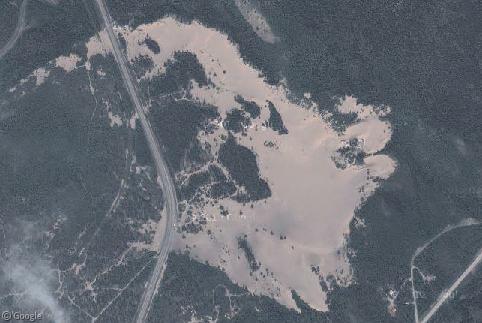
The 40 acre Desert of Maine is located in a pine forest near the town of Freeport. Although not a real desert, the “sand” is natural to the area: it is glacial silt that would have been ground down under the earth sometime around the last ice age.

The silt would have remained hidden underground if it wasn’t for some poor farming practices in the early 1900s that eroded all the soil. The farmer eventually had to sell up to an enterprising man who correctly assumed tourists would flock to see some sand in the middle of a forest.

Since 1925 up to 30,000 people a year have visited the “desert”, which is made even more exciting by the inclusion of plastic camels. If that wasn’t enough, there is also a “sand museum” where you can see the sand of real deserts donated from around the world… sounds fascinating!

More info on the official website and NY Times.

Thanks to Elliott C. Evans and jon moses.

The Great Dune of Pyla (Desert Week)

Wednesday, 18th June 2008 by Alex

We’re continuing the first annual GSS Desert Week! In time-honoured tradition, we’ll mostly be posting about deserts. For about a week.

Whilst not technically a desert, The Great Dune of Pyla (or Pilat), France, is without doubt the largest sand dune in Europe. The dune is around 500m by 3km and up to 117 metres tall, totaling about 60,000,000 m³.

Worryingly, the massive sand dune isn’t content to stay put, and seems hell-bent on swallowing up the forest and anything else that gets in its way. In tandem with coastal erosion, the dune is advancing inland at a rate of around 5 metres a year - which, multiplied by the dune’s length means that up to 15,000m2 of forest is being lost every year.

Roads and several houses have already been obliterated by the dune’s progress, and if its progression continues at the same pace, in 40 year’s time the Biscarrosse road and campsite will too have been lost forever.

See the Great Dune of Pyla’s official website for more info (where they also have a good gallery of photos clearly showing the forest being consumed by sand), or read the painfully factual Wikipedia page.

Sand Tornado (Desert Week)

Tuesday, 17th June 2008 by James

We’re continuing the first annual GSS Desert Week! In time-honoured tradition, we’ll mostly be posting about deserts. For about a week!

The Sahara is probably the world’s most famous desert, and covers much of northern Africa. However today we’re only looking at one tiny part of the desert, in the country of Niger.

It’s not obvious at first, but if you look closely at the top of this sand dune you’ll see what we think is a dust devil (which is like a tornado made of sand).

Sandstorms are common in the Sahara and the walls of sand can reach up to 6,000 metres high. In fact, so much sand is blown up into the air that the Earth has an atmospheric layer made up entirely of Sahara sand!

This image comes to Google Earth as part of the National Geographic Megaflyover project. See all our previous posts for more of the fantastic high-resolution images.

Read more on Dust Devils and the Sahara on Wikipedia.

Thanks to Yvan.

The Namib Desert (Desert Week)

Monday, 16th June 2008 by Alex

Welcome to the first annual GSS Desert Week! In time-honoured tradition, we’ll mostly be posting about deserts. For about a week!

The Namib Desert in Namibia and Angola forms part of the Namib-Naukluft National Park, and covers an area of 50,000 km². This part of the world has experienced arid conditions for at least 55 million years, which makes the Namib Desert the oldest desert in the world.

The Namib covers much of the Atlantic Ocean coast of Namibia, where the collision of the water-laden sea air and the bone-dry desert air causes immense fogs and strong currents, making this place as notorious for ending the lives of sailors as the more famous Skeleton Coast to the north. There are plenty of shipwrecks to be found in this imagery for those that care to find them!

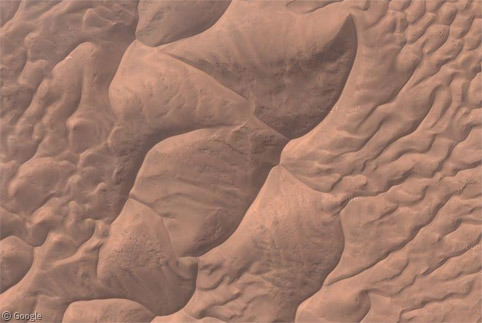
Away from the coast, this massive desert receives less than 10 mm of rain annually and is almost completely barren, apart from the spectacularly complex dune patterns.

In the eastern part of the desert we find the famous Sossusvlei salt pan, which can sometimes be seen filled with water when a flash-flood fills the Tsauchab river. Note the tourist buses parked in the shade of a tree.

To the south is the Dead Vlei salt pan where even from up here we can spot the “skeletons” of trees which are believed to be about 900 years old - scorched black by the sun and unable to decompose due to lack of moisture.

Perhaps most impressive of all the sights here though, are the mammoth dunes which surround the salt pans. Some of them rise up to 340 metres, which makes them the highest sand dunes in the world.

Check out the photos on Flickr of giant dunes, tree skeletons, and the dunes as seen from in the Dead Vlei.

See Wikipedia for more info on the Namib Desert, the Namib-Naukluft National Park, the Tsauchab, Sossusvlei and the Dead Vlei.