All sights in category 'Large Type'

Google Sightseeing takes you on tour of the world as seen from satellite, using the free Google Earth program, or Google Maps in your web browser. Each weekday your guides James and Alex present new weird and wonderful sights as suggested by readers.

The editors: James & Alex

The Faith Dome

Posted by Alex Steinberger, Friday, 15th May 2009

1 Star2 Stars3 Stars4 Stars5 Stars

The Crenshaw Christian Center’s Faith Dome is a non-denominational megachurch located in the heart of South Los Angeles. With seating for over 10,000 attendants, it is one of the largest places of worship in the United States.

FaithDome

Brainchild of Ever Increasing Faith Ministries pastor Frederick K. Price, construction of the Faith Dome was completed in 1989 on 32 acres of the former Pepperdine University1 campus. The geodesic church sanctuary is constructed almost entirely of aluminum and hosts Dr. Price’s sermons which reach over 15 million families across the United States each week.

By all reports a lively character, Dr. Price oversaw the construction of this behemoth structure from start to finish. During an inaugural sermon, he described his love for the new church structure, exclaiming “Hallelujah! Jesus just hit a grand-slam home run!”

streetview domeBirdsEye dome

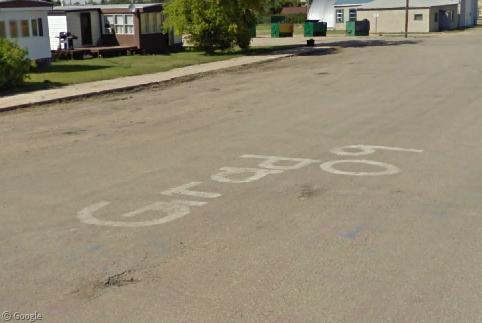
Situated along a busy flight lane, the Faith Dome is clearly visible to thousands of airline passengers landing at Los Angeles International Airport every day. It seems that Dr. Price and his construction team must have been acutely aware of this fact. An enormous advertisement to anyone looking down, the church’s car park has been emblazoned with gigantic letters proclaiming the Faith Dome’s glorious existence.

FaithDome Lettering

Then again, it could be a way of broadcasting to the “big man” himself.

Thanks to stongey and Bird’s Eye Tourist.


  1. Pepperdine University fled the area in the 1960s due to crime and the overall degradation of the neighborhood. It is currently located in Malibu, CA. 

Old Rat’s Nest Island, Australia

Posted by Evan Brammer, Wednesday, 13th May 2009

1 Star2 Stars3 Stars4 Stars5 Stars

Peering out the window of the little airtaxi that has brought you to The Rat’s Nest, or Rottnest Island, 18 km southwest off the coast of Australia, you’ll notice the island’s name spelled out in trees. This little island, only 15 km long and 4km wide, has been the site of an aboriginal prison, WWI & WWII internment camps, and today is an important local holiday destination, popular for its shipwreck bearing reefs and notable surf breaks.

The trees that spell out “Rottnest” were planted purposely to welcome visitors to the island, which was named for the native quokka, a marsupial that resembles a large rat and thrives on the island due to the lack of a significant predator.

rottnest-trees

There are no fresh water sources on the surface of the island so rainwater has always had to be collected instead. However in the 1970s, fresh water was discovered underground, and since 1995 the government has desalinated water from these salt lakes using reverse osmosis.

salt-lakes

One of the most famous (or infamous) buildings on the island is the Rottnest Quod, an eight-sided structure that was used to imprison over 3,700 aboriginal men and boys between 1838 and 1931. Rottnest was used in this way to “calm” the mainland native population that were committing the terrible crime of digging up crops from land that used to belong to them.

the-quod

Today the Quod is a source of contention as it was used as a budget hostel for most of the 20th century and has now been converted into high-priced accommodation for tourists. However, aboriginal activists say that the site should remain a historical heritage site, demonstrating the harsh treatment of the natives by the colonial government.

Other notable features of the island are a zero tolerance approach to “antisocial behaviour”, laws banning private ownership of land, cycling being the main form of transport, and an annual 18km swim from the mainland to the easternmost point on the island.

pointed-beach-head

More info on Rottnest Island at Wikipedia.

Thanks to Simon Craigie.

St. Patrick’s Day in the USA

Posted by Alex Turnbull, Tuesday, 17th March 2009

1 Star2 Stars3 Stars4 Stars5 Stars

March 17th is St. Patrick’s Day, which was originally the annual feast of the best known of Ireland’s patron saints1, and today a worldwide celebration devoted to all things Irish.

Over here in Ireland and the UK, we have been known to celebrate with vast quantities of Guinness. Over in the US however, they like large scale annual celebrations involving crazy things like temporarily dying the Chicago River green (which sadly hasn’t yet been captured on Google Earth2).

But in today’s post we’ll be looking at some of the places that St. Patrick has found a permanent home in the USA.

This is St Patrick’s park in Indiana, where they have created a 400 metre long homage to their namesake, entirely in the medium of trees. Which is apt, given how much of the colour green gets bandied around on the 17th of March.

We’ve visited the original Dublin already on Google Sightseeing, but there are at least nine cities called Dublin in the USA alone!

See for yourself: Dublin, California; Dublin, Georgia; Dublin, Indiana; Dublin, New Hampshire; Dublin, North Carolina; Dublin, Ohio; Dublin, Pennsylvania; Dublin, Texas; and Dublin, Virginia.

In New York City we find St. Patrick’s Cathedral, a spectacular Neo-Gothic cathedral in midtown Manhattan that has become ingrained in Hollywood movie history, after being featured in several movies including 2002’s Spider-Man.

So, where else has St. Patrick and the influence of Ireland made a lasting impression around the world?

Happy Paddy’s day!

Thanks to Chris R.


  1. Despite the fact that he was actually Welsh

  2. Unfortunately I can’t even find an image of it in the historical GE imagery

Saharan Stone Circle Mystery

Posted by Alex Turnbull, Monday, 16th March 2009

1 Star2 Stars3 Stars4 Stars5 Stars

Right in the middle of the Sahara desert, in the dunes of northern Niger, there’s a circle which is clearly not a natural formation.

The circle itself is roughly 52 metres across, but if we zoom out a little, we can see eight other markings which mark the sides and corners of a huge square area, about 620 metres on each side.

This French website claims that French soldiers created similar looking circles and markings elsewhere in the Sahara “at the beginning of the aviation era”, although the reason why is unclear. Although the one in the article has no coverage yet National Geographic has a ground level photo of it.

However, very faintly visible above the circle are another set of markings, which might have once been a makeshift runway.

On closer examination, it seems that this particular circle has been “updated” since it was originally made. It’s a little hard to make out, but in the centre of the circle is the word “FACHI”, which it turns out, is the name of the nearest village.

See also the previously posted mysterious circle in a square in Saudi Arabia.

Thanks to Crash.

The World’s Largest Skateparks

Posted by Alex Turnbull, Thursday, 12th March 2009

1 Star2 Stars3 Stars4 Stars5 Stars

Shanghai is the most populous city in China, and as befits a population over 20 million, the city has been blessed with the largest skatepark in the world.

SMP Skatepark has an incredible 13,700 m2 of skateable space, much of it incorporating local stone and granite. The park has two street skating areas, multiple bowls, a full pipe (video), a 52 m long wooden vert ramp, and a 2000 m2 competition area.

The closest rival to the SMP park in sheer size is not where you might expect. Not that a skating holiday in the Cayman Islands would be anything less than totally freaking awesome of course.

The Black Pearl skatepark is a 4,800 m2 concrete park with a wide selection of bowls, transitions, and street terrain. If you get bored of all that skating, the blue area to the south is actually a surfing machine that’s capable of moving around 570,000 litres of water every minute, producing a surf wave over 3 metres tall!

All of which makes me wish I was 16 again.

For more skateboarding sights, see our posts on Marseille Skatepark, Kona Skatepark and Danny Way’s Mega Ramp.

Thanks to WebUrbanist.