All sights in category 'Shadows'

Google Sightseeing takes you on tour of the world as seen from satellite, using the free Google Earth program, or Google Maps in your web browser. Each weekday your guides James and Alex present new weird and wonderful sights as suggested by readers.

The editors: James & Alex

Island Monument Mystery (Island Week 3)

Posted by Alex Turnbull, Friday, 5th September 2008

1 Star2 Stars3 Stars4 Stars5 Stars

It’s Island Week 3 here at GSS, which means we’ll mostly be posting about Islands. It’ll probably last about a week.

Here in the Mentawai Islands of West Sumatra, Indonesia there is a tiny, seemingly unnamed, almost totally-forested island.

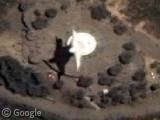
The only thing on this island, other than trees, is a mysterious, lonely white monument. But what is it?

Our mystery island is just to the south of the much larger island of Hilibafunua (about which I have failed to find anything interesting), but north of the even larger Siberut – an island that is home to a 1,905 km² National Park and inhabited by the Mentawai, a tribe of hunter-gatherers who like to sharpen their teeth.

Our mystery monument hasn’t been posted on the Google Earth Forums (it would show up in the Google Earth Community layer in Google Earth if it had), and I can’t find any reference to it on the web, at least not in English.

So, who can tell us what this is, or even better, locate a photograph of it?

Thanks to Smiglo.

Lindisfarne (Island week 3)

Posted by Alex Turnbull, Wednesday, 3rd September 2008

1 Star2 Stars3 Stars4 Stars5 Stars

It’s Island Week 3 here at GSS, which means we’ll mostly be posting about Islands. It’ll probably last about a week.

Lindisfarne is a tidal island, off the north-east coast of England, which thanks to having been home to a monastery since the 7th century AD, is also known as Holy Island.

The causeway that connects Lindisfarne to the mainland is flooded twice a day by the tide (you can see the tidemark on this section of the road), so drivers must be careful about when they start to cross. Refuge places are provided for the cars should they become stranded by quickly rising water.

Before the advent of cars those wishing to reach the monastery would have had to cross the sands on foot at low tide. Known as Pilgrim’s Way, we can see the markers that still define that path today, as well as small refuge boxes for those who choose a foolish time to attempt the walk.

Here’s the second refuge box on the Pilgrim’s Way, but following the markers along there are no people to be seen, probably because a large section of the path is under water.

Where the Pilgrim’s way finally meets land we find a nice modern-day maze of, er… something, and just south of here we finally come across the ancient ruins of the island’s monastery.

To the east of the monastery, we can also see the small Lindisfarne Castle and the old castle limekilns, which are in the care of the National Trust and open to visitors.

Elsewhere on the island there are monuments, some spectacular sections of coastline, lots of sand, and there’s even a lake for all you recursion junkies.

There’s more about the long history of Lindisfarne at Wikipedia, or have a look at this PDF of the island’s sights.

See also the previously featured Mont Saint Michel tidal island.

Especially for Spamboy.

Tinsley Towers

Posted by Alex Turnbull, Thursday, 28th August 2008

1 Star2 Stars3 Stars4 Stars5 Stars

Tinsley Viaduct is a two-tier road bridge in Sheffield, England; the first of its kind in the UK. It carries the M1 motorway over a 1033 metre section of the Don Valley, and is one of Sheffield’s most prominent landmarks. Sadly there’s not much to see from our viewpoint.

Fortunately for us however, the Tinsley Viaduct runs right past the Tinsley Towers, a fantastic pair of defunct cooling towers. Due to their extremely close proximity to the viaduct, they were left standing when the power plant they served was demolished in the 70s.

As it happens, “extremely close” is a bit of an understatement – the nearest tower stands only 12 metres from the M1!

Actually, “stood” is the correct term I’m afraid.

Following years of strengthening work to the viaduct (and presumably advances in demolition technology), the towers were finally brought down1 in the early hours of Sunday the 24th August. You can watch a video of the spectacular destruction of the towers over at the BBC.

Thanks to Radio 2 and the ever informative Jonathan Rawle.


  1. Despite several campaigns to save them, including a rather fanciful attempt to reposition them as some kind of “art installation”. 

The Donghai Bridge

Posted by Alex Turnbull, Thursday, 31st July 2008

1 Star2 Stars3 Stars4 Stars5 Stars

Such is the volume of new imagery that is added to Google Earth, that by the time we got around to posting the longest cross-sea bridge in the world, it had already been superseded.

Fortunately for us however, the current reigning champion was captured whilst still under construction, which means that we’re able to bring you the longest cross-sea bridge on Google Earth, China’s Donghai Bridge.

Measuring a whopping 32.5 kilometres (20.2 miles), the Donghai Bridge was completed in 2005, and connects Shanghai (above) to the Yangshan Islands in the East China Sea.

Most of the six lane bridge is low-level viaduct, but there are two cable-stayed sections which allow ships to pass, the larger of which has a span of 420 m.

Apparently the seemingly meandering path the bridge takes across the East China Sea was specifically designed to keep drivers more alert during their long crossing.

While questions have been raised over the financial logic of projects like the Donghai Bridge, China is rapidly emerging as the new Land of Long Bridges. China now has seven of the top twelve longest bridges in the world, all of which were completed in the last 5 years.

There’s information about and a great picture of the Donghai Bridge available at Wikipedia. You can also read about the current longest cross-sea bridge, which will likely also have been superseded by the time we get to it.

Thanks to Lukas Nowacki and Tom.

Hokkaidō Centennial Memorial Tower

Posted by Alex Turnbull, Wednesday, 23rd July 2008

1 Star2 Stars3 Stars4 Stars5 Stars

This is supposedly the Hokkaidō Centennial Memorial Tower in Nopporo Forest Park, Hokkaidō, Japan. The official site claims it’s 100m tall, and was completed in 1970 to honour the 100th anniversary of Hokkaidō’s official colonisation1.

Of course dear geeky-reader, you will have already realised that this is simply an elaborate ruse.

Unmistakably, this is in fact Orthanc, the black tower of Isengard, atop which Gandalf was trapped by the wizard Saruman during The Lord of the Rings: The Fellowship of the Ring.


On the left, the Hokkaidō tower, and on the right, Orthanc.

The proof is incontrovertible, as I found both of these images on the Internet.

Thanks to photojennic.


  1. Matching metres to years seems to be a bit of a common theme in tower design.