All sights in category 'Stadiums and Sport'

Google Sightseeing takes you on tour of the world as seen from satellite, using the free Google Earth program, or Google Maps in your web browser. Each weekday your guides James and Alex present new weird and wonderful sights as suggested by readers.

The editors: James & Alex

Glastonbury

Posted by RobK, Wednesday, 1st July 2009

1 Star2 Stars3 Stars4 Stars5 Stars

This year’s Glastonbury Festival of Contemporary Performing Arts drew 177,000 party people to deepest Somerset, reaffirming Glastonbury’s position as the largest greenfield music and performing arts festival in the world.

Some went for the music. Some went for the mud. A few might even have gone for Bruce Springsteen - but no doubt a good (if slightly damp) time was had by all.

farm

Despite its name, the festival is not actually held in Glastonbury, but at Worthy Farm in the village of Pilton, some six miles to the east.1 Google’s aerial photos clearly weren’t taken at the end of June, as they reveal a remarkably unsullied rural scene - the site is still a working dairy farm. The famous Pyramid Stage is missing, but the foundations (and surrounding dried mud) can clearly be seen, as can the electricity pylons that cross the site.

pyramid pylon

Of the second stage (known, with a great deal of imagination, as the Other Stage), there is no sign at all - it is situated here, in a peaceful-looking field. (If you squint a bit, perhaps you can just make out a vague dark semicircular area.)

otherstage

Near the southern edge of the site, you can see the stone circle, a favourite hippy hangout that was built for the festival by a druid, no less.

stonecircle

“Glasto” will be 40 years old next year, but it remains a brief annual blip of madness in the Worthy Farm routine. Once the music is over, the stages dismantled, the last hungover revellers departed and the vast quantities of rubbish cleaned up, Pilton’s cows can once again live in peace - until next time. :)

cows

It’s interesting to compare this map of this year’s festival site to the aerial photos, so you can see what happened where.

Thanks to Barry.


  1. The distinctive tower-topped hill of Glastonbury Tor, said to be the Avalon of Arthurian legend, can be seen on the skyline from the festival site. 

Top 5 Golf Courses across the World

Posted by Evan Brammer, Monday, 29th June 2009

1 Star2 Stars3 Stars4 Stars5 Stars

“Best” is a subjective word at, err… best. What one person or group values as the “top” will never be the same for everyone – still, when you’re looking for something and you want the “best”, it’s always nice when someone compiles a list. Whether you agree or not with their assessment, in 2007 Golf.com published a list chronicling the “100 Top Golf Courses in the World“.1

Because seven out of the top ten are all within the continental U.S., today we’re looking at the Top 5 Golf Courses scraped from their list, whilst allowing only one entry per country.

#5 Hirono Golf Club, Kobe, Japan

Hirono Golf Club, Kobe, Japan

Situated between rolling hills overlooking the city of Kobe, Japan, the Hirono Golf Club is the location of a very exclusive 18 holes. Its claim to fame isn’t the number of major world competitions it’s held2, instead it’s simply how hard it is to get in. Apparently this is the course that all other Asian courses are measured against, but I’m not sure how anyone would know; given that getting a tee time at Hirono is nigh on impossible.

Coming in at #37 on the Golf.com’s list, the C.H. Alison-built course is the only entry in our worldwide Top 5 that comes from a non-English speaking country.

#4 Royal Melbourne (West), Melbourne, Australia

Royal Melbourne (West), Melbourne, Australia

Just south of the main urbanised area of Melbourne is the West course of the Royal Melbourne Golf Club which is known for its “intricate bunkering, tough but fair challenge, variety of shotmaking, and exceptionally fast and true greens”. Designed by world renowned course architect, Dr. Alister MacKenzie it’s ranked 6th on Golf.com’s list, but comes it at number 4 on our improved version!

#3 Royal County Down Golf Club, Newcastle, Northern Ireland

Royal County Down Golf Club, Newcastle, Northern Ireland

Our third course was designed by Old Tom Morris for just 4 guineas. Considered the best in Ireland, the Royal County Down opened in 1889 and today is considered the tenth most exclusive club in the world.

The imagery isn’t the brightest, but does capture the climatic conditions of Northern Ireland perfectly. However, according to the club website, the Royal County Down is one of the most photographed links courses in the world, and with rolling greens peering out over the Irish Sea, it’s easy to see why.

#2 St. Andrews (Old Course), St. Andrews, Scotland

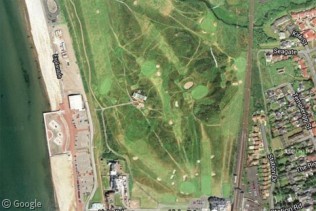
St. Andrews (Old Course), St. Andrews, Scotland

This is of course where the game of golf began. Officially recognised as being designed by “nature”, the 14th century-built Old Course at St. Andrews is the blessed hope of all that play the game. It is the oldest course in the world and probably #1 on the “must play” bucket-list for most golfers. For our list, it comes in at #2 (#3 on Golf.com’s list).

The Open Championship,3 the oldest professional golfing competition, has been held at the Old Course at St. Andrews every five years since 1873. Unfortunately, the last time a Scot won was in 1910.

The Old Course is held in the public trust by an act of Parliament, and every Sunday golfing is banned for the day to allow the course to rest, so it is instead enjoyed by locals for family picnics and leisurely strolls through the greens.

#1 Pine Valley Golf Club, Pine Valley, New Jersey

Pine Valley Golf Club, Pine Valley, New Jersey

Finally we reach the Pine Valley Golf Club. Originally built upon 164 acres of marshland by George Arthur Crump, today the private course sprawls nearly 2 sq km in the thick pinelands of New Jersey.

According to Wikipedia, Crump, a hotelier who knew the area from his hunting expeditions, was subject to obsessive idiosyncrasies that ultimately contributed to designing the #1 course in the world.

Some of those peculiarities included:

  1. Holes should not be laid parallel to each other.
  2. Consecutive holes should not play in the same direction.
  3. Players should only be able to see the hole they are playing on.

Don’t expect to play here anytime soon however – to get a tee time at Pine Valley you have to be personally invited and accompanied by one of the board members! Interestingly, Tiger’s been invited, though he’s never played.

Have you played Hirono, taken in the views at the Royal Down, or paid homage at the Old? What do you think about Golf.com’s assessment of the “best”? Have they got it spot on or are there others that deserve the honour? Let us know in the comments, and make sure to leave a link to your favourite course.


  1. If you’re interested in how they ranked the courses, they’ve detailed it for you here. 

  2. Only two such competitions took place here, both about eighty years ago. 

  3. Known as the British Open for those outside of the U.K. 

The Twenty20 Cricket World Cup

Posted by RobK, Wednesday, 10th June 2009

1 Star2 Stars3 Stars4 Stars5 Stars

Ah, the English summer: Pimm’s on the lawn, sandcastles on the beach, socks inside sandals, and the gentle sound of leather on willow. Yes, along with tennis, the nation’s sporting thoughts at this time of year turn to cricket - and, this month, to the Twenty20 World Cup.

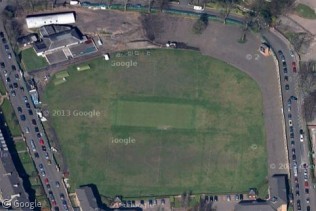
oval

Cricket mystifies many people from outside the former British Empire1. Quite apart from its arcane terminology (googlies and doosras; backward short leg and silly mid off), some struggle to see the appeal of a game where you can play for five days and still end up with a draw.

In recent years though, a new and - dare we say it? - more exciting form of the game has become increasingly popular. In Twenty20 cricket, as the name suggests, each side bats for only 20 overs2 and essentially just tries to slog the ball for as many runs as possible. Purists complain that this takes all the finesse out of the game and could spell the death of Test cricket3, but many fans are just happy to be able to watch a complete match without having to take a week off work…

2009’s Twenty20 World Cup, the second in the event’s history4, is being contested by 12 nations at three venues in England, two of which are in London. First up is Lord’s, where the final will be held on June 21.

lords

Often called “the home of cricket”, this is the headquarters of the world’s oldest cricket club, the MCC5. The current location, which dates from 1814, is actually the third incarnation. Thomas Lord built his first ground in the area in 1787, near the site of present-day Dorset Square, then a second which had to be abandoned due to the building of the Regent’s Canal.

dorset canal

It looks as if there was a match being played on the day the Street View car drove past Lord’s, judging by the marshals and crowds. Let’s hope those big black clouds went away!

lordssv clouds

We head south of the River Thames for our next venue: The Oval, or, to give it its proper corporate-sponsored name, The Brit Insurance Oval.

oval

This ground dates from 1845 and in 1880 became the first venue in England to hold a Test match (England v Australia). Two years later, after Australia beat the home nation at The Oval, a mock newspaper obituary mourned the death of English cricket, stating “the body will be cremated and the ashes taken to Australia”; to this day the two nations compete for The Ashes.

The Oval hasn’t always hosted cricket though: the first ever international football6 match took place here in 1870 (England v Scotland), and all but one of the first 20 FA Cup finals were held here. Despite being in the London Borough of Lambeth, The Oval is the home ground of Surrey County Cricket Club.

Street View doesn’t show too much of the ground itself, but one of the large gasometers to the north, a well-known landmark associated with the venue, is clearly visible.

gasometer

The last of our three locations is a hundred miles or so to the north, in Nottingham. Trent Bridge is the home of Nottinghamshire County Cricket Club and takes its name, unsurprisingly, from the adjacent bridge which carries the main London road over the River Trent.

trent

Cricket has been played on the site since the 1830s, when Nottinghamshire’s club captain married the landlady of the Trent Bridge Inn, and set up a ground in the meadow behind it. The impressive pavilion was built in 1886 and served as a military hospital during the first world war. It can be seen in Street View, but only end-on.

trentpav trentsv

Also on view are the smart new stands and floodlights that were completed last year. A rather less lovely landmark of the ground is the ugly office block that was built after a corner of the ground was sold off in the 1960s.

bridgeford block

If you haven’t learned enough about cricket yet, you can read more about Lord’s, The Oval and Trent Bridge at Cricinfo.


  1. And inside it, for that matter. 

  2. An over consists of six deliveries of the ball. 

  3. Considered the most prestigious form of cricket, Test matches are the aforementioned five-day international marathons. 

  4. The first was held in 2007 in South Africa. 

  5. Although Lord’s is not the oldest cricket ground. That title reputedly goes to Mitcham Cricket Green in south London. 

  6. Or soccer, if you insist. 

In Memorial of Pre

Posted by Evan Brammer, Friday, 5th June 2009

1 Star2 Stars3 Stars4 Stars5 Stars

Steve Prefontaine. His is a name synonymous with running; a name all of your running-junky friends are sure to be familiar with.1 In 1975, at the time he was struck and killed in a car accident, he held every U.S. track record from 2,000 to 10,000 meters. When he was dead-out sprinting there seemed to be flames coming from his Nikes. In fact, he was the first athlete to endorse Nike.2

Prefontaine, lovingly referred to as Pre by those that knew him and us that admire his abilities, so enamoured the sports world that there are many places that bear his name in memorial. Here are just a few of the memorial locations set up in and around the state of Oregon, including Hayward Field, which is the location of the annual Pre Classic, due to take place this Sunday, June 7th.

hayward-field

Prefontaine Memorial Park with Pre Rock

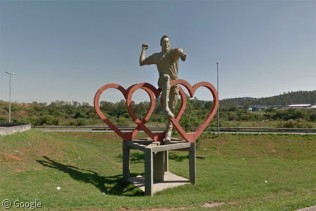
“Prefontaine Memorial Park” could be a contender for The World’s Smallest Park, as it consists of not much more than one rock that stands near the site of Pre’s car accident. The stone memorial commonly known as “Pre Rock” bears a plaque that tells the story of Prefontaine’s death.

During the night on May 30, 1975, Pre swerved his 1973 Gold MG to avoid hitting an oncoming car. By the time emergency services had arrived, Pre was dead. Pre Rock is constantly covered in wreaths, notes, and U.S. flags; as we can see in this Streetview image.3

pres-rock

Pre’s Trail

When Pre competed in Europe he came to appreciate the style and terrain of their cross-country courses, and wanted a similar experience for Tracktown USA4 runners. When he returned, he won over Eugene city officials to the idea who worked with U of O track coach Bill Bowerman to design and build it, with the trailhead being just south of Autzen Stadium in Alton Baker Park.

pres-trail-west pres-trail-east

Pre’s Trail Western Trailhead / Eastern Trailhead

The trail had yet to be built at the time of Pre’s death. However, the city was able to finish the 5.5km trail within four months, just in time to be used in a memorial run that would see over five hundred runners come out to remember their friend.

Steve Prefontaine Memorial Hall

When guests arrive at the Nike Campus at One Bowerman Drive in Beaverton, Oregon they are ushered into Steve Prefontaine Hall. Pre is often referred to as the “soul of Nike” by founder Phil Knight because of his commitment to running and his intense desire to always come out on top. Within the Hall are many of Nike’s newest developments, as well as individual pieces of memorabilia of Pre’s and many other athletes that have worked with the company in the past.

steve-prefontaine-hall

Several movies have been made chronicling Steve Prefontaine’s life, and Hayward Field played itself in each of them.

You can also check out the the Prefontaine Memorial at the Coos Bay Visitor Center. Each year over 1,000 runners compete in the Prefontaine Memorial Run held there in his hometown.


  1. Or, maybe you. 

  2. Pre battle-tested Nikes back when they were made on a waffle-iron in coach Bill Bowerman’s kitchen. Bowerman would later create Nike with former middle-distance runner Phil Knight. Together they shoed and clothed the world in a “swoosh”, banking billions in the process. 

  3. A fact this author (who is proudly from Eugene) can personally attest to, as there have always been personal effects left at Pre’s Rock every time he’s passed by. 

  4. With the consistent turnout of Olympians from the University of Oregon, Eugene is seen as a “mecca” for the running world. Numerous Olympic trials, NCAA, and USA Track and Field championships have been held here, specifically at the legendary Hayward Field

The Gotland Ring under construction

Posted by Alex Turnbull, Tuesday, 21st April 2009

1 Star2 Stars3 Stars4 Stars5 Stars

The island of Gotland is one of the most popular tourist destinations in Sweden, and is also home to the Gotland Ring, a motorsports racetrack carved into an old limestone quarry which, once finished, will be the longest racetrack on Earth.

Today about 3km of the Northern loop are currently in use1, but around 7km will be ready by next year. As well as the track itself, Google’s images let us see the absolutely massive wind turbines that form part of the operator’s vision to be the most environmentally friendly racing facility of its type in the world.

Although it’s far from complete at this stage, these images do also let us begin to see the profile of the Southern Loop, which will apparently be ready for “tarmac installation” next year, but won’t be ready for racing until 2012. As this diagram demonstrates, when finished the two loops will be joined, allowing drivers to race around one complete circuit totalling 28km.2

The land on which the track is being built belongs to a company called Nordkalk, and as the imagery makes quite obvious, it used to be a large limestone quarry. It looks like production of limestone is still in full flow here, judging by the activity going on at the nearby lake, and in fact much of the crushed stone needed for building the circuit was provided by the mining operation.

Gotland Ring does have a Wikipedia page, but it currently reads like a badly translated press release. Perhaps a kindly Swede could do a better job of translating the key points from the official site?


  1. You can even try it yourself apparently! 

  2. That’s over 7km longer than the current longest race track, The Nürburgring, which is a whole other post!