All sights in category 'Structures'

Google Sightseeing takes you on tour of the world as seen from satellite, using the free Google Earth program, or Google Maps in your web browser. Each weekday your guides James and Alex present new weird and wonderful sights as suggested by readers.

The editors: James & Alex

The Atacama Desert (Desert Week)

Friday, 20th June 2008 by Alex

We’re continuing the first annual GSS Desert Week! We’re mostly posting about deserts and it’s lasting about a week!

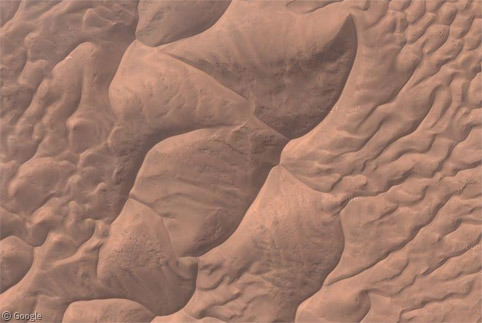
The Atacama Desert is a virtually rainless plateau in Chile, South America. Made up of salt basins, sand and lava flows, the 181,300 km2 desert is more than 20 million years old, and as it only receives about 3mm of rain a year is considered to be one of the driest places on Earth. Areas such as the Valle de la Luna haven’t received a single drop of rain in hundreds of years.


Valle de la Luna (Wikipedia) shown bottom left of this image (Ground level photo)

This bizarre landscape isn’t completely devoid of life however. To the east of the Valle de la Luna lies the village of San Pedro de Atacama, which has developed in the middle of the desert thanks to an oasis. People have been living here for a very long time - the ruins at Aldea de Tulor date from 800 BC.1


Aldea de Tulor (Ground level photo)

The Atacama Desert is incredibly rich in copper, and the two largest copper mines in the world, Chuquicamata and Escondida are both here. Escondida alone produced 1.483 million tons of copper in 2007 - 9.5% of the entire world’s output.


Chuquicamata (Wikipedia) and Escondida (Wikipedia) copper mines

Mining here hasn’t always been so successful however - the Atacama Desert is littered with the ruins of 170 old abandoned nitrate (or “saltpeter”) mining towns, all of which (bar one) were shut down after the Germans invented synthetic nitrate at the turn of the 20th century.

The most important of these abandoned mines is the Humberstone and Santa Laura Saltpeter Works, and it has actually been designated a UNESCO World Heritage Site.

Thanks to the extremely arid conditions, cloud cover is incredibly rare in the Atacama desert. Combined with the high elevation of the area, that makes it a perfect location for stargazing, which is why there are several observatories here, including at 2,635 metres the Paranal Observatory, that houses the utterly brilliantly named Very Large Telescope (Wikipedia).

Thanks to Bakan_Vargas, Bleij and Tom (and Chris Branagan too).


  1. The Atacama desert is also famous for the many Incan geoglyphs that we featured in February 2007, including the absolutely fantastic Atacama Giant. 

World’s Largest Croc

Friday, 6th June 2008 by Alex

Not reptilian, as you might expect, but rather a ridiculously overpriced, stupidly coloured plastic sandal. A very, very big one.

There’s not much more to be said about Crocs that hasn’t been said already, and yet someone has managed to devote an entire blog to hating their very existence.

Sheesh, the stupid topics blogs manage to base themselves on huh?

Anyway, here’s some links to some giant crocodiles and giant alligators as seen by satellite!

Thanks to mnj1233.

Petra, an ancient city hewn from the living rock

Thursday, 22nd May 2008 by Alex

Completely unknown to the Western world until 1812, this is the ancient city of Petra in Jordan.

Although nobody knows for sure when people first settled here, the incredible architecture that survives is thought to be at least 2,000 years old - and the most impressive thing is that much of what remains wasn’t built, but actually carved directly out of the sandstone cliffs - like this entire amphitheatre for example.


Ground level photo

Probably the best preserved part of the ancient city is Al Khazneh, or The Treasury, which is sheltered at the end of a tall, narrow gorge known as al-Siq. The shelter afforded by the high walls explains why the Treasury hasn’t been sandblasted away like many of Petra’s other architectural features.1

Although the angle these images were taken at doesn’t allow us to see the façade itself, we can see a crowd milling around in front of it.

The Treasury is at the top of this thumbnail, and the pictures that the crowd are taking would look a lot like this.

If you’re thinking this place seems familiar, perhaps you recognise it from 1989’s Indiana Jones and the Last Crusade, in which it played a part as the fictional “Temple of the Holy Grail”.2

If you’d like to explore more, here’s a good map of all the local sights, or read Petra’s Wikipedia page.

Thanks to Jason Griswold and Dan Kuck.


  1. The Treasury has still seen some serious damage however, not least the clearly visible bullet holes in an urn high up on the structure. This damage has been attributed to Bedouins trying to spill the hidden treasure that gave this building its name. Of course the decorative urn they believed was holding this mythical treasure is actually made of solid sandstone… 

  2. Naturally it’s no coincidence that today sees the international launch of Indiana Jones and the Kingdom of the Crystal Skull… Excited? You bet! 

The World’s Longest Pier

Tuesday, 20th May 2008 by Alex

The town of Progreso, Mexico, sits on a limestone shelf that falls away extremely gradually as it gets further out to sea. As a result, when they built a pier to allow cruise ships to dock here, it had to be long. Really long.

Measuring a phenomenal 6.5 kilometers (4 miles), this is the world’s longest pier.

The original pier was completed in 1942, and despite being little more than a two-lane highway, is actually quite nice looking seen from the beach. In this satellite shot you can clearly see where the original construction ends, and the more recent one begins.1

Cruise ships dock here for a day or two to allow the tourists to visit some of the nearby archaeological sites, and we can see there’s one berthed here at the moment. Tourists need to take a bus to shore, which takes nearly 10 minutes!

The pier also plays a major part in the local container industry - we can see loads of them stacked on the pier - and there’s also a tanker here just now too.

For more long piers, see our previous posts on England’s 2.1 km Southend Pier (the world’s longest pleasure pier) and Australia’s 1.8 km Busselton Jetty2.

Thanks to cboone and Michael.


  1. For those of you who care about these things, yes it does look rather like the more recent part of the “pier” isn’t suspended over the water, which would technically make this part, er… a wharf? However this makes things far too complex, so we’re sticking with pier. 

  2. Confusingly, the Busselton Jetty is the longest wooden pier in the southern hemisphere, but Australians seem to call them jetties

Days Out in Korea

Thursday, 15th May 2008 by Rob

Normally considered to be places of fun and pleasure, perhaps the last country you would expect to find the world’s largest stadium is in North Korea, one of the most isolated nations on the planet. However with the capacity to seat 150,000 people, the Rungado May Day Stadium is the biggest stadium of its kind in the world.1

During a professional wrestling match in 1995 the stadium held 190,000 people simultaneously, with crowds sprawling in its 8-tiered seating and across its 207,000m² pitch. The lofty canopies stretch 60m into the sky at their peaks.

This being North Korea however, the stadium’s primary use is actually to celebrate the President, Kim Jong-il, who holds elaborate parades and displays of power here each May Day. Even more disturbingly, during the 1990s a number of army generals were apparently executed by being burned alive here.

The petal-shaped structure is not the only major stadium in the city, though. Just a few hundred metres away, there’s another massive presidential ego boost - Kim-Il Sung Stadium2, which can seat a not unimpressive 70,000 people.

A massive amount of entertainment, don’t you think, for a country where the GDP per capita fails to reach £1000, and 1 in 4 of the country’s 23 million people are short of food?

Of course the money handling skills of the North Korean leaders are infamous, as demonstrated so clearly by the previously featured Ryugyong Hotel which would have been the world’s tallest hotel - if they could have afforded to finish it.

You can read more about the Rungado May Day Stadium at Wikipedia and on The Guardian’s website.


  1. Yes, the Czech Republic’s Strahov Stadium seats 220,000, but has been split into 9 different football pitches, so apparently no longer counts

  2. Kim Il Sung, father of North Korea’s current president Kim John-il, is still revered as a God, even fourteen years after his death. Despite leaving his country in economic ruin, over 800 statues still idolise him. 

Star Fort Megapost

Thursday, 1st May 2008 by Alex

A star fort or trace italienne is a type of military fortification first introduced in Italy around the mid-fifteenth century. Traditional medieval castles, towers and ring forts had proved extremely vulnerable to increasingly mobile cannons, and star forts were introduced specifically to better defend against them.

The tiny Italian town of Palmanova was founded in 1593, and using all the military innovations of the 16th century was built in the shape of nine-pointed star. You can still see quite clearly how the shape of the ramparts allows the points of the star to defend each other. Originally a moat surrounded the town (which partially remains today), and three heavily guarded gates (1, 2, 3) were the only way in.


Palmanova, Italy (Wikipedia)

Cannons were most effective when they were fired perpendicular to the walls of the building under attack, and the star shaped design meant that to best position their weapons, attacking forces would have enter the space between the points of the star - where they would be fired on from both sides!

The judicious use of moats could further thwart the attacking forces, as demonstrated superbly here at Naarden, Netherlands.


Naarden, Netherlands (Wikipedia)

By the late seventeenth-century star forts reached the pinnacle of their development, as shown by this complicated example in Bourtange, Netherlands, which has been fully restored to how it would have been in 1742. Here we can see that the design provides defence in depth, with tiers of ramparts that an attacker would have had to overcome to be in with a chance of taking the fort.


Bourtange, Netherlands (Wikipedia)

This ingenious design quickly became the gold standard for defensive forts, and went on to spread across Europe and the Americas:


Fort Manoel, Malta (Wikipedia)


Fort McHenry, Maryland (Wikipedia)


Fort Jay (Wikipedia) and Fort Ticonderoga (Wikipedia), New York


Castillo de San Marcos, Florida (Wikipedia)

The design even reached South Africa, where today the Castle of Good Hope can be seen right in the middle of the city! It used to be on the coast, but land reclamation allowed the city to expand around it.


Castle of Good Hope, Cape Town, South Africa (Wikipedia)

In the nineteenth century the development of the exploding shell changed the nature of defensive fortifications forever, and the star fort soon became utterly obsolete. Which is why several are today used for completely different purposes - like this example in Slovakia where they now spend their time trying to keep people inside rather than out.


Leopoldov Prison, Slovakia (Wikipedia)

And finally, what is probably the world’s most famous star fort isn’t actually known for being a star fort at all - as Fort Wood is today the distinctive star-shaped pedestal underneath New York’s Statue of Liberty.


Fort Wood, New York (Wikipedia)

We’ve previously featured just one star fort several star forts, including Kastellet in Copenhagen, Citadel Hill in Canada, and the aforementioned Fort McHenry in Maryland. If that’s not enough, there’s a whole page about them at Wikipedia too.

Thanks to Dan W, Manuel Hewitt, RB, tom schuring, Stefano Bertolo and Federico Cretti.

The World’s Largest Drain

Thursday, 24th April 2008 by Alex

Here in Lake Berryessa, California, we find the largest drain hole in the world, affectionally known locally as The Glory Hole.

Narrowing from 22 metres diameter to 8.5 metres at its thinnest point, this absolutely enormous funnel is technically the largest “morning glory spillway” in the world - an uncontrolled outlet which, should the water level rise sufficiently high, allows up to 1370 m³ per second (48,400 cubic feet) of water to bypass the Monticello Dam. Check out this photo of the spillway in full flow.

The spillway’s horizontal exit is on the southern side of the dam, and this ground level shot demonstrates why this is a popular spot for local skateboarders and bikers during the drier months!

Read more about spillways, the Monticello Dam and Lake Berryessa at Wikipedia, and trophybassonly.com has some fascinating photos of the spillway during construction in the 1950s.

Thanks to Mark and fogonazos.

National Botanic Garden of Wales

Tuesday, 15th April 2008 by Alex

Near Llanarthney, Wales we find a serene scene of rolling green hills, well pruned gardens and a few grazing sheep. Then, sticking out like a sore thumb is the massive Great Glasshouse of the National Botanic Garden of Wales.

Designed by renowned British architect Sir Norman Foster, this is the largest single-span greenhouse in the world. 95m long and 55m wide, the roof contains 785 panes of glass and is partially built below ground level, so that it seems to “swell from the ground like a grassy hillock”…

The Great Glasshouse contains more than a thousand plant species – many endangered – and conserves specimens from warm climates around the globe including Chile, Western Australia, South Africa, California, the Canary Islands and the Mediterranean. If you zoom in close enough you can actually see some of the plant-life that is able to survive here thanks to this massive glass roof.

Read more at Wikipedia. Thanks to TorIV