All sights in category 'Weirdness'

Google Sightseeing takes you on tour of the world as seen from satellite, using the free Google Earth program, or Google Maps in your web browser. Each weekday your guides James and Alex present new weird and wonderful sights as suggested by readers.

The editors: James & Alex

The Door to Hell

Posted by Alex Steinberger, Friday, 3rd July 2009

1 Star2 Stars3 Stars4 Stars5 Stars

The Darvaza (Darweze) natural gas crater is an endlessly smouldering geological anomaly located in the isolated Karakum Desert of Turkmenistan. Known locally as the “Door to Hell,” this close relative of the “Pool of Fire” and little-known tourist attraction has been on fire for at least three decades.

crater

Above, we see the natural gas crater (barely) as a glowing red spot in an otherwise unremarkable landscape. Given the low quality of the satellite imagery in this area, it is surprising that anyone knows that the “Door to Hell” even exists. This begs the rather existential question: if a crater is burning in the middle of nowhere, does anyone see it?

crater2 crater

As a matter of fact, a group of Russian geologists experienced it first hand in 19711 when the ground beneath their drilling equipment collapsed creating the abyss. Dispatched to the Karakum desert by the Soviet Union, they were searching for natural gas and found so much of the stuff that harvesting it became unsafe. With noxious gases threatening to harm nearby villages, the geologists set the seeping crater ablaze, unwittingly lighting the largest barbecue known to man.

The “Door to Hell” crater has been on fire ever since and shows no sign of stopping. Visible from a great distance, the glow from this eternal flame can even be seen in Google Earth’s City Lights layer.

City Lights City Lights Close Up

Wow, that’s bright! Visitors to Turkmenistan can venture out to see hell first hand, but there aren’t any organised tours so you have to hire your own driver2. Now who’s up for toasting the World’s Largest S’more?

Some really awesome photos of both craters can be found on this photography site and an impressive video of the “Door to Hell” is available on YouTube.

Thanks to Cris Diaz and Marc Buma


  1. Depending on the source, at least three separate years, 1958, 1971, and 1986, are listed for when the expedition took place. I chose to go with Wikipedia’s 1971 date, mostly because it was in between the other two. 

  2. If you do venture out you could visit another possibly related crater while you’re there. 

North Sentinel Island

Posted by RobK, Thursday, 25th June 2009

1 Star2 Stars3 Stars4 Stars5 Stars

We’ve tagged this sight as “India”, but in truth North Sentinel Island is hardly even a part of the world as we know it.

sentinel

Although it is barely 40km away from the well populated South Andaman Island, North Sentinel is home to what is probably the last “uncontacted” tribe on Earth. The islanders are fiercely independent and have shunned all attempts to contact them, although in 1991 a few intrepid tribesmen did go as far as accepting gifts of coconuts from Indian government officials who approached the island in a dinghy. They survive as hunter-gatherers, armed with bows and arrows tipped with metal scavenged from whatever flotsam and jetsam washes up on shore.

Nobody knows how many people live on the island - the official 2001 census figure, recorded from aerial surveys, was 39, but some estimates are as high as 400. What we do know is that the tsunami of December 2004 had a devastating impact on much of the Andaman region, and North Sentinel was no exception. For a dramatic illustration of its effects, compare these two images:

sentinelbefore sentinelafter

The first picture, taken from Google Earth, was captured before the tsunami (the exact date isn’t recorded but it was circa 2000). The second image was taken in April 2005 by the European Space Agency’s Proba satellite, and shows that the island’s fringing reefs have been lifted considerably, exposing large areas of coral and destroying much of the shallow lagoon.

The Indian government, worried that the North Sentinelese1 had been wiped out by the disaster, dispatched a helicopter to investigate. They found that at least some of the islanders were still alive and kicking - and when the chopper got too close, it came under attack from a hail of rocks and arrows. How the islanders will cope with the damage to their ecosystem remains to be seen, but they will at least be left to do it in peace: India’s official policy is now to make no further attempt to contact or “assimilate” the islanders, so although they remain notionally “Indian”, they are still essentially untouched by the outside world.

Read more about the island and its people at Wikipedia, and at EVS-Islands, which also has an excellent map.


  1. They are also known as Sentineli, although of course nobody knows what they call themselves. 

Just when you thought it was safe…

Posted by RobK, Thursday, 30th April 2009

1 Star2 Stars3 Stars4 Stars5 Stars

Headington, a suburb of the famous university city of Oxford, is the only known habitat of the aerial shark, a rare but fearsome predator that dives on its unsuspecting victims from heights of over a quarter of a mile. Incredibly, Google’s Street View car has managed to capture the aftermath of a horrific aerial shark attack!

shark

Okay, we made that up. This 25ft-long shark is actually made out of fibreglass1, and was thrust through the roof of number 2 New High Street in 1986 in the name of art. Bill Heine, who commissioned the sculpture and still owns the house, says he did it “to express someone feeling totally impotent and ripping a hole in their roof out of a sense of impotence and anger and desperation… It is saying something about CND, nuclear power, Chernobyl and Nagasaki.”

shark2

The shark has since become a local landmark, but it nearly didn’t survive: soon after it was erected, Oxford City Council ruled that putting a shark through your roof without planning permission simply wouldn’t do, and ordered it to be taken down. Bill appealed, and in a rare show of common sense, the government decided it could stay2.

Unfortunately, when the Street View image was captured, the house was covered in scaffolding. To see it in all its glory, go to the official shark site.

Thanks to Cyan and Julian.


  1. The shark sadly lacks a head, the interior space of the building instead being used for the supporting structure. 

  2. The official documents (PDF file) make for bizarrely entertaining reading, with the Secretary of State noting carefully that “It is not in dispute that the shark is a large and prominent feature in the street scene”. 

Lake Peigneur

Posted by Alex Steinberger, Thursday, 16th April 2009

1 Star2 Stars3 Stars4 Stars5 Stars

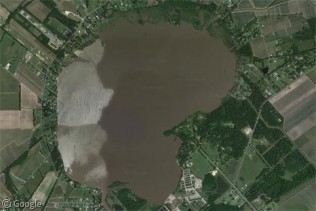
Before 1980, Louisiana’s Lake Peigneur was a 3 metre deep freshwater lake, but due to a highly unusual man-made disaster, today it is a 60 m deep saltwater lake.

On the morning of November 20th, 1980, a group of Texaco Fuel Company workers drilling the lake for oil inadvertently broke through the lake bed into the upper reaches of the Diamond Crystal Salt Mine below. The water began to pour rapidly into the cavern left by the mining process, and soon the expanding sinkhole had swallowed the entire lake, the drilling platform, and 11 barges1!

sinkhole

Barges being pulled into the sinkhole

The suction that this sinkhole created was so powerful that it actually managed to reverse the flow of the Delcambre canal, a 12-mile-long waterway leading to the Gulf of Mexico. Once the lake itself had emptied, the inflow from this canal created a 50 m waterfall, the largest ever recorded in the state of Louisiana2.

delcambre canal

Miraculously, everyone in close proximity to the sinkhole as well as the 55 workers in the flooded mine were able to escape with their lives. 9 of the 11 barges even managed to “pop” back up to the surface once water pressure had equalised!

Though Texaco was never charged with negligence due to a complete lack of evidence3, the Diamond Salt Company still managed to walk away with $32 million in an out-of-court settlement. Needless to say, they never went back into the salt-mining business.

Thanks to Gerald Talley and Terry Foster. There’s more info on Lake Peigneur at Wikipedia.


  1. Watch footage of the disaster on Youtube. 

  2. Temporary or otherwise. 

  3. No lake, no mine, no evidence! 

Clipperton Island

Posted by Alex Steinberger, Thursday, 9th April 2009

1 Star2 Stars3 Stars4 Stars5 Stars

Clipperton Island, one of the most remote land masses on earth, is an uninhabited coral atoll under French authority, located in the Eastern Pacific Ocean approximately 1,120 kilometres south west of Mexico.

clipperton1

The island was named for John Clipperton, an English pirate who visited the island briefly in the 18th century and may have used it to hide treasure… which so far has never been found!1

clipperton3

12 kilometres in diameter, the ring-shaped island completely encloses a stagnant freshwater lagoon with many deep basins. One of these, known as “the bottomless hole,” contains an extremely high concentration of sulphuric acid, making Clipperton a less than desirable vacation destination.

clipperton22

Add to that a severe lack of fresh water and an abundance of poisonous land crabs – and Clipperton Island shapes up to be the perfect location for an evil super-villain’s island fortress of doom!

Though uninhabited today, at its peak around 1914 Clipperton was home to a group of 100 men, women and children, and was the site of a booming guano-mining2 operation.

Only three years later, only 10 women and children remained - thanks to a lack of supplies and a homicidal lighthouse keeper. Since then the island has only been visited periodically by French military patrols and the occasional scientific expedition.


  1. Of course that might just mean he never left any. 

  2. That’s right, faeces harvesting!