Search Results for 'buddha'

Very Large Buddhas (Redux)

Posted by Ian Brown, Thursday, 16th July 2009

1 Star2 Stars3 Stars4 Stars5 Stars

The world of gargantuan statuary has changed considerably since we published the original Very Large Buddhas post just over 3 years ago. The title of world’s largest statue is now held by the Spring Temple Buddha in Henan, China.

The statue alone is 128m tall, and it stands on a 20m tall lotus throne, which in turn stands on a 25m tall pedestal – giving the structure a total height of 153m.

The statue – including the lotus throne – is 128m tall. Its original 25m tall pedestal gave the structure a total height of 153m. However, recent information shows that the hill it was built on has been constructed into an additional pedestal. The total height is now believed to be 208m. Panoramio has several pictures, and this image in particular gives you a sense of just how immense this monument is (and shows the new pedestal under construction.)

Little is known about the Spring Temple Buddha in the West, so it likely wasn’t listed on Wikipedia when Alex wrote the original post. It was constructed in 2002 in response to Taliban bombing of Buddha statues in Afghanistan, as well as to thwart Indian plans to create the world’s largest statue.  I haven’t been able to find any vital statistics about it, but this image seems to show that the toes alone are close to 2m high.

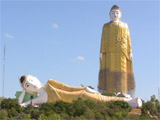
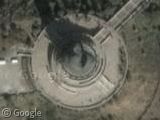
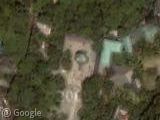
The world’s second largest statue is the Laykyun Setkyar in Myanmar, which is so new (completed in 2008) that we only see it partially constructed on Google Maps.

At 116m on a 13.5m pedestal it is barely taller in total than the Spring Temple statue alone. Panoramio has a few pictures of the completed structure, which also show that it is, interestingly, located near a reclining Buddha which, at 90m in length, would probably be the world’s 9th tallest statue if it was upright.

Buddhas

As it is also located in a somewhat secretive country, detailed statistics are similarly hard to find. The regime consistently claims it is the world’s largest though, despite evidence to the contrary.

The world’s third largest statue is Ushiku Daibutsu in Japan. It was featured in the original Very Large Buddhas post, though there is new imagery that shows it in greater detail.

Thanks to Lukasz for the link to the reclining Buddha, and to Alex for letting me update his original post.

Borobudur

Posted by Evan Brammer, Wednesday, 27th May 2009

1 Star2 Stars3 Stars4 Stars5 Stars

Sitting between twin volcanoes in “the garden of Java” – the Kedu Plain of Indonesia – is a ninth century Buddhist temple: Borobudur. One huge stupa (shrine for the Lord Buddha), it also contains seventy-two smaller, bell-shaped stupas; each pierced with many decorative holes that make the bells to resemble cages.

Inside each of the smaller, cage-like stupas sits a statue of Buddha, but in total there are actually 504 statues of Buddha here.

Candi Borobudur
Borobudur (Ground-level photo)

The temple, known as a candi (chan-dee) in Javanese, was re-discovered in 1814 when then-British ruler, Sir Thomas Raffles, was advised by locals as to its presence. It laid hidden for many years, covered in jungle growth and volcanic ash. Raffles ordered a restoration that would last through the next 170 years.

Early in the 1900’s, during one of the renovation periods, two smaller candis built using the same style were found to Borobudur’s northeast:

Candi Pawon Candi Mendut
Candi Pawon (Ground-level photo), and Candi Mendut (Ground-level photo)

All told, the three candis sit about two and half miles apart: from Borobudur to Mendut, with Pawon sitting in the middle. What is most interesting though, is that all three are arranged in a perfect line. Pretty impressive given that this was done without the power of Google Earth – 1100 years ago!

Today Borobudur is the number one tourist destination in Indonesia, receiving several million visitors each year.

There are loads of cool-looking HDR photos available over at Stuck in Customs, and of course Wikipedia has more information as ever.

See also our previous coverage on Angkor Wat, a similarly styled Buddhist temple in Cambodia.

Rinpung Dzong

Posted by Ian Brown, Wednesday, 15th April 2009

1 Star2 Stars3 Stars4 Stars5 Stars

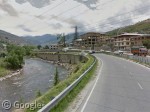
For our first post from Bhutan we visit the town of Paro and the Buddhist monastery Rinpung Dzong.

Rinpung Dzong

Nestled in a river valley and surrounded by mountains, Paro is home to 20,000 people and numerous significant monasteries, of which Rinpung Dzong is the largest. The present structure was completed in 1646 but a temple and fortress were first built on the elevated rocky outcrop in the fifteenth century. In addition to the monastery, the building houses administrative offices for the town and surrounding district.

Used for some scenes in the movie Little Buddha, the temple is perhaps best known for an annual festival1 which attracts crowds of people from across the valley, in addition to increasing numbers of tourists. It takes place in a small courtyard a short (but steep) walk uphill from the monastery.

Rinpung Dzong

The highlight of the festival is the unveiling of a 300 year old sacred banner known as a Thanka. The Thanka is unfurled in the middle of the night on the side of a 4-storey building (on the right of the image above); people line up to briefly touch the scroll before dawn when it is removed to prevent sunlight from harming the ancient fabric.

To the north-east (and further uphill), a former watchtower for the Dzong – with its unique design of six spiralling floors – has been converted into the National Museum of Bhutan.

Rinpung Dzong


  1. This blog entry also has good pictures and description of the Paro Festival – scroll about 1/3 of the way down the page. 

Stupas Around The World

Posted by Ian Brown, Wednesday, 29th October 2008

1 Star2 Stars3 Stars4 Stars5 Stars

A stupa is a Buddhist monument, originally simple mounds believed to cover the remains of the Buddha. They have evolved over the centuries to be large, ornately decorated structures, and today there are hundreds of significant stupas around the world.

Boudhanath Stupa near Kathmandu in Nepal is one of the largest in the world, and it is a focal point for Tibetan refugees in Nepal. During religious festivals the stupa is lined with thousands of oil lamps which provide an incredibly atmospheric view for the thousands of people circumambulating the structure.

Dhamek Stupa in Sarnath, India is considered the oldest known stupa, having been built around 500AD to replace an earlier structure. It represents the original, simpler design of stupas – being simply a column of bricks and stone.

In the Rocky Mountains of Colorado is the Great Stupa of Dharmakaya, one of the first and largest stupas in North America, this stupa was built to commemorate Chogyam Trungpa, a respected teacher who helped develop Buddhism in the West.

Previously on Google Sightseeing: The Shwedagon Pagoda, Wat Phra That Doi Suthep.

There’s lots more to learn at the Wikipedia entries for Bodhnath, Dhamek and Dharmakaya.

Thanks to Davee, Evelyn Mitchell, Michael and Yuval.

The Shwedagon Pagoda

Posted by Alex Turnbull, Thursday, 14th August 2008

1 Star2 Stars3 Stars4 Stars5 Stars

This incredibly shiny building is the Shwedagon Pagoda, also known as the “Golden Pagoda” (for obvious reasons) and it is the most frequented religious site in Burma (officially the Union of Myanmar), as Buddhists believe it contains relics of the past four Buddhas.

The original stupa (a mound-like structure containing Buddhist relics) was built sometime around the 6th century, although Buddhists believe that it’s nearer 2500 years old.

It has certainly been rebuilt numerous times, and reached it current height of 98m sometime in the 15th century.

Also starting around that time, the entire surface of the pagoda was covered in real gold. The bling gets blingier too, with the top section featuring 5,448 diamonds, 2,317 rubies, and one massive 76 carat diamond!

The pagoda has had a long history as a political arena, most recently in September 2007 during nationwide demonstrations against the oppressive military regime. At least 5 people died during clashes between security forces and thousands of protesters led by the Buddhist monks.

Find out more at Wikipedia.

Thanks to Justin Lee and SFHandyman.