All sights in Europe

Google Sightseeing takes you on tour of the world as seen from satellite, using the free Google Earth program, or Google Maps in your web browser. Each weekday your guides James and Alex present new weird and wonderful sights as suggested by readers.

The editors: James & Alex

The Nonexistent Town of Argleton

Posted by Alex Turnbull, Tuesday, 3rd November 2009

1 Star2 Stars3 Stars4 Stars5 Stars

Nestled in the Lancashire countryside, just to the south of Ormskirk, is the small town of Argleton. Or so Google would have us believe.

Zooming in closer reveals that Argleton isn’t exactly a bustling metropolis. In fact it looks suspiciously like a couple of fields.

Roy Bayfield of Ormskirk was so intrigued by the mystery that he walked to the centre of Argleton just to check that there was definitely nothing there. There really wasn’t.

So where has Argleton come from? Some of Aughton’s 8,300 residents believe that it’s the result of a simple mispronunciation, but conspiracists have suggested another theory.

The map data used here comes from Tele Atlas, and it has long been known that cartographers sometimes alter their maps as a way of protecting their intellectual copyrights. Usually this takes the form of Trap Streets (which are designed to “trap” people who steal the data, as they copy the unique mistakes along with everything else), however in this case, is it possible that Tele Atlas has invented an entire town?

In the past the inclusion of a fake town in a map would have likely caused no harm, but in the age of automatic content generation, Argleton was building up a fair bit of fake history.1 Simply by having been declared to exist, automatic listings were being generated for it, meaning that is someone were to look it up online, they would believe it to be a lively town with jobs, hotels and schools.

Of course one final possibility remains – that Argleton is simply a mistake. Consider the fact that just a few kilometres to the north, Google has quite brilliantly renamed a local cul-de-sac to Dummy 1325.

Thanks to Google Maps Mania for alerting us to this one, which was originally posted by Mike Nolan at the Edge Hill University.


  1. Before the story of Google’s sinister activities swamped the rankings that is. 

Calatrava’s Bridges

Posted by Ian Brown, Monday, 2nd November 2009

1 Star2 Stars3 Stars4 Stars5 Stars

Santiago Calatrava is a renowned Spanish architect whose work we’ve admired in the past on Google Sightseeing. We’re going to take a more in-depth look at his innovative work in two areas, beginning today with bridges.

One of Calatrava’s earliest bridge commissions helped cement his international reputation for civic engineering, the Bac de Roda bridge in Barcelona. Like the vast majority of his work, the structure is entirely white.

Bridge Bac de Roda Bridge

Part of the city’s pre-Olympic development, the bridge incorporates steel cables, a method used in many of Calatrava’s subsequent designs, including the Puente del Alamillo in Seville, which features a 142m tall mast.

Puente del Alamillo Puente del Alamillo

Similar in design to the previously featured Sundial Bridge, the Puente del Alamillo was part of Seville’s preparations for Expo ‘92.

In Buenos Aires the 100m long Puente de la Mujer uses the same technique, but the mast is angled forward rather than backwards. In this case, the mast also supports a section of bridge that pivots through 90 degrees to allow boat traffic to pass, coming to rest at the stabilising pylon visible in the river to the south.

Puente de la Mujer

While Calvatara’s bridges are generally well received and establish themselves as symbols of the communities where they are built, there have been some exceptions. In Bilbao, the Zubizuri has met with opposition on several fronts.

Zubizuri

The Zubizuri’s deck includes glass bricks which apparently break easily and become very slippery in the rain, additionally, the placement of the bridge on the river edge (rather than the elevated city street) made it somewhat impractical to actually use, so the city had to build a connecting walkway – the curved structure to the left of the bridge. Calatrava actually felt this was detrimental to his creation, and amazingly, won €30,000 through his legal action.

Furthermore, Calatrava’s Ponte della Costituzione in Venice – shown as under construction on Google Maps, but actually completed a year ago – has also met with controversy for being too expensive, inaccessible to anyone unable to traverse its many steps, and for being too close to one of the city’s classic bridges across the Grand Canal.

Venice Bridge

Named for one of Dublin’s most famous writers1, the James Joyce bridge has had a better reception from locals, perhaps because the design mirrors many of the other arched bridges across the Liffey. However like the Zubizuri, the James Joyce has a glass block walkway2 – though it’s possible that the frosted finish to the glass makes it safer to traverse in Irish weather!

James Joyce Bridge

Another of Calatrava’s bridges, named for another writer – Samuel Beckett – is under construction further east. It will be a swing bridge very similar to Puente de la Mujer.

Finally, the spectacular Chords Bridge in Jerusalem is one of Calatrava’s more notable recent bridge designs, but unfortunately it’s not yet visible on Google Maps.

The second part of this examination of Calatrava’s work looks at some of his most famous and notable buildings.

Thanks to Redder Zooming.


  1. The house facing the south end of the bridge was the location for Joyce’s story The Dead

  2. Which is illuminated at night

The World’s Most Haunted Sites

Posted by Chris Hannigan, Friday, 30th October 2009

1 Star2 Stars3 Stars4 Stars5 Stars

Want to see a ghost? Not scared of the dark? We’ve got a list of 5 of the most haunted destinations in the world for you to visit1. Bring a flashlight and let’s get started…

Many places can claim to be haunted, but on every list you find a certain few that keep popping up. The Myrtles Plantation in St. Francisville, LA USA is one of these places, and is considered one of the most haunted locations in the United States. Built in 1794, the property is said to be the site of up to 10 different murders, and home of 12 resident ghosts. Visitors claim to hear footsteps going up and down the halls, see ghostly children running around the property, and even talk with the ghosts of slaves who ask about chores. Want to visit? Go ahead and book a room because it’s currently a thriving bed and breakfast.

Our second stop isn’t actually a specific location, but an entire country. With the rise of paranormal television shows and magazines, Singapore is quickly becoming known as a hotbed of activity for wannabe ghost hunters. Throughout the city there are numerous ghostly stories to be told. One location is said to be haunted by an entire family that committed suicide together. Another home in Changi Beach apparently is haunted by a ghost that likes to slap house guests across the face! It gets worse though… at the Bedok Tenant House, supposedly a ghost actually killed a woman. The victim went on to become a screaming ghost herself! Maybe that’s all just a bit to scary and you should just stay in the city. Well be careful when travelling on the subway, apparently there are headless ghosts that run through stations terrorising passengers!

Stop number three takes us to England and the infamous Tower of London. GSS visited the tower back in 2005, and the street view update has now given us the ground level perspective. The tower was built way back in the year 1078, so you know there are some creepy stories to be told. Guests claim to see numerous shadows replaying the violent murder of the Countess of Salisbury. She tried to run from her scheduled execution back in 1541, but was chased and then axed to death by her executioner. Others claim to see more legendary ghosts like the beheaded Ann Boleyn. She’s often seen by guests carrying her head in her hands around the property.

Back in the United States, the retired Queen Mary is often called the most haunted ship in the world. Now permanently docked in Long Beach as a hotel, this once luxury ocean liner has been the set for numerous movies and ghost hunting television programs from both the US and the UK. Visitors report being touched by invisible fingers in their room, hear banging and movements from throughout the ship, and even claim to hear a soldier calling for help from the engine room. Strangely enough, it just so happens that a soldier was crushed to death in there back in 1966.

Our last stop takes us to Scotland and to perhaps, the most haunted structure in the world. The site of the Edinburgh Castle has been occupied by man since the late Bronze Age, and the current castle has been dated back to 12th century. The structure sits atop a volcanic rock 80 meters high, with the steep cliff faces surrounding it visible from the street view car. Visitor’s stories range from tales of wandering war prisoners, headless drummers, and ghostly dogs. Some even claim to hear the tunes of a long-dead piper player coming from the castle’s ancient tunnels. Story goes that the piper discovered the tunnels a few hundred years ago, and was playing his tune so that people on the surface could hear him and map his progress. Well at one point the tunes stopped, and the piper was never found. Over two thousand years of history certainly mean the next time you visit the castle and its dungeons, you’re surely not to be alone.

Be sure to check Google for some more great ghost stories at each of these locations. Wikipedia offers great historical information on the Tower of London and Edinburgh Castle. If you’re brave enough, spend the night by booking a room at either the Queen Mary or Myrtle’s Plantation.

Special thanks goes out to Greg, Sergio, Will, Mike, Gareth, Jeff, Kate, Dave, Michele, Ron, Max, James, Ned, Robert, Terry, Boris, Benjamin, Matt, Paul, 7up7, Steve, and Larry for the suggestions and links!


  1. Not a top 5 list, just 5 worthy of a mention. 

Millennium Dome / The O2

Posted by Ian Brown, Thursday, 29th October 2009

1 Star2 Stars3 Stars4 Stars5 Stars

The Millennium Dome was an exhibition centre built in London to celebrate the first year of the new millennium1. It has since been converted into the O2 entertainment complex.

Millennium Dome

Whatever the name, we’re very impressed with the shadows cast by the twelve 100m tall pylons, which are intended to represent a clock face, a nod to the Greenwich Meridian which runs nearby.

The pylons anchor cables which support gleaming white plastic-coated fibreglass panels. At 365m across (representing the number of days in the year), this is the largest dome of its type in the world. It reaches a height of 50m, and encloses an area of more than 80,000 square metres. Pierce Brosnan’s James Bond fell down the outside of The Dome during the opening sequence of The World Is Not Enough.

The uniformity of The Dome is interrupted by one flaw – a large hole had to be left in the structure to accommodate a ventilation shaft from the Blackwall Tunnel which runs below the site.

Millennium Dome Millennium Dome

The Millennium Experience opened on January 1, 2000. It was conceived as a showcase of British excellence – a blend of art, performance and exploration in 14 zones funded by a top-notch collection of sponsors eager to attach their brand to the promise of the new millennium.

However, the reality2 was that, despite the project running considerably over budget, visitors often found the queues unbearable and the exhibits confusing. This resulted in a media backlash, though it is claimed that visitor feedback was generally positive (even if the total number of visitors was half what was originally hoped).

After closing at the end of 2000, the contents of The Dome were auctioned off3, and the facility sat idle other than for occasional special events.

Millennium Dome

Approaching The Dome on Millennium Way

A development company purchased the site and sold naming rights to O2 in 2005. The interior was gutted and two years construction saw the creation of a fully enclosed entertainment ‘district’, dominated by a 20,000+ seat arena4, but also featuring cinemas, clubs, restaurants and exhibition spaces.

The O2 Arena has presented many of the world’s best known musical acts as well as sporting events and other spectacles. Prince played 21 shows shortly after the arena opened, and before his death earlier this year, Michael Jackson had scheduled (and sold out) 50 shows over 9 months.

Millennium Dome

The Dome from the north bank of the River Thames.

The Arena will host several events during the 2012 Olympics, though it will be renamed the North Greenwich Arena due to licensing and sponsorship restrictions.


  1. Or the final year of the old millennium, depending on your preferred start/end dates. 

  2. Predicted by Iain Sinclair in his essay Sorry Meniscus, and revisited in his book London Orbital

  3. At least one person has an online collection of Dome Memorabilia. 

  4. A separate building constructed – with some difficulty, because crane height was limited – within the structure of the dome. 

Bridges over the Millennia

Posted by Cédric, Monday, 26th October 2009

1 Star2 Stars3 Stars4 Stars5 Stars

New writer: Cédric Cédric lives in Germany where he works for the science and education department of one of Germany’s regional public radio and TV stations. He has a life-long project to see the world, especially by train.

The invention of the road was probably rather quickly followed by the idea of the bridge, simply because wet feet are pretty annoying when travelling. And so, over the course of thousands of years, many, many bridges were built. The beginnings were humble, and none of the very early wooden constructions survive.

However, with the invention of the arch over three thousand years ago, things got moving (and spanning). At first, arches were crude, but nevertheless the results proved to be solid; the three Arkadiko Bridges, built by Mycenaean Greeks at the end of the Bronze Age in around 1200 BC, are still with us – and one is even still in usable shape today.

Arkadiko Bridge, Greece

In even better shape are the Tarr Steps, a “clapper bridge” in southern England, which was probably built around 1000 BC. The Tarr Steps are made of raw stone slabs weighing several tons apiece; some of which have occasionally been carried up to 50 m downstream during floods, but they’ve always been placed back on their piers afterwards.

Tarr Steps, Somerset, England

With the rise and expansion of the Roman Empire came architects and engineers, who had more modern building materials such as cement and concrete at their disposal. The Romans built smoothly paved roads, palaces, temples and thermal baths1 all over the Empire, as well as the first truly large-scale bridges for roads and water. Many of these Roman viaducts and aqueducts are still in amazingly good shape today.

One of the most famous Roman aqueducts is the two thousand year old Pont du Gard, a three level, 50 metre (165 ft) high structure that forms part of a water conduit over 40km (25 miles) long which carried water to the Roman town of Nemausus, today’s Nîmes.

Pont du Gard, France

About the same age is the Pont Saint-Martin, spanning the river Lys with an arch of over 30m (100 ft) – one of the widest arches of the time2. Amazingly it’s still in day-to-day use.

Pont Saint-Martin, Valle D'Aosta, Italy

After the Romans had left (or were kicked out of) most of Europe by around AD 600, large-scale bridge building hit a bit of a recession. Big bridges for big roads were no longer needed to facilitate the Empire’s infantry deployments, and the big workforces (i.e., lots of slaves) weren’t that readily available any more.

Wet feet were still widely out of fashion though, and as traffic increased, the local Europeans eventually built their own big bridges. Nearly 900 years old is Avignon’s Pont Saint-Bénezet, better known as the Pont d’Avignon.

Pont Saint-Bénezet, Avignon, France

Over the course of 500 years, the Pont d’Avignon repeatedly collapsed due to heavy floods and shoddy repairs, and it was eventually abandoned in 1668. Today, less than a fifth of its original length remains.

In some other places, wet feet were so unpopular that bridge builders just kept on building. The 800-year-old Swarkestone Bridge in England’s Midlands not only crosses the Trent, but also adjacent swamp lands.

Swarkestone Bridge and Causeway, Derbyshire, England

At over a kilometre long, the Swarkestone Bridge is England’s longest stone bridge, and in daily use by hundreds of drivers. However, its builders never imagined their work to be so heavily used; after nearly eight centuries of stability, the Swarkestone Bridge and Causeway is in dire need of repairs.

With constant population growth, traffic increased everywhere. Local traffic in the emerging metropolises proved to be especially annoying. In Paris, this lead to Henry III (the French one) ordering the construction of a new bridge across the Seine river in 1578. Finished in 1607, it became the Pont Neuf, or “New Bridge”.

Pont Neuf, Paris

Ironically, the Pont Neuf is now Paris’ oldest surviving bridge, and it’s surviving very well. Open to normal road traffic in the heart of Paris, the then nearly 400-year-old construction had to bear a load of 10,000 cars a day until the introduction of new traffic routes in 2004. It’s much quieter today, but still crossed by hundreds of drivers every day.

Bridges have always been more than a mere Thing To Cross Things. A big bridge was also a display of power and technological prowess. Bridges not only had to be useful, but also had to intimidate enemies and impress friends. Many bridges in big cities are much more elaborately built than would be dictated by mere necessity, be it the impressive Tower Bridge3 in London, or Rialto Bridge in Venice.

Tower Bridge, London Ponte di Rialto, Venice, Italy

A new bridge’s look is still of great importance nowadays, despite a certain lack of enemies in need of intimidation. They please locals, appeal to tourists and serve as interesting landmarks. New bridges are often built according to beautiful and unique designs despite almost always being more expensive than is strictly required.

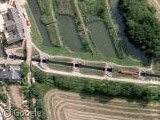
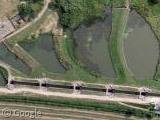
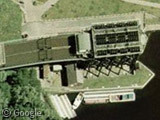
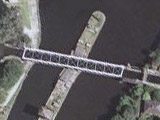
Modern building materials and techniques allow for much greater freedom in forms and shapes, with often stunning results. Over the last decades, some truly beautiful, big, delicate, or simply weird bridges have been built, such as the Gateshead Millennium Bridge which implements a novel lift bridge concept, or the previously featured Wasserstraßenkreuz Magdeburg, which allows a shipping canal to cross a river.

Gateshead Millennium Bridge, England Wasserstraßenkreuz Magdeburg, Germany

Today, bridges routinely span more than a kilometre without touching ground. They brave storms and earthquakes, relying not on divine protection but on engineers’ ingenuity. However, modern industrial materials, despite their incredible properties, have a significantly lower life expectancy than bare rock. A thousand years from now, there probably won’t be too many bridges left of those built over the last few decades – while some roman or mediaeval constructions have a fair chance of still being around to amaze and impress our descendants.

We adore bridges here at Google Sightseeing, and to prove it, our Bridges category features nearly 100 of the world’s most fascinating bridges.


  1. Using state-of-the-art under-floor and in-wall heating over 2,000 years ago

  2. It has a ratio of rise to span of 3.3 (i.e., for every metre of height, it spans 3.3 metres), which is sensational for the time. 

  3. The name is derived from the bridge’s location close to the Tower of London, not from its towers.