California City
Monday, 18th February 2008 by Rob
Way out in the Mojave Desert lies California City. With an estimated 2007 population of little more than 12,500, the name suggests a hope for much more than it ever became. Nevertheless, the city's area is a massive 203.6 square miles, which actually makes it the 34th largest city by area in the United States!1

In 1958, property developer Nat Mendelsohn had his eyes on this patch of desert with the hope of founding a rival to Los Angeles, and promptly gobbled up 80,000 acres of prime Mojave sand. Mendelsohn had grand plans, and even went to the effort of laying out acres of street blocks, but the city wasn't a success.
Today, a large proportion of California City's residents are employed at nearby Edwards Air Force Base but the city is still so small it doesn't even have its own grocery shop!

Amazingly, even though there are no houses outside the central development, developers have gone to the trouble of naming every single street, and have designated parks for miles around. One such, "Borax Bill Park" is named after the leader of the Twenty mule team, which became famous in the late 19th century for carrying minerals from mines further inland to the west of the Mojave, passing through this area during their expeditions.

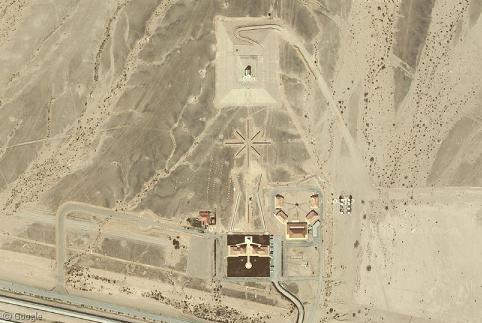
California city's main claim to fame (apart from its startlingly pathetic population growth), is the Hyundai-Kia Proving grounds, a new $60 million dollar test track based over 4300 acres. The cheap land and privacy of the desert makes this an ideal location for test tracks - just a few miles away is the even bigger Honda Proving Center of California, where the company's concept cars are tested and tweaked before release.

There's more on California City at both Wikipedia and from their official community website. There's also a great aerial shot which shows the proving grounds and the vast emptiness of the city.
Thanks to Ross Burnett and seer.
-
It is also the 3rd largest city in California by area, beating San Jose, which has a population of nearly 1 million! ↩︎

About the author


Hi. Not a comment on California City, so I’m not sure it’s the right place. But any idea on when is Kosovo going to apear as an independent state on GE?
@Eduardo: I don’t see how that’s important to anybody, as the people and governments of Kosavo and Serbia have bigger issues to be worrying about. Anyway, the answer is obviously sometime after the UN decides if they will recognise Kosovo’s independence.
“the 34th largest city by area in the United States” – I suppose you guys are running out of real trivia?
What puzzles me most, though, is why in a city with so much space people would want to live this close together: https://www.googlesightseeing.com/maps?p=&c=&t=k&hl=en&ll=35.137673,-118.00495&z=18
However few there are living here, I hope a proportion play golf, and a big part of the town seems to be given over to it.
There’s also some LARGE TYPE (not very) for a skydive – and what could conceivibly look if you close one eye to be the face of Homer Simpson https://www.googlesightseeing.com/maps?p=&c=&t=k&hl=en&ll=35.130662,-118.027357&z=18
Nearby to the city is Mojave Air and Space Port: https://www.googlesightseeing.com/maps?p=&c=&t=k&hl=en&ll=35.064252,-118.155255&z=15
This is, like at Tucson, a ‘graveyard’, but for commercial planes rather than military. It is also the set for quite a few action films, like Die Hard 2, Executive Decision and S.W.A.T. – they often paint the aircraft into an appropriate livery, use then scrap them.
http://www.mojaveairport.com/filming.htm
The airport is also the launch site for SpaceShip One tests, which is the craft that Virgin Galactic are planning on using for their spaceships.
@ dr.R: The simple answer is utilities. Only the central town and a couple other parts have water or electrical supplies.
I’ve been through California City countless times on various 4×4 trips. It looks even more desolate in person than the aerials would suggest, despite a building “boom” (and I use that term lightly) over the past few years. Rumor has it, though, they’re supposed to be getting a grocery store and (gasp!) a hotel at some point in the possibly foreseeable future.
A bit further south…at Air Force Plant 42 here is a good shot of a U2 Spyplane https://www.googlesightseeing.com/maps?p=&c=&t=k&hl=en&ll=34.620491,-118.116331&z=18
@Rob The Mythbusters have also utilized the Space Port in some of the myth busting adventures.
@dr. R Could be homes for elderly or retired. Another reason could be location and availability of water/sewer.
The city is “master planned” similar to Washington D.C. which was also a “master planned” city. This means that the city has been carefully planned and laid out from the very beginning. Given the location near the airport it could be the master plan showed that area to be developed for higher-density residential development.
he he….I actually lived in a mobile home park in CA City for a few months back in 1970s while we waited for a house to become available at Edwards. I seem to remember a lot of old run down hangars and warehouse buildings near CA City, but don’t see them anymore. I remember the lake in middle of town well. We used to go there and feed the ducks.
Matt
I lived in Cal City for a few months in 2005 while working on an internship in Mojave. When I was there, there was a grocery store — Cal City Market — just a block away from our apartment 🙂 It’s near the corner of Cal City Blvd and Neuralia Rd, View Placemark (35.124884,-117.982596)
In the same plaza is the Green Tea Chinese Restaurant and Bar; stop in some time and say hello to Arthur for me. And I used to go running east of town on Castle Butte, View Placemark (35.114889,-117.878108)
There’s not much out there (photo: http://picasaweb.google.com/kirk.kittell/2005LifeInMojave/photo#5084284383576394098), but it was an excellent jumping off point to go to Death Valley — still one of my favorite places in the world.
A similar non-lived in city is Salton City, about half way down on the west side of the Salton Sea, California. The idea for the development came from the Holly Corporation in the (mid?) sixties. All the roads have names and there are a few folks living there. The Salton Sea proved far to salty to realize the recreation potential so the City remains just an idea. Has a Salton City Airport, too.
Speaking of Salton Sea. What the heck did Google do to the Salton Sea. Looks like they erased all the natural colors and replaced with boring grey color.
12,000 isn’t exactly a ghost town. You would think that many shoppers would be able to support a grocery store. Or does everyone shop at the PX on the air force base?
I think it’s interesting that every home has a fenced in yard. Is that to keep desert creatures out?
To add to Robin’s comment on Salton City. I recall taking the charter bus from San Diego to Salton City [via Palm Springs of course] in 1959 as part of the promotion [so the marketing pre-dates the 1960s by a few years at least]. My mom bought into it, and I inherited the “dream property” a few years ago. I’ve not seen it since 1959, but I assume it doesn’t look much different now than 50 years ago.
Neat link. I remember coming across all these “ghost streets” meticulously laid out in the desert a few months ago and wondering what the story is. There’s something strangely compelling about the very suburban street plan of cul-de-sacs and crescents, traced out over otherwise unaltered desert!
Is it possible to drive around on these unfinished streets? The Wiki page says they are “crumbling paved streets” but on the aerial pics they look like dirt roads.
California City’s huge partially-built street network is somehow fascinating to me. There are some other developments that have also caught my eye. They typically seem intended to be rural cities, so to speak, with each house having a couple of acres.
Take a look at the “Subdivision Road Pattern” here near Rio Rancho, New Mexico.
There’s California Valley, California, which is practically in the middle of nowhere but also has a road network.
Here‘s Lehigh Acres, Florida, which has a rather huge street network but loads of streets with little or no development on them. The area around Port Charlotte, Florida, is in a similar situation. Actually, South Florida is full of these quasi-developments because of speculation. Developers legally created a tremendous amount of official lots that they could sell, and a few were built, but far more were not. So these counties now have lots of dispersed residences that can’t be served by utilities because running lines out there is too expensive and don’t have well-maintained roads because there are too many roads to maintain and too few people to pay for them. That’s to say nothing of environmental problems resulting from such dispersion. From Google Maps, it looks like a mess.
Here‘s an article with some history on this kind of development in this area. And here‘s a research paper called “Planning in the Wake of Florida Land Scams” that discusses the problem and some solutions.
CC is hardly a ghost town especially during sept-may. More and more people are RVing and off roading at that time. I would guess there are 800-1000 campsites during the weekends and forget about going Thanksgiving, New Years and Memorial day. Too many folks out there in the desert then.
This Organic Green Tea is tea made out of the leaves of camellia sinensis, this tea undergoes such a good procedure that it prevents the tea from oxidation, in other words, this undergoes a process in which minimal oxidation occurs, and this is an advantage for when we start to drink this product. This tea is originally from china, and this is a tea that has got so many advantages to the people who drink it, that it quickly became a popular drink all over the world, and trusts me, you are going to want to become one of these people who get nothing but incredible benefits out of a tea like this.
I grew up here when I was a wee youngster me and pa,and ma,and my sisters and brothers all 16 of us in a single wide trailer,used to love the smell of meth on an early spring morning,then pa got busted and ma was caught hooking again! but i’m outt prison now and plan on taking over my pa’s meth making business even thoug i ain’t no good at math,but the moonshine is plenty and the tobbaco is dirt cheap!