All sights in Colorado

Google Sightseeing takes you on tour of the world as seen from satellite, using the free Google Earth program, or Google Maps in your web browser. Each weekday your guides James and Alex present new weird and wonderful sights as suggested by readers.

The editors: James & Alex

Bears in the City

Posted by Ian Brown, Friday, 13th March 2009

1 Star2 Stars3 Stars4 Stars5 Stars

Today we’re investigating a trio of bear sightings in cities across the United States.

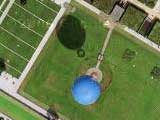
First we visit Denver, where a strange blue object visible from above is revealed by Street View to be a giant blue bear peering through the windows of the Colorado Convention Centre.

Bear Bear

This 12m high steel and fibreglass sculpture titled I See What You Mean by artist Lawrence Argent was installed in 2005.  And in case you’re wondering, here’s what it looks like from the inside!

Another large bear adorns the exterior of a casino in Elko, NV to promote their star attraction.

Bear

The statue is a replica of White King - 3m tall and weighing 1000kg - claimed  to be the largest polar bear ever killed. The stuffed bear is on display in the casino’s coffeeshop.

And finally to Detroit, and bears of a different kind - teddy bears and stuffed toys of many kinds create the ‘unique’ decor of this house on Mt Elliott Street.

Bears

While you may wonder about the affect on local property values, it is actually part of a neighbourhood art project.

Thanks to lyrics_guru.

Happy New Google Earth in the News

Posted by Alex Turnbull, Monday, 5th January 2009

1 Star2 Stars3 Stars4 Stars5 Stars

Yes, we’re finally back, and as to be expected, we missed some great Google Earth-related news while we were off.

Firstly the story that seems to have sprung up everywhere is (of course) a Street View one. The garage419 site posted images from a high mountain road in Colorado, where the Google car supposedly took some spy-shots of a fleet of top-secret, as-yet-unreleased Porches!

This is actually the Mount Evans Scenic Byway, which is the highest paved vehicle road in North America, and apparently the only place in the world where car manufacturers can test their vehicles at altitudes of up to 4,306 metres (14,127 feet). Looks like those clever German engineers don’t leave anything to chance, eh?

Next, the Daily Fail tells the story of a “Lost World” discovered with the help of Google Earth. Our satellite sightseeing friends at Kew Gardens spotted an unexpected patch of green forest in the mountains of Mozambique, and when they paid the area a visit, were rewarded with the discovery of a new species of adder, three new species of butterfly, a rarely seen orchid, giant snakes, and colonies of rare birds.

Of course the country’s crappest newspaper failed to include a link to said unspoiled paradise, so it was up to the always reliable Stefan at Ogle Earth to come up with the goods.

Stefan points out that the most interesting thing about the area from up here is that even when viewing it with the enormously comprehensive Geonames.org database loaded, there are still no place names to be seen. Which suggests to us that anyone could find their own undiscovered paradise, simply by looking for places that aren’t marked in Geonames or any of Google Earth’s own databases! Fame and fortune awaits, clearly.

Finally, we come to the story of an American “treasure hunter”, who has gone to court to try to win the right to excavate a sunken ship, which he says he discovered using Google Earth. Mr Nathan Smith reckons the ship ran aground and sank in the mud near the Mission River, Texas, in 1822 while trying to avoid a hurricane. Mr Smith claims that half the crew died during the voyage and those remaining were killed by a local cannibal tribe. He also believes that the ship contains $3 billion in buried treasure1.

Of course Mr Smith isn’t telling exactly where this sunken treasure is, only that it’s somewhere around here. However sources that have seen the Google Earth image in question describe it as looking “something like a shoe print“, so maybe we could beat him to it!

So, what else did we miss?


  1. For the record, it should be pointed out that Mr Smith’s treasure hunting “career” was inspired by Nicolas Cage’s performance in National Treasure… 

Giant Spiders

Posted by Ian Brown, Tuesday, 2nd December 2008

1 Star2 Stars3 Stars4 Stars5 Stars

Caution arachnophobes, many parts of the world appear to be home to giant spiders, thankfully all in the name of art.

First up, a giant bug on top of a building in Reno, Nevada.

This spider sculpture was created by artist David Fambrough. It consists of the body of a VW beetle / bug (depending where you live) with huge metal legs. Some people wanted to squash the impressive looking bug, but it has been granted a reprieve and will instead be moved to another part of the city.

Controversy can also surround the bronze or steel casts of Louise Bourgeois‘ sculpture Maman, which can currently be found in 8 different location worldwide. In my home town, Ottawa, there’s a 10m tall Maman which cost $3.2millionCAD, though it quickly became a popular local icon.

Maman can also be found outside art galleries in Bilbao, Tokyo and Seoul.

In Kansas City Maman isn’t visible on Google Maps, but Street View reveals that she is happily menacing two women and a (doubtless quite traumatised) baby in a stroller.

Maman also lives in St Petersburg, Paris and Havana, but I can’t track her down on Google Maps or Google Earth. Let me know if you can!

Finally, giant spiders must spin giant webs … like this one in Colorado, which appears to be at least a couple of hundred metres wide.

Thanks to Steve and Bleij.

Halloween ’08

Posted by Alex Turnbull, Friday, 31st October 2008

1 Star2 Stars3 Stars4 Stars5 Stars

Here in the UK there’s a lot of dressing up that happens around Halloween, there isn’t anything like the kind of mania that seems to possess Americans with regards to dressing up their homes, gardens or anything else that gets in the way of the Halloween Money Machine!

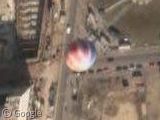
When Street View first launched we posted about this huge Jack-o’-lantern spotted off U.S. Route 287 in Broomfield, Colorado.

Since then somebody found this house on Adams Street1 in the town of Easthampton, Massachusetts, which has been completely obscured by inflatable Halloween decorations, including a terrifying Tigger, whose frightening visage has been thankfully blurred by Google’s privacy software!

Achieving this level of terrification however, is still a simple matter of inflating some oversized cartoon characters. So you’ve got to take your hat off to whoever scrawled this looming Jack-o’-lantern right in the middle of Highway 51, Wisconsin!

What’s really frightening is that anyone thought that this was a good idea at some point in their drunken evening…

Thanks to Merlin and Virtual Globe Trotting.


  1. Only one “d” unfortunately

Stupas Around The World

Posted by Ian Brown, Wednesday, 29th October 2008

1 Star2 Stars3 Stars4 Stars5 Stars

A stupa is a Buddhist monument, originally simple mounds believed to cover the remains of the Buddha. They have evolved over the centuries to be large, ornately decorated structures, and today there are hundreds of significant stupas around the world.

Boudhanath Stupa near Kathmandu in Nepal is one of the largest in the world, and it is a focal point for Tibetan refugees in Nepal. During religious festivals the stupa is lined with thousands of oil lamps which provide an incredibly atmospheric view for the thousands of people circumambulating the structure.

Dhamek Stupa in Sarnath, India is considered the oldest known stupa, having been built around 500AD to replace an earlier structure. It represents the original, simpler design of stupas - being simply a column of bricks and stone.

In the Rocky Mountains of Colorado is the Great Stupa of Dharmakaya, one of the first and largest stupas in North America, this stupa was built to commemorate Chogyam Trungpa, a respected teacher who helped develop Buddhism in the West.

Previously on Google Sightseeing: The Shwedagon Pagoda, Wat Phra That Doi Suthep.

There’s lots more to learn at the Wikipedia entries for Bodhnath, Dhamek and Dharmakaya.

Thanks to Davee, Evelyn Mitchell, Michael and Yuval.