All sights in Peru

Google Sightseeing takes you on tour of the world as seen from satellite, using the free Google Earth program, or Google Maps in your web browser. Each weekday your guides James and Alex present new weird and wonderful sights as suggested by readers.

The editors: James & Alex

Band of Holes

Posted by Ian Brown, Monday, 17th November 2008

1 Star2 Stars3 Stars4 Stars5 Stars

In south-western Peru, on a plain called Cajamarquilla is the band of holes.


Running for about a mile across the barren rock is this line of holes of varying depths and sizes, with occasional clear gaps, for which locals and archaeologists have no explanation. They have guessed at grain storage and burial sites, though neither theory has held up to scrutiny.

Information and pictures and be found here. What’s your theory?

And don’t miss these Peruvian mysteries previously posted on Google Sightseeing.

Thanks to Remko Jansen and Andrew.

Moray (Inca Ruins)

Posted by Alex Turnbull, Thursday, 16th November 2006

1 Star2 Stars3 Stars4 Stars5 Stars

Nearby to the previously posted Machu Picchu, Peru, is a very unusual archaeological site - the strangely beautiful Inca ruins of Moray.

moray1.jpg

The concentric rings clearly visible were farming terraces with a sophisticated irrigation system, constructed inside enormous natural depressions in the landscape. Supposedly the Incas built them here to experiment with the different farming conditions the landscape accommodates, as the annual temperature difference between the top and bottom can be up to 15°C (27°F).

Which is fairly impressive given that even this largest depression is only 30 metres (100 feet) deep.

moray2.jpg

Here’s the very brief Wikipedia page.

Thanks to Josh E.

Machu Picchu

Posted by James Turnbull, Friday, 14th July 2006

1 Star2 Stars3 Stars4 Stars5 Stars

Machu Picchu, the “Lost City of the Incas”, is an ancient ruined city found at the top of a mountain. It was probably built around 1440 and the most impressive thing is that it’s all still there, despite being constructed with stones neatly slotted together - there’s no mortar of any sort.

You can follow the switchback road all the way down the mountain to the Urubamba River and north east to the little village of Aguas Calientes. The road is named the Hiram Bingham Highway, after the Yale archaeologist who re-discovered this site in 1911 and promptly pinched hundreds of ancient artefacts (Wikipedia.)

Thanks: Sam Tihen, Tim Finnegan, Ignacio, RoyalPineapple, Fher, Maurício R. Maurer, martin e, Quinn Kuiken, Dan T, Tim, fish, Tom Gula & eRez

Nazca Lines

Posted by James Turnbull, Thursday, 29th June 2006

1 Star2 Stars3 Stars4 Stars5 Stars

The bizarre Nazca Lines were created thousands of years ago (between 200BC and 600AD) using simple tools to scrape away the dark pebbles and reveal the light sand underneath.

Although they’re called the Nazca lines, the famous geoglyphs also feature hummingbirds, spiders, monkeys, and lizards and this giant parrot. But nobody’s really sure why the Nazca people went to all this effort - the images are so large that they couldn’t have seen them without some sort of aircraft, and that’s not very likely as the lines predate manned flight by just a few years.

Apparently for the best view of the lines you need to take a flight over the 53 mile area.

Thanks: too many people to list who submitted this before and after it was high resolution. Thanks all!

Peru (heart) Large Type

Posted by James Turnbull, Thursday, 15th December 2005

1 Star2 Stars3 Stars4 Stars5 Stars

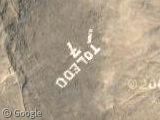
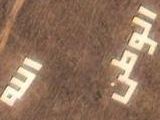
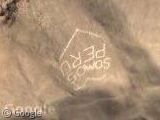
Nowhere in the world do they like putting large type on the hills as much as they do in Peru. A lot of these messages refer to political parties such as the UPP (Union for Peru) and Somos Peru so were presumably written around the Peru elections of April 2001.

There’s absolutly loads of things, a lot of which I either can’t make out in Google Local or can’t understand as I don’t speak Spanish, such as here, here, here, here and here! You might find it easier to view them all on our embedded map or in Google Earth.

Thanks: Tim, Ali, Niklas Bergius, Uwe Rose