Google Sightseeing takes you on tour of the world as seen from satellite, using the free Google Earth program, or Google Maps in your web browser. Each weekday your guides James and Alex present new weird and wonderful sights as suggested by readers.

The editors: James & Alex

The Faith Dome

Posted by Alex Steinberger, Friday, 15th May 2009

1 Star2 Stars3 Stars4 Stars5 Stars

The Crenshaw Christian Center’s Faith Dome is a non-denominational megachurch located in the heart of South Los Angeles. With seating for over 10,000 attendants, it is one of the largest places of worship in the United States.

FaithDome

Brainchild of Ever Increasing Faith Ministries pastor Frederick K. Price, construction of the Faith Dome was completed in 1989 on 32 acres of the former Pepperdine University1 campus. The geodesic church sanctuary is constructed almost entirely of aluminum and hosts Dr. Price’s sermons which reach over 15 million families across the United States each week.

By all reports a lively character, Dr. Price oversaw the construction of this behemoth structure from start to finish. During an inaugural sermon, he described his love for the new church structure, exclaiming “Hallelujah! Jesus just hit a grand-slam home run!”

streetview domeBirdsEye dome

Situated along a busy flight lane, the Faith Dome is clearly visible to thousands of airline passengers landing at Los Angeles International Airport every day. It seems that Dr. Price and his construction team must have been acutely aware of this fact. An enormous advertisement to anyone looking down, the church’s car park has been emblazoned with gigantic letters proclaiming the Faith Dome’s glorious existence.

FaithDome Lettering

Then again, it could be a way of broadcasting to the “big man” himself.

Thanks to stongey and Bird’s Eye Tourist.


  1. Pepperdine University fled the area in the 1960s due to crime and the overall degradation of the neighborhood. It is currently located in Malibu, CA. 

Ghost Town: Rhyolite, Nevada

Posted by Alex Turnbull, Thursday, 14th May 2009

1 Star2 Stars3 Stars4 Stars5 Stars

This post is part of an occasional series where we visit some of the world’s most interesting abandoned places.

A couple of hundred kilometres northwest of Las Vegas lies the former mining town of Rhyolite, one of the largest ghost towns in Nevada.

Founded in 1904, the town had an initially huge level of growth, but it was abruptly abandoned just a handful of years later. Today the eerie remains of Rhyolite which still survive here in the desert provide us with a fascinating look into America’s past.


The town was named for the richest ore in the area, rhyolite; but it was a gold rush in the nearby hills that propelled the population to around 4,000 just three years later.

By this time the town had water mains, electricity, telephones, a hospital, a bank, an opera house, a school, the railroad, and (allegedly) 53 saloons.


The ruin of the Cook Bank Building; and as it was in its heyday.

By the end of 1910 the Montgomery Shoshone Mine - the town’s lifeblood - was operating at a loss, and in 1911 it closed for good. With the mine gone there was nothing to keep the people here any longer, and by 1920 the population of Rhyolite was effectively zero.


Rhyolite School today; and as it was in 1915, already looking deserted.

One of the best surviving buildings in Rhyolite is the former Las Vegas & Tonopah Railroad Depot. It’s unusual for ghost towns in Nevada1 to have this many buildings remaining - the survival of these ones in the harsh desert environment is thanks to their construction using materials other than wood and canvas. Like the house made of tens of thousands of beer bottles.


Las Vegas & Tonopah Railroad Depot today; and under construction in 1908.

The buildings here won’t last forever, but the fact that they have survived this long is impressive enough.

Vimeo has a good video tour, Flickr has a ton of photos, and the official site has a wealth of absolute fascinating historical photos.


  1. Of which there are over 500

Old Rat’s Nest Island, Australia

Posted by Evan Brammer, Wednesday, 13th May 2009

1 Star2 Stars3 Stars4 Stars5 Stars

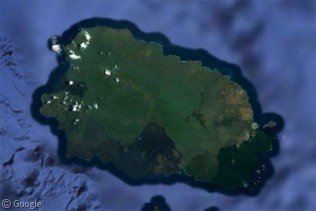
Peering out the window of the little airtaxi that has brought you to The Rat’s Nest, or Rottnest Island, 18 km southwest off the coast of Australia, you’ll notice the island’s name spelled out in trees. This little island, only 15 km long and 4km wide, has been the site of an aboriginal prison, WWI & WWII internment camps, and today is an important local holiday destination, popular for its shipwreck bearing reefs and notable surf breaks.

The trees that spell out “Rottnest” were planted purposely to welcome visitors to the island, which was named for the native quokka, a marsupial that resembles a large rat and thrives on the island due to the lack of a significant predator.

rottnest-trees

There are no fresh water sources on the surface of the island so rainwater has always had to be collected instead. However in the 1970s, fresh water was discovered underground, and since 1995 the government has desalinated water from these salt lakes using reverse osmosis.

salt-lakes

One of the most famous (or infamous) buildings on the island is the Rottnest Quod, an eight-sided structure that was used to imprison over 3,700 aboriginal men and boys between 1838 and 1931. Rottnest was used in this way to “calm” the mainland native population that were committing the terrible crime of digging up crops from land that used to belong to them.

the-quod

Today the Quod is a source of contention as it was used as a budget hostel for most of the 20th century and has now been converted into high-priced accommodation for tourists. However, aboriginal activists say that the site should remain a historical heritage site, demonstrating the harsh treatment of the natives by the colonial government.

Other notable features of the island are a zero tolerance approach to “antisocial behaviour”, laws banning private ownership of land, cycling being the main form of transport, and an annual 18km swim from the mainland to the easternmost point on the island.

pointed-beach-head

More info on Rottnest Island at Wikipedia.

Thanks to Simon Craigie.

Street View Flasher Shows Penis to World

Posted by Alex Turnbull, Tuesday, 12th May 2009

1 Star2 Stars3 Stars4 Stars5 Stars

Warning: This post contains partial nudity that you may not deem suitable for the workplace or for children.

Update: As expected this image has been quickly removed by Google. For those who feel compelled to have a closer look, here’s a screenshot.

Unfortunately for this gentleman in Barcelona, he has chosen to take a pee by the side of the road just as the Google Street View car was passing.

What sets this man apart from others who have done the same, is that instead of turning his back on the passing cars, he foolishly chose to relieve himself whilst facing the street.

Luckily for him, Google’s face-blurring technology was working on this occasion, but unluckily for us, his penis remains completely un-blurred. If you think it looks a little small from here, then you can actually zoom in quite a lot closer (if you dare).

We’ve previously seen naked breasts, bums, and blurry lady-bits on Google Street View, as well as many different men (and even a woman) who have been caught taking a leak, but we never imagined we would ever see urination in such explicit detail.1

I’m not sure about you dear reader2, but I for one hope that we never have to see anyone captured, um… dropping the kids off at the pool.


  1. Fortunately for everyone involved, posting it here all but guarantees its removal from the service in the near future. 

  2. If indeed you have stuck with our story this far. 

Hạ Long Bay, Vietnam

Posted by Kevin Batdorf, Monday, 11th May 2009

1 Star2 Stars3 Stars4 Stars5 Stars

In the north of Vietnam, a few hours east of the capitol, Hanoi, lies a beautiful area known as Hạ Long Bay. Hạ Long, which can be directly translated as “Bay of Descending Dragons”, comprises just under 2000 islands, only half of which have been named.

Ha Long Bay

Other than the truly spectacular scenery which features some absolutely amazing caves, some of the most impressive sights in Hạ Long Bay are the local communities. With a population around the same as the number of inhabitable islands, many of the locals live on floating villages, and some of these small communities are like little towns - complete with banks and schools. Most of their income comes from local fishermen, but tourism also plays a part.

floating-villages

The bay gets its name from an ancient legend which tells of how, during a Chinese invasion, the Jade Emperor sent a mother dragon and her children to aid the Vietnamese and prevent them from facing defeat. The dragons shot from their mouths around 2000 stones which immediately transformed into the jade islands seen today.

The dragon’s defenses supposedly blocked the Chinese ships and gave the Vietnamese the leverage needed to gain victory.

For more info check out the Hạ Long Bay official website, or the Hạ Long Bay Wikipedia page.